A tropical beach has a surprisingly busy supply chain. Some of its white sand was once part of a reef, passed through the throat and gut of a parrotfish, and emerged as grains small enough for waves to carry ashore. The punchline sounds invented. The science is not.
An Animals Around the Globe article published November 7, 2026 drew attention to the phenomenon. But the most informative numbers come from peer-reviewed studies published years earlier, and their details are more interesting than the simplified claim that these fish produce “most” tropical sand.
First, how does a fish turn rock into sand?
Parrotfish have fused teeth that form a hard, beak-like biting surface. Many species scrape algal growth and microorganisms from reef surfaces; some excavate larger bites of the underlying limestone, which is made largely from old coral skeletons. The swallowed material is crushed further by specialized structures deep in the throat called a pharyngeal mill.
The fish digest organic food but eject much of the gritty calcium carbonate. What leaves the fish is not a newly secreted chemical substance: it is mostly ground-up reef material. Currents can redistribute those particles into lagoons, reef flats and eventually beaches. NOAA describes parrotfish as one of several biological sources of sand; the Natural History Museum explains the fish’s unusual grinding mechanism.
One island, 685 metric tons of new sediment a year
In a 2015 study in the journal Geology, researchers examined the reef platform surrounding Vakkaru Island in the Maldives. They estimated that the platform generated about 685,000 kilograms of sediment annually—roughly 685 metric tons—with about three-quarters produced on a narrow outer reef flat.
That outer reef flat accounted for only 21% of the surveyed platform area, yet it was a dominant sediment source. Parrotfish generated more than 85% of the new sand-sized sediment on that outer reef flat. It is a remarkable measurement, but it is not evidence that 85% of all the sand on every tropical beach comes from parrotfish. The study distinguishes the rate at which fresh sediment is produced from the accumulated material already making up an island.
Indeed, the researchers identified fine-to-medium coral sand as about 59% of Vakkaru’s island sediment, while other sediment types and biological sources also contributed. Reef organisms such as calcareous algae, mollusks and foraminifera can generate particles too. Elsewhere, beaches may be built largely from mineral grains delivered by rivers or from eroded volcanic rock. “White sand” describes an appearance, not a single biological origin.
The second study reveals where the sand really comes from
A 2021 study in Ecology and Evolution measured parrotfish-derived sediment across eight Maldivian reef habitats. It found the fish’s output varied sharply by location, species and body size. Almost half the measured parrotfish sediment production took place in a rubble-dominated habitat representing just 8% of the reef platform.
In that rubble habitat, more than 90% of the sediment came from erosion of the reef framework rather than simply processing loose sand already present. On some coral and patch-reef habitats, by contrast, nearly half the expelled sediment was reworked material. This distinction matters: not every grain leaving a parrotfish is freshly created sand. Sometimes the fish is effectively recycling sand already in circulation.
The new particles also have to travel. Whether sediment ultimately replenishes a tourist beach depends on waves, currents, reef geometry, storms and the movement of grains through the local coastal system. Biology supplies material; physics decides where much of it ends up.
Are the beach builders helping or wearing down their reefs?
Here the story develops an uncomfortable twist. Grazing fish can hold algae in check and keep hard surfaces available for coral settlement. NOAA identifies overfishing of herbivorous reef fish as one force that can upset this ecological balance. Reducing fishing pressure and protecting habitat can be important conservation measures.
But parrotfish are not uniformly beneficial in every setting. Their excavating bites also remove the reef’s calcium-carbonate framework. A 2024 review in Conservation Letters argues that on severely damaged reefs, increased bioerosion by some parrotfish populations may accelerate structural losses without necessarily producing a compensating recovery in living coral cover. That is not an argument for indiscriminate fishing; it is a warning against treating very different parrotfish species and reef conditions as interchangeable.
For low-lying reef islands, this creates a complicated budget: living coral helps build and maintain the framework; fish and other organisms break down some of that framework into mobile sediment; waves may deposit that sediment on shore or take it away. A reef can produce beach-building sand while still losing its underlying structure. And parrotfish protection alone cannot solve ocean warming, pollution or the loss of reef-building corals.
The actual takeaway: protect the whole sand-making system
The most defensible conclusion is also the most astonishing: in certain reef settings, fish are a major part of how coastlines are manufactured. This is not a quirky isolated fact about digestion. It is a connection between reef ecology, sediment transport and the security of islands whose beaches are continually reshaped by the sea.
Next time a postcard-perfect strip of white sand appears to be an inert pile of grains, remember that some of those particles may have had a very active recent history. The bigger question is whether tropical coastlines can keep rebuilding themselves when the reefs—and the fish communities working on them—are under pressure.
Watch and examine the evidence
Contextual video: PBS / NOVA, Gross Science: White Sand Beaches Are Made of Fish Poop (2 minutes 9 seconds). This is a general science explainer, not footage from the Maldivian field studies.
- Perry et al. (2015): Reef ecology and island-building sediment in the Maldives — original quantitative study.
- Yarlett et al. (2021): Quantifying parrotfish-derived sediment — open-access field research.
- Molina-Hernández and Álvarez-Filip (2024): Parrotfish bioerosion and reef resilience — ecological tradeoffs.
- NOAA Ocean Service: How sand forms — broader context.
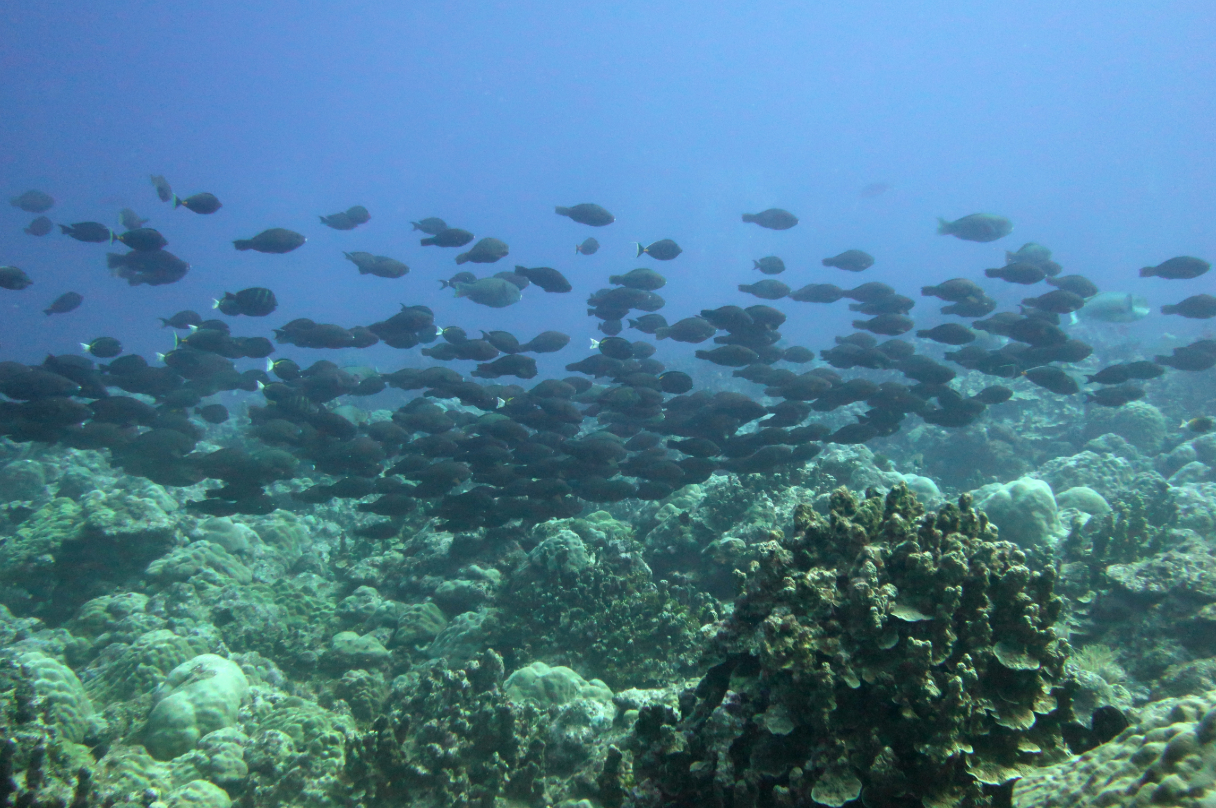
Photo: A real school of parrotfish over a Guam coral reef, photographed in 2022. NOAA Fisheries / Kaylyn McCoy, public domain. Contextual image; not the Maldives research site. Original image and rights record. Related Apep Bar coverage: Stanford Revived Bleached Coral in Seven Weeks. Saving Entire Reefs Is the Hard Part.