Analysis | Apep Bar — In one laboratory, antimatter survived 614 consecutive days. In another, a single antimatter particle was persuaded to reveal its quantum behavior with extraordinary precision. The surprising part is not that either experiment disproved the laws of physics. Neither did. It is that two very different scientific achievements are bringing researchers closer to asking nature an unusually unforgiving question: does antimatter obey exactly the same fundamental rules as matter?
The two results invite a contest—who kept antimatter longer?—but that is the wrong scoreboard. CERN’s BASE experiment stored and monitored a cloud of antiprotons from October 2023 to July 2025; Northwestern University’s Gerald Gabrielse and colleagues demonstrated a one-positron quantum cyclotron in work published on October 21, 2026. Both use electromagnetic confinement, yet they solve different problems. One establishes exceptional long-term storage and experimental access; the other makes a single particle’s quantum states controllable and readable. Their common target is a fundamental symmetry called CPT.
CERN: 614 days without losing the antimatter
In its 2025 annual report, filed February 15, 2026, the BASE collaboration described continuously monitoring antiprotons for 614 days in its reservoir trap. The cloud was held at roughly 5 kelvin, with exceptionally little residual gas. The team reports a loss rate below one antiproton per month, periods of nearly five months without any losses, and only three antiprotons consumed within one year of experiment operation. The reported losses were linked to deliberate experimental handling, not observed spontaneous disappearance from the reservoir.
This matters because antiprotons are not ordinary laboratory samples. An antiproton has the same magnitude of electric charge as a proton, but the opposite sign; contact with ordinary matter can lead to annihilation. BASE avoids that by suspending charged particles inside carefully controlled electric and magnetic fields, in a near-perfect vacuum. The result is not an antimatter bottle made of some exotic solid: the walls must never touch the contents.
Nor does the 614-day figure mean the same single antiproton was continuously isolated and individually interrogated for 614 days. It refers to uninterrupted storage and monitoring of a cloud, with particles deliberately extracted or used during operations. That distinction is essential. A long-running reservoir is an invaluable platform, not by itself a measurement of a particle’s magnetic moment or proof of a new law of nature.
Why a reservoir changes the experiment
CERN’s accelerator complex produces antiprotons, but its operating calendar and electromagnetic environment are not ideal for every precision experiment. A reservoir capable of keeping particles alive across shutdowns lets researchers continue working even when fresh antiproton beams are unavailable. The BASE collaboration also uses distinct analysis, precision, and cooling traps to prepare and investigate individual antiprotons. Its previously reported comparisons put the proton–antiproton charge-to-mass ratio agreement to within 16 parts per trillion; the magnetic-moment comparison reached roughly 1.5–1.6 parts per billion. Those are tests of a prediction, not anomalies that have overturned it.
Storage is now being turned into mobility. In March 2026, BASE transported 92 antiprotons in a portable trap across CERN. A 2026 Nature paper describes transporting them over a 7.5-kilometer route without measured particle loss. The point of the drive was not to show off an antimatter delivery service. It was to demonstrate that these rare particles could eventually be studied away from the accelerator’s magnetic noise in quieter, purpose-built laboratories.
Northwestern: one positron, resolved quantum states
At Northwestern, the target particle was different. A positron is an electron’s antimatter counterpart, positively charged instead of negatively. The team captured one produced in sodium-22 radioactive decay, slowed it, and suspended it in a Penning trap cooled to about 300 millikelvins—0.3 degree above absolute zero. Their paper, “One-Positron Quantum Cyclotron,” published in Physical Review Letters on October 21, 2026, reports that the positron’s lowest cyclotron and spin energy states could be resolved.
The accomplishment goes beyond leaving a particle in a trap for a long time. The researchers could prepare its cyclotron ground state, apply carefully selected microwave excitation, and detect transitions between individual quantum states without immediately destroying the state being measured. Northwestern reports that its positron stayed trapped for months. The device provides a way to measure how an antimatter particle moves and responds to a magnetic field with exceptional sensitivity.
Why care about those tiny transitions? A particle’s magnetic moment measures how it responds to magnetic fields, and its value can be inferred from highly precise frequencies of cyclotron motion and spin. Gabrielse’s group has already made extraordinarily accurate measurements of an electron using related techniques. The new device offers a route to performing the corresponding positron measurement and comparing the two directly.
The crucial limit: Northwestern has not yet reported the definitive new electron–positron magnetic-moment comparison. The authors conclude that, with further optimization and careful checks of experimental uncertainties, the technique could test CPT in the lepton sector more than 30 times more precisely than before. Thirty times is a prospective improvement in a symmetry test—not a demonstrated 30-fold discrepancy with established physics.
The false rivalry: CERN also controls single-particle quantum states
It would be misleading to call CERN the storage laboratory and Northwestern the quantum laboratory as though those roles never overlap. In July 2025, CERN announced that BASE had achieved coherent quantum manipulation of a single antiproton spin, keeping it oscillating between quantum states for almost a minute, with a reported coherence time of about 50 seconds. CERN described the result as its first antimatter quantum bit.
So the accurate comparison is narrower and more interesting. BASE’s 614-day experiment demonstrates exceptionally durable antiproton reservoir confinement; the BASE team also develops single-antiproton spectroscopy and transport. Northwestern’s new result demonstrates the first one-positron quantum cyclotron with resolved cyclotron and spin states, aimed at a specific future electron–positron comparison. They are complementary routes into the same symmetry problem, not rival claims to have “invented quantum antimatter.”
What exactly is CPT—and what would break the Standard Model?
CPT combines three transformations. C exchanges particles with antiparticles (charge conjugation); P reverses spatial coordinates like a mirror; and T reverses the direction of time in the mathematical description. Under broad assumptions of local, Lorentz-invariant relativistic quantum field theory, the combined CPT transformation is expected to leave the underlying physics unchanged. This requirement is built deeply into the theoretical framework of the Standard Model.
For particle–antiparticle partners, CPT demands corresponding intrinsic properties: equal masses and lifetimes; opposite electric charge; and magnetic properties that match once the relevant charge and sign conventions are accounted for. CERN’s proton–antiproton comparisons and Northwestern’s proposed electron–positron comparison probe different sectors. Agreement at higher precision strengthens the constraints on certain kinds of new physics. It does not prove that every possible extension of the Standard Model is wrong.
The evidence that would force a rethink
- A real discrepancy, not a noisy hint. A measured proton–antiproton or electron–positron difference would need to be substantially larger than the combined statistical and systematic uncertainty, with the expected CPT relation stated clearly.
- Repeated measurements and aggressive error checks. Researchers would need to rule out magnetic-field drifts, trap imperfections, particle-state misidentification, calibration bias, temperature effects, and other mundane causes. A spectacular number is not enough if the apparatus can imitate it.
- Independent verification and a coherent theoretical account. Other laboratories and different measurement techniques would need to test the discrepancy. A robust violation of CPT would force physicists to revisit assumptions underpinning standard relativistic quantum field theory—not merely adjust a minor parameter.
Such a result could be extraordinary. But the word could is doing honest scientific work here. Neither the 614-day reservoir nor the one-positron cyclotron has produced a confirmed CPT violation. Both are machinery for asking the question more rigorously.
Would a broken symmetry explain why the universe exists?
One of cosmology’s biggest puzzles is why the observable universe contains so much more matter than antimatter. The Standard Model includes some matter–antimatter asymmetries, such as certain forms of CP violation, but known effects do not fully account for the observed cosmic imbalance. Experiments looking for CPT differences could reveal new physics relevant to that puzzle. They would not automatically explain cosmic matter dominance: researchers would still need a viable mechanism, and evidence that it actually operated in the early universe.
That is the distinction often lost when a headline announces that scientists “rewrote physics.” A device designed to seek a violation is not evidence that the violation has occurred. For now, the most striking statement is the less cinematic one: researchers can keep antimatter isolated for extraordinarily long periods and, in separate experiments, read exquisitely small changes in its quantum behavior.
Why the next experiment matters more than the record
CERN has shown that antiprotons can outlast accelerator shutdowns and even survive a carefully controlled trip across a laboratory campus. Northwestern has shown it can prepare and interrogate the quantum states of one positron in a way suited to precision magnetic-moment measurements. The next decisive milestones are improved matter–antimatter measurements, explicit uncertainty budgets, and reproducibility—not another press-release superlative.
Our earlier Apep Bar report, “Antimatter Under Arrest: A Single Positron Opens a New Test of Nature’s Symmetry,” examined Northwestern’s apparatus. This follow-up places it beside BASE’s long-term storage, antiproton quantum control, and transport program.
For the moment, antimatter is staying exactly where the physicists tell it to stay. The more disruptive possibility is what it may eventually tell them back. When measurements finally become accurate enough to reveal a mismatch, will the universe contradict our theories—or will the instruments still have one more trick to confess?
Video and primary sources
Verified contextual video: CERN — “BASE experiment at CERN succeeds in transporting antimatter” (March 24, 2026). This is actual footage of CERN’s 2026 transport experiment, not footage of the 614-day storage run or Northwestern’s positron trap.
- BASE annual report 2025, section 6 (record-length antiproton storage), dated February 15, 2026.
- “Road transport of trapped antiprotons,” Nature (2026).
- Myers and colleagues, “One-Positron Quantum Cyclotron,” Physical Review Letters 137, 173001 (2026).
- Northwestern University research announcement, October 21, 2026.
- CERN: First single-antiproton quantum-bit demonstration, July 23, 2025.
- Paolo Crivelli’s independent APS Physics commentary, October 21, 2026.
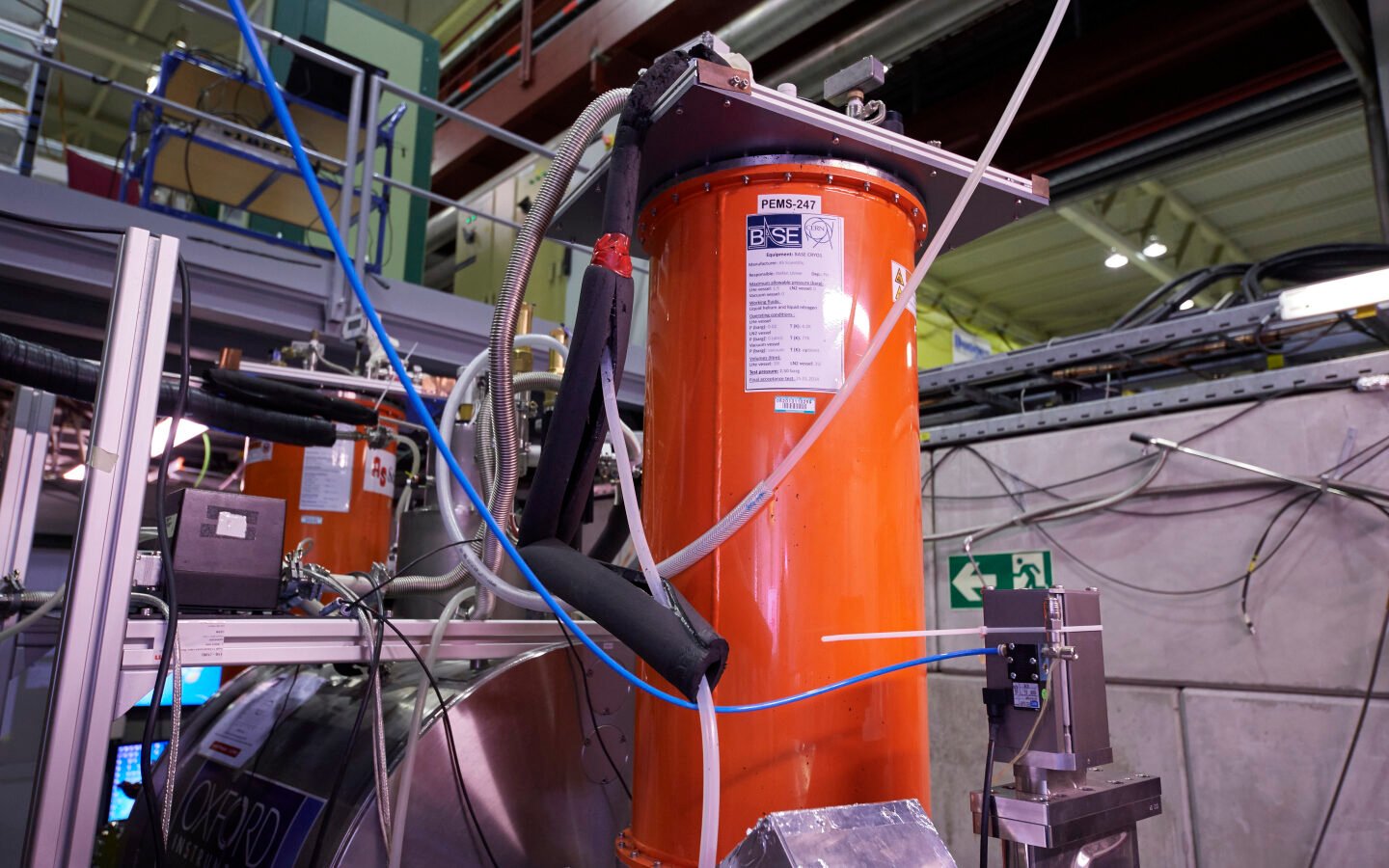
Featured photograph: The actual BASE antimatter apparatus at CERN, photographed January 17, 2017 by Maximilien Brice. Copyright CERN, CC BY 4.0; original CERN photo record. This is an archival documentary photograph of CERN’s experiment, not an image taken during the 2023–2025 614-day storage interval or a photograph of Northwestern’s positron apparatus. Northwestern’s experimental equipment can be seen in its official October 2026 report.
Question. Investigate. Reconsider.