A coral fragment was turning white and starving. Then it touched a healthy neighbor—and, within weeks, the color returned.
That scene is not a metaphor for ocean restoration. It is what researchers at Stanford University’s Hopkins Marine Station observed in a laboratory experiment: bleached coral fragments made a rapid recovery after contact with healthy, genetically identical counterparts. The finding, published on October 14, 2026, in Science Advances, reveals a powerful biological mechanism. It does not mean scientists have reversed global warming or cured entire coral reefs.
Those are two very different claims. And understanding the difference makes the discovery more interesting, not less.
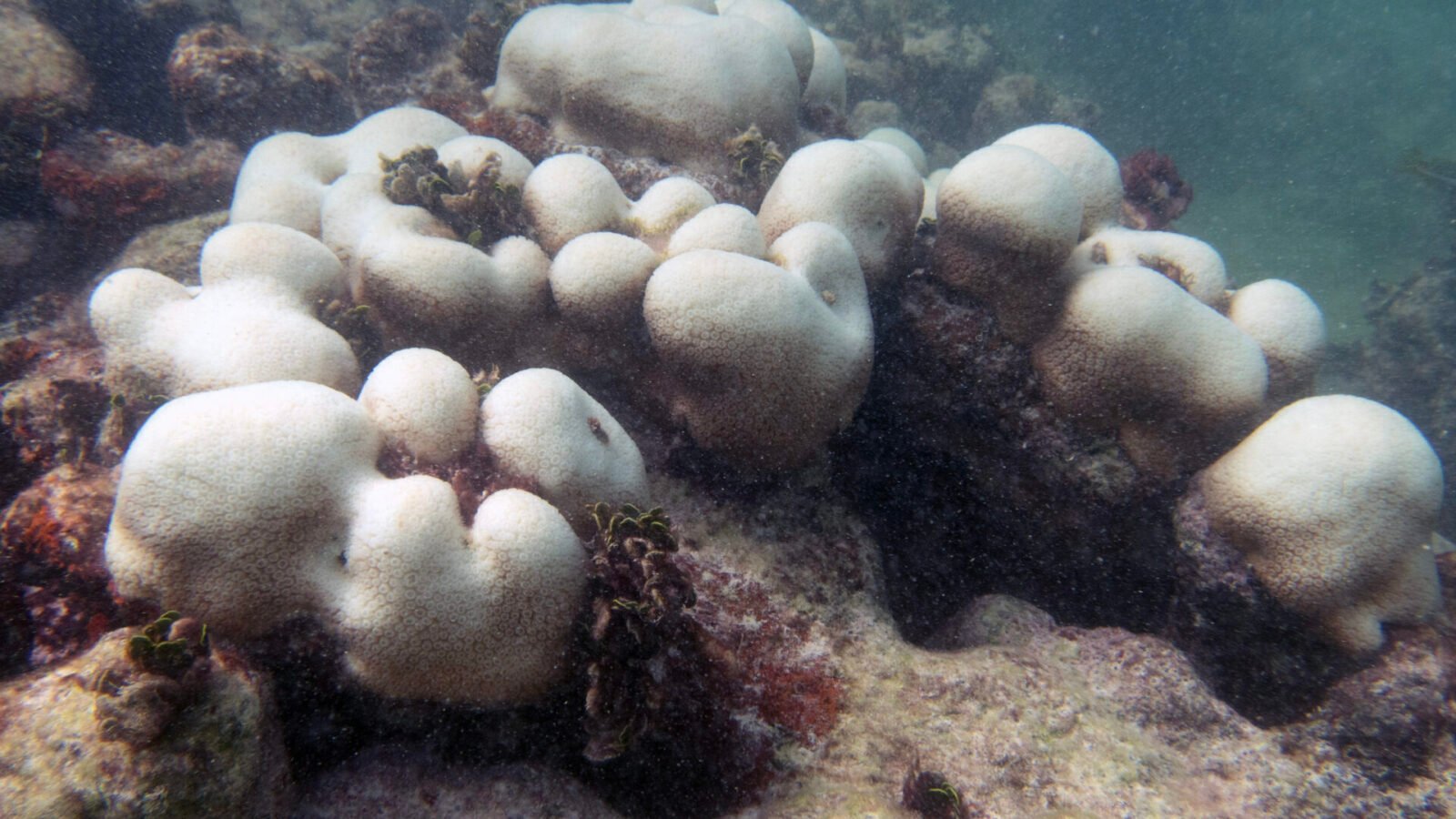
Featured photograph: Actual bleaching of lobed star coral (Orbicella annularis) during the July 2026 marine heatwave in Florida’s Lower Keys. U.S. Geological Survey, public domain. This is a contextual field photograph, not an image from the Stanford laboratory trial. Image documentation and usage rights.
The chance observation that led to a startling experiment
In 2025, Stanford marine scientist Stephen Palumbi noticed something peculiar in a tank. Two pieces of coral from the same colony—one healthy, one bleached—had fallen against each other. Color appeared to be returning near the place they met. Researcher Daniel S. Collins and colleagues decided to test whether physical contact could help the stressed fragment regain the microscopic algae that supply much of a coral’s nutrition.
They began with 10 pairs of fragments from a single coral animal, a species called Pocillopora damicornis. Five healthy-and-bleached pairs were placed in direct contact; the remaining five were kept only a few millimeters apart. The distinction proved decisive: the bleached coral fragments that touched healthy genetically identical partners recovered within seven weeks, while the separated controls did not recover and eventually died, according to Stanford’s account of the study.
Why did a distance of a few millimeters matter so much? The coral animals were not merely sitting next to each other. At their point of contact, compatible tissues fused, forming a living bridge. Microscopy revealed that beneficial algae—called symbionts—could move from the healthy fragment into the bleached one. The symbionts were detectable on the move within days.
Once transferred, the algae began reproducing inside the damaged coral. During the second week, their population doubled roughly every four days—much faster than the rates typically documented in naturally recovering corals. Contact did not have to last for the whole recovery period: the researchers found that a week, and in some experiments less, could provide enough algae to set self-recovery in motion. The full process still took weeks.
Why bleaching happens—and why white does not always mean dead
Corals are animals, even if their branching and mound-shaped colonies can resemble plants or rocks. Many reef-building corals live in close partnership with microscopic photosynthetic algae. The algae make energy-rich compounds; the coral provides shelter and other resources. When an ocean heatwave disrupts that relationship, stressed corals can lose their algal partners and turn pale or white. That is coral bleaching.
A bleached coral is not automatically a dead coral. But its nutritional lifeline is compromised. With prolonged or repeated stress, surviving and rebuilding become much harder. Coral reefs also face acidification, pollution, disease and local ecological pressures. Replacing algae may help a starving fragment recover; it does not remove those pressures.
The planetary scale is sobering. The U.S. National Oceanic and Atmospheric Administration concluded in June 2026 that the fourth global mass bleaching event likely ended in mid-2025. Across the event, beginning in 2023, roughly 84.4% of global reef area experienced bleaching-level heat stress. That is a measure of exposure to dangerous heat, not a claim that 84.4% of corals died. The distinction matters for understanding both the catastrophe and the possibilities for recovery.
The catch: a healthy neighbor cannot be just any neighbor
The Stanford results relied on a very particular form of compatibility. Corals can form genetically identical clones through fragmentation. When the team paired fragments from different genetic individuals—different genets—their tissues did not fuse in the same restorative way. Instead, the corals could react antagonistically, much as incompatible organisms reject a transplant. The faster recovery mechanism depended on the shared genetic identity of the two pieces.
That limitation means the apparent simplicity of the experiment is deceptive. Reef restoration teams cannot simply press a random piece of healthy coral against a bleached one and expect it to heal. They would need access to a healthy clone of the same individual, plus conditions that allow surviving algae to multiply. That is an enormous logistical demand across complex, diverse reefs.
The research also used small, aquarium-sourced fragments under laboratory conditions. It does not yet demonstrate survival through renewed heatwaves, results across many coral species, or practical restoration at reef scale. The original peer-reviewed paper, “Rapid coral bleaching recovery via symbiont transfer from healthy corals”, treats this as a newly identified biological process and a foundation for interventions—not a deployed climate solution.
What scientists might do with the discovery
The valuable idea may not be to put millions of coral pieces into contact. It may be to learn how to deliver the right symbionts without requiring a genetically identical healthy fragment beside each injured one. The Stanford group has proposed investigating whether algae could be collected from healthy corals ahead of heatwaves, then delivered to stressed fragments in other ways. Those are research directions, not demonstrated field cures.
Other approaches are already being explored: breeding more heat-tolerant corals, nurturing fragments in restoration nurseries, and protecting reefs during intense heat. The new mechanism could become one tool among many. It also changes a sometimes defeatist assumption: a bleached coral may retain more ability to recover than its ghostly color suggests.
But reef-scale intervention remains a race against continuing thermal stress. A coral that regains its algae can bleach again when waters overheat. Lasting protection still depends in part on limiting the warming and reducing local environmental pressures that make reefs vulnerable.
What the headline gets right—and wrong
A November 9 article at BGR summarized the findings under a sweeping headline about reversing global warming’s effects on coral reefs. The laboratory observation is real; the proposed reach of the headline is broader than the evidence. In the experiment, bleaching was reversed in individual coral fragments by transferring beneficial algae. Ocean temperatures did not fall, the underlying climate threat did not disappear, and scientists have not shown they can revive an entire damaged reef this way.
The more precise headline may also be the more hopeful one: researchers now have direct evidence of a fast, naturally occurring route for restoring the symbionts that corals need to survive. Can that pathway be adapted to work without a healthy clone right beside every bleached fragment? That is the question that matters next.
Watch the research
Euronews video report, October 15, 2026, covers the Stanford laboratory finding with researchers and coral fragments. Associated Press video, November 4, 2026, also reports on the same study. These are reports about the laboratory work, not footage of whole reefs being restored.
Sources and further reading
- Collins et al., Science Advances (2026), original peer-reviewed study, DOI 10.1126/sciadv.aeh1580.
- Stanford University, October 14, 2026, research account and experimental images.
- Nature, October 14, 2026, independent reporting and biological context.
- NOAA Coral Reef Watch, June 2026 global bleaching status.
- USGS July 2026 real-world coral photograph and public-domain licensing.