A gazelle can outrun a person. But can it outlast one? For decades, an unusual theory of human evolution has proposed that some of our ancestors hunted not by winning a sprint, but by making the chase last so long that their prey could no longer safely shed heat. The strategy is called persistence hunting, and its most surprising feature may be that the hunter does not have to run continuously.
Research published in 2024, 2025 and 2026 has given this idea fresh substance. Historical records document many more endurance pursuits than researchers once recognized. A field experiment in Namibia recorded an oryx reaching a dangerous body temperature while a pursuing human remained cooler. Yet none of this establishes that persistence hunting was the primary reason humans evolved long-distance running. The distinction matters: proof that a technique works today is not proof of what happened two million years ago.
The strange advantage of being a slow predator
Humans are unimpressive sprinters compared with antelope, horses and many other mammals. Our comparative strength is a combination of endurance, cooling and decision-making. Much of human skin can release sweat that evaporates and removes heat; our locomotor muscles also include fatigue-resistant fibers. A fleeing quadruped may need to interrupt fast movement to recover and cool, depending on species, temperature and conditions.
That does not mean an antelope simply drops after a fixed number of miles. It means that in some hot, open environments, hunters who can track an animal, alternate running with walking, and force repeated flights might gradually change the contest. An influential 2004 Nature paper by Dennis Bramble and Daniel Lieberman argued that skeletal and physiological adaptations for sustained running arose within the genus Homo roughly two million years ago. It did not establish a single evolutionary cause.
The archives contained hundreds of overlooked chases
One major objection used to be straightforward: if running prey down was such a useful strategy, why were well-documented examples so rare? In a May 2024 study in Nature Human Behaviour, anthropologists Eugène Morin and Bruce Winterhalder revisited ethnographic and historical sources and identified roughly 400 descriptions of endurance pursuits across 272 locations. Their foraging models suggested that, under particular conditions, the energetic payoff could compare favorably with other hunting approaches.
A follow-up study published in the Journal of Human Evolution in March 2026 analyzed 425 recorded cases. Its authors describe a far more flexible practice than the movie version of a person jogging relentlessly behind a terrified animal: hunters often switched between running, walking and tracking, and used the prey’s own cycles of escape and recovery. High temperatures and even crusted snow could sometimes favor pursuit. The authors considered not just food efficiency, but risk reduction and social signaling as possible incentives.
Those historical accounts are significant, but they are not a census of all societies, nor archaeological recordings of early humans. Accounts vary in date, quality and detail; a successful pursuit described in a source cannot establish how often attempts failed, or how representative the tactic was of prehistory.
What the oryx experiment actually measured
The strongest recent physiological evidence came from a study published online November 7, 2025, in the Journal of Human Evolution. A team including Martin Hora and Herman Pontzer studied six pursuits of gemsbok, also known as oryx, in Namibia. The human subject measured in detail was one 58-year-old, nonacclimatized ultrarunner and experienced hunter, accompanied by three hunters accustomed to the conditions.
Across three days, the participants covered a combined 49.5 kilometers on foot in 7.8 hours of pursuits. Two pursuits succeeded: one healthy oryx was caught after about two hours, during which running accounted for only 31 percent of the time; a second, already injured animal was caught after an hour with walking alone. The study reports air temperatures of 36–41°C (97–106°F). The measured human’s core temperature remained at or below 39°C (102°F), while an oryx reached approximately 44°C (111°F).
That is a striking demonstration of what hot-weather pursuit can do. It is not a universal success rate. Four chases ended because animals left, or approached the boundary of, the private estate where the study occurred. The sample of directly monitored humans was tiny, one prey animal was injured, and the logistics of a contemporary hunt differ from those of prehistoric foragers. The study demonstrates feasibility, not a reconstructed ancient lifestyle.

What the skeptics still have right
Humans are not the world’s fastest—or necessarily the most enduring—mammals across all circumstances. In research comparing human-versus-horse race results, scientists found that hotter weather reduced human running performance less sharply than it reduced horses’ performance. Still, horses were faster in absolute terms. The authors argued that human skill, planning and tracking could be more important than any simplistic claim that we are the ultimate endurance animal.
There are evolutionary alternatives, too. Running and walking over long distances could have helped early humans travel between food patches, scavenge carcasses, and function across wide territories. Different pressures can favor overlapping anatomical traits. A body adapted for moving long distances does not come with a fossilized label saying designed for hunting.
And the very mechanism that gives humans a hot-weather advantage comes with a bill. Sweating costs water, and a pursuit through severe heat can be dangerous for humans as well as prey. The successful Namib field study recorded exceptionally high daily water turnover. This is not a safe activity to attempt as a challenge or endurance stunt.
A hunting strategy—or an origin story we want to believe?
The evidence now supports a more nuanced conclusion. Persistence hunting is real, has been documented in multiple human societies, and can be energetically viable in certain environments. Contemporary physiological data show how a sustained pursuit can overheat an oryx. The 2026 historical analysis broadens the record and clarifies that tracking, judgment and alternating gaits matter as much as pure running ability.
What remains uncertain is the evolutionary claim: whether the tactic was frequent enough, early enough and influential enough to shape our species’ endurance adaptations. The tempting story is that humans became extraordinary runners by refusing to stop chasing. The more intriguing possibility is that our ancestors combined moderate athletic gifts with something stranger: the ability to read an animal, a landscape and a changing opportunity.
So what made humans formidable hunters—the legs, the sweat, or the minds deciding when to use them?
Primary research and further reading
- Bramble and Lieberman (2004), Nature: Endurance running and the evolution of Homo.
- Morin and Winterhalder (2024), Nature Human Behaviour: Ethnography and ethnohistory support the efficiency of hunting through endurance running in humans.
- Hora and colleagues (2025), Journal of Human Evolution: Human energy expenditure and thermoregulation during persistence hunting in the Namib.
- Winterhalder and Morin (2026), Journal of Human Evolution: Endurance pursuit hunting among recent foragers and its relevance for hominin locomotor evolution.
- Comparative study: Are humans evolved specialists for running in the heat?
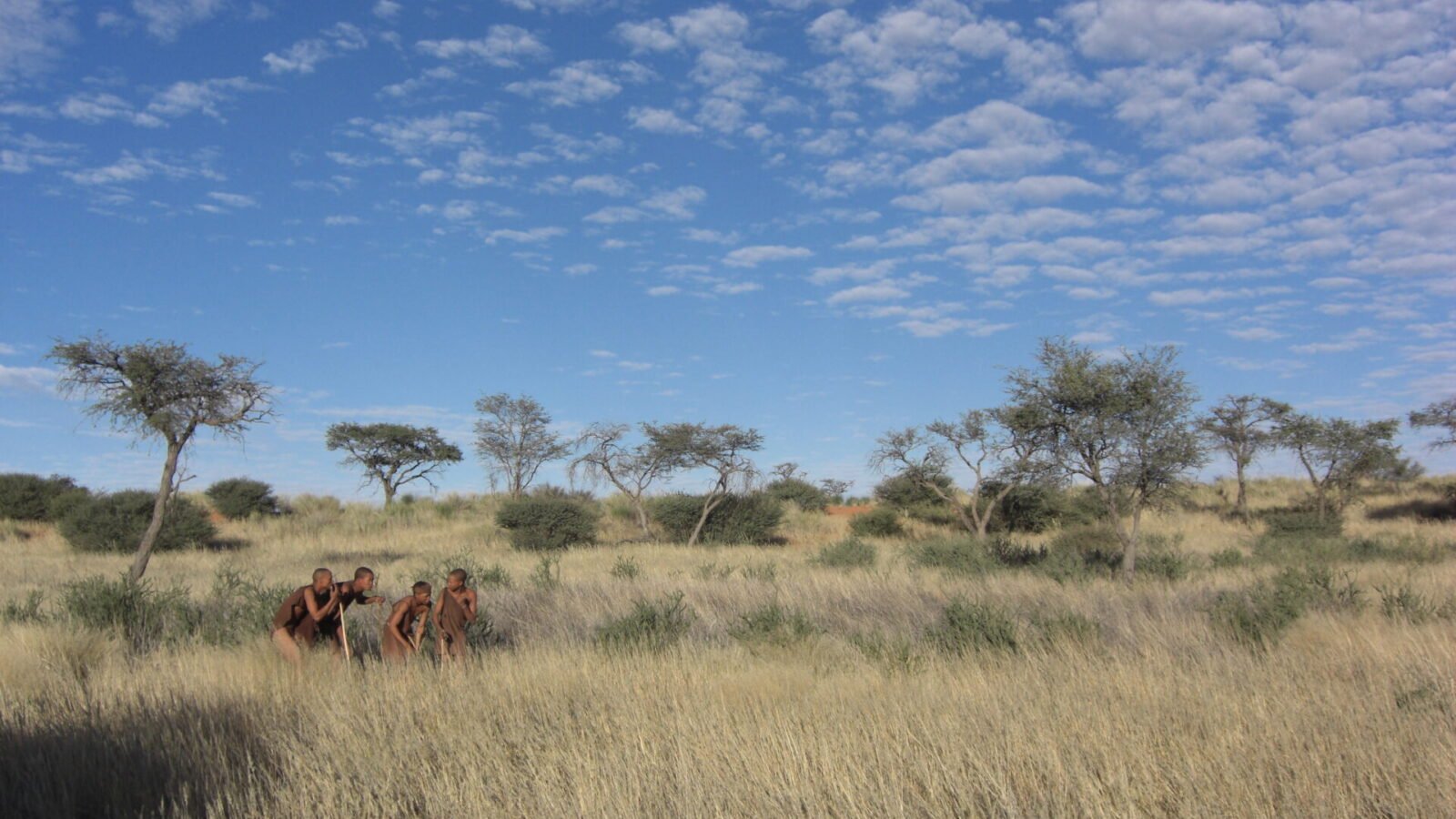
Image notes: The featured photograph documents San hunters demonstrating hunting techniques in the Kalahari in 2009. It does not depict a documented persistence hunt or the 2025 oryx experiment. Photo: sjorford / Wikimedia Commons, CC BY-SA 2.0 (cropped for display). The article’s separate oryx photograph is documentary context, not evidence from the field study.