ANALYSIS | November 10, 2026. The headline sounds almost futuristic: artificial intelligence is changing cancer treatment, and a personalized vaccine has delivered a major clinical trial success. But the most interesting part of this story is also the easiest to misunderstand. A promising cancer treatment has been tested in patients; AI-assisted cancer research is advancing alongside it. Those are related developments, not the same discovery.
A November 10 report from Tom’s Guide draws together three threads: a late-stage melanoma vaccine trial, an AI system that predicts how individual tumors might respond to drugs, and a protein-modeling technology that can accelerate laboratory research. Each offers real possibilities. Each has different evidence behind it.
The real patient result: 82.2% versus 70.0%
At the European Society for Medical Oncology (ESMO) Congress in October 2026, researchers presented results from INTerpath-001 (NCT05933577), a randomized, double-blind Phase 3 trial involving 1,137 adults whose high-risk stage IIB–IV cutaneous melanoma had been surgically removed.
One group received pembrolizumab, the immune checkpoint inhibitor sold as Keytruda, plus an investigational individualized mRNA therapy called intismeran autogene (V940/mRNA-4157). The comparison group received pembrolizumab plus placebo. After a median follow-up of 24.6 months, 82.2% of participants in the combination arm were alive without recurrence at two years, versus 70.0% in the comparison arm.
The relative hazard of recurrence or death was 42% lower with the combination (hazard ratio 0.58; 95% confidence interval 0.45–0.75). That 42% statistic is not an absolute 42-percentage-point improvement. The two-year recurrence-free rate differed by 12.2 percentage points. Distant metastasis-free survival was 88.5% versus 80.2%, with a 38% relative reduction in the hazard of distant metastasis or death.
These findings are reported by ESMO, the trial sponsors, and The ASCO Post. They make this an important clinical result, not merely a computer-generated prediction.
How the personalized vaccine is made
Conventional vaccines are typically manufactured to target the same pathogen in many people. Intismeran is different: after a tumor is removed, its DNA is analyzed alongside normal tissue to identify mutations unique to that patient’s cancer. A computational selection process prioritizes potential neoantigens—altered protein fragments the immune system may recognize. The resulting personalized mRNA product encodes up to 34 of them.
The intention is to teach immune cells to identify residual melanoma cells that surgery may have missed. Pembrolizumab, meanwhile, interferes with the PD-1 checkpoint pathway that can prevent an immune response. The combination attempts to identify the target and release the immune system’s brakes at the same time.
ESMO describes the treatment as designed using a predictive computer algorithm. That is a meaningful computational role, but it should not be inflated into a claim that a generative chatbot invented a cancer cure. Nor should this investigational treatment be confused with a vaccine that prevents someone from developing melanoma in the first place. It is an after-surgery treatment for patients already diagnosed with particular stages of melanoma.
What the trial has not proved
Improving recurrence-free survival matters enormously to someone at high risk of the disease returning. But it is not the same as proving people live longer. The trial’s overall-survival analysis remains immature; at the interim analysis, a statistically conclusive overall-survival advantage had not been established. Follow-up is continuing.
Side effects also deserve attention. According to the sponsor’s detailed report, treatment-related adverse events occurred in 95.8% of the combination group compared with 90.0% of the control group; grade 3–5 treatment-related events occurred in 14.2% and 13.4%, respectively. Fever, injection-site pain and fatigue were common with the vaccine combination. Investigators did not identify a new safety signal, but that does not mean the regimen has no risks.
Independent ESMO commentary also notes that personalized manufacturing takes time and that treatment choices may become complicated for patients who could instead receive immunotherapy before surgery. Regulatory review, cost, capacity to sequence tumors, manufacturing logistics and equal access are unresolved. As of November 10, 2026, intismeran remains investigational.
AI’s other job: reading tumors cell by cell
Now consider a second, separate advance. In April 2024, National Cancer Institute researchers published PERCEPTION—short for PERsonalized Single-Cell Expression-Based Planning for Treatments In ONcology—in Nature Cancer.
Traditional bulk analysis blends signals from many tumor cells. But cancers are not uniform assemblies: one pocket of cells may respond to a drug while another resists it. PERCEPTION uses measurements of gene activity in individual tumor cells to model potential responses and resistance. The researchers tested the system in laboratory cell models and retrospectively assessed data from clinical cohorts, including multiple myeloma and breast cancer, as well as resistance in lung cancer.
The NCI calls this a proof of concept, not a tool proven by prospective trials to improve survival when it selects treatment. It has not been established as a routine replacement for oncology teams. Predicting a response in existing data is a different level of evidence from demonstrating better patient outcomes through a controlled clinical study.
AlphaFold: a faster map, not a ready-made medicine
Google DeepMind’s AlphaFold system addresses another challenge: predicting the three-dimensional structures of proteins. The open AlphaFold Protein Structure Database, operated with EMBL-EBI, contains more than 200 million predicted protein structures.
That gives scientists a massive starting map for investigating how biological molecules work and where drugs might interact with them. It can make early discovery more efficient, including in cancer biology. But a predicted protein structure does not establish whether a molecule is safe, whether it works inside a human tumor, or whether patients benefit from a treatment. Cell experiments, animal studies when appropriate, manufacturing quality checks, and clinical trials still matter.
These achievements are often presented together as evidence of an AI revolution in oncology. They should also be kept apart: AlphaFold predicts structures; PERCEPTION predicts drug responses; INTerpath-001 measures outcomes in actual patients.
The question beyond the headline
Other cancer treatments have looked impressive in dishes or animal models and then failed to translate into human benefit. As Apep Bar previously examined in a laboratory-cancer-claim fact check, the evidence ladder matters. In INTerpath-001, researchers have climbed much higher: a randomized Phase 3 trial has shown a reduction in melanoma recurrence. The remaining rungs are durable survival data, regulatory assessment, practical production and widespread patient access.
If a cancer treatment is designed around one patient’s tumor, medicine is no longer just asking which drug works for the average diagnosis. It is asking what distinguishes this patient’s disease—and whether the system can act on that knowledge quickly, fairly and reliably.
That is the promising story here. And it leaves an urgent question: Can precision oncology make personalized medicine accessible beyond a few highly resourced centers, without overselling what its algorithms know?
Sources and further reading
- ESMO, October 24, 2026 — Independent oncology discussion of Phase 3 results and limits
- ClinicalTrials.gov — INTerpath-001 registration (NCT05933577)
- Merck and Moderna — Detailed trial data and adverse events (October 22, 2026)
- The ASCO Post — Independent summary and overall-survival limits
- Nature Cancer, 2024 — Original PERCEPTION research and NCI explanation
- EMBL-EBI / DeepMind — AlphaFold Protein Structure Database
- Tom’s Guide — Source article (November 10, 2026)
Related official video resource: ESMO Congress 2026 presentation listing for Georgina V. Long’s INTerpath-001 talk. Access may require an ESMO login. This is the trial presentation, not footage of a patient’s treatment.
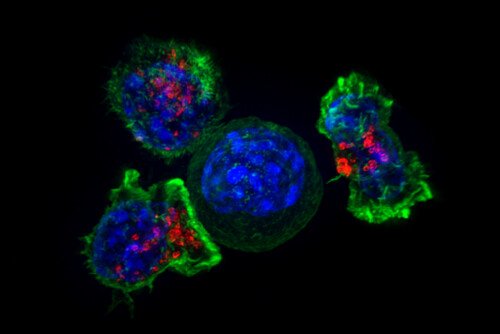
Featured image: actual scientific microscopy of killer T cells around a cancer cell, courtesy of the U.S. National Institutes of Health (Public Domain Mark 1.0). Contextual illustration of immune-cell behavior; not imagery from INTerpath-001.