HIDDEN HISTORY / ARCHAEOLOGY — November 6, 2026 · By Lotta Goddess
The ancient clue was not a pipe or a bowl. It was a braid of human hair, preserved for nearly three millennia in a Siberian royal tomb—and still carrying molecular signals associated with cannabis.
An international team led by archaeologist Gino Caspari at the University of Bern reports that cannabis seeds and cannabinoid-related signals in human hair found at the Tunnug 1 burial mound in Russia’s Republic of Tyva may represent the earliest directly dated evidence of the plant’s psychoactive use. Published in Science on November 5, 2026, the study pushes the proposed timeline back roughly 300 years beyond the best-known earlier chemical evidence. But one significant caveat has already emerged: an outside forensic toxicologist questions whether the hair proves consumption rather than environmental exposure. Read the original Science study; see the University of Bern’s findings and archaeological photo gallery.

What excavators found inside Tunnug 1
Tunnug 1 sits in the Uyuk Valley of southern Siberia, a landscape where early communities associated with the Scythian cultural world built monumental burial mounds. This particular kurgan spans roughly 140 meters (460 feet). Its central chambers contained wooden burial structures, artifacts linked to an elite horse-riding society, and human remains. Archaeological investigations began in 2017 and have continued through punishing weather and difficult terrain.
Among the less glamorous discoveries were tiny dark seeds. The University of Bern reports approximately 1,000 cannabis seeds; more expansive field counts cited in news interviews exceed 1,400. Crucially, six seeds were directly radiocarbon dated. Combined with dating from the burial complex, they placed the deposition in the early eighth century BCE—about 2,800 years ago. Plant material in such a burial could signify an offering, a practical commodity, or a substance used during a ceremony. Seeds alone cannot tell us which.

The hair changed the story
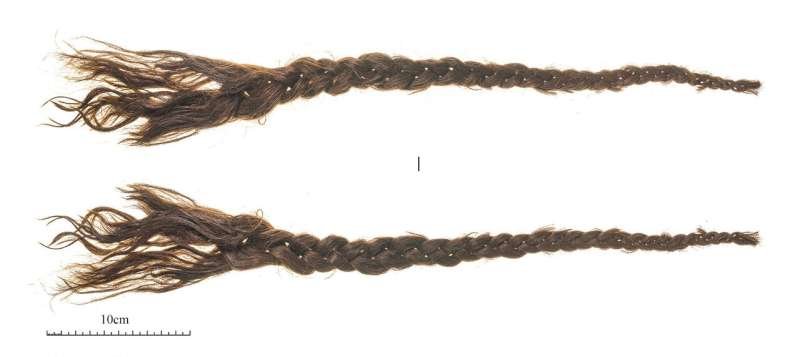
The critical evidence came from exceptionally well-preserved human hair in the central burial area. Using techniques that included high-resolution mass spectrometry, the researchers found chemical signals consistent with cannabinol (CBN), a compound that can form as the main intoxicating cannabinoid THC oxidizes. They also found weaker signals consistent by mass with THC. The team interprets that combination, in the same context as the dated cannabis seeds, as evidence that people associated with the tomb used cannabis for mind-altering purposes.
This is a different kind of evidence from finding cannabis seeds in a grave: hair can preserve a chemical record of exposure while a person was alive. The researchers say it offers a rare opportunity to examine the body, the plant and the burial ritual together. In a 404 Media interview, Caspari described the convergence of clues as exceptionally rare.
Yet the study does not establish a dose, the strength of the ancient cannabis, or the route of exposure. There is no evidence here of a specific smoking device, a joint, or a recipe. Ingestion is possible; inhalation is possible. The condition and chemistry of material buried for almost 3,000 years add uncertainty that modern drug testing does not normally face.
A serious objection: Did someone consume it, or did the hair pick it up?
That question is not merely rhetorical. In Associated Press reporting published November 5, Volker Auwärter, head of forensic toxicology at University Medical Center Freiburg, criticized the hair-testing evidence. He argued that the analysis did not adequately distinguish drug consumption from external contamination—the possibility that hair acquired cannabinoid compounds from its surrounding burial environment rather than through the deceased person’s body.
Another independent scholar, Elisa Guerra Doce of the University of Valladolid, offered a more favorable interpretation to AP. Hair toxicology has an established role in archaeology, she said, and the combined evidence supports actual use rather than a funerary offering alone. The disagreement concerns how far this particular analytical result can be pushed, not whether the seeds and hair were recovered.
The fairest conclusion is that Tunnug 1 offers strong, potentially groundbreaking evidence of ancient cannabis exposure and probable use—not a video recording of someone getting high. Confirmatory chemical testing and more samples could sharpen the distinction.
Horses, possible human sacrifice—and the danger of inventing a ritual
The setting is more unsettling than the average plant-science discovery. Archaeologists documented the remains of numerous horses associated with the mound. The research team also considers some of the human remains consistent with possible ritual human sacrifice, though the circumstances require cautious interpretation. There is no direct demonstration that cannabis was administered to people who were sacrificed, let alone evidence of why anyone would have done so.
Caspari has floated the possibility that cannabis helped participants endure or prepare for ceremonies. That is a hypothesis, not an excavated fact. Hair chemistry cannot identify the drinker or smoker’s emotional state, whether the substance was taken voluntarily, or whether it was connected to death rites at all. The association between cannabis and the burial is important without turning uncertain ancient lives into a sensational script.
Herodotus described a Scythian cannabis vapor bath centuries later
In Book IV of The Histories, chapters 73–75, the fifth-century BCE Greek writer Herodotus describes Scythians sheltering beneath felt coverings and throwing hemp onto hot stones, producing clouds of vapor. The passage is striking because it associates cannabis with post-burial customs. But Herodotus wrote centuries after the Tunnug 1 interments and described Scythian groups across a vast region; he was not an eyewitness to this Siberian tomb. His text provides a cultural parallel, not direct proof of what took place there.
The strongest earlier chemical comparator comes from the Jirzankal Cemetery in the Pamir Mountains of western China. In a 2019 Science Advances study, researchers detected cannabis-related residues in wooden braziers with heated stones, dating to around 500 BCE. That evidence points more specifically to cannabis burning and inhalation during funerary ceremonies. The new Siberian hair results are older, while the Chinese braziers remain a clearer clue to the method of use. Two archaeological records, two different strengths of evidence.
What ancient DNA could reveal next
The seeds may hold another kind of time capsule: ancient cannabis DNA. The team says preservation is excellent and sequencing has already begun. Researchers hope to investigate how cannabis moved across Eurasia, how people gathered or cultivated it and whether later domestication altered cannabinoid profiles. No one can yet infer the THC concentration of the plants buried at Tunnug 1, and surviving seeds do not by themselves prove intentional breeding for potency.
This also has a modern resonance. A separate Apep Bar investigation into high-potency cannabis examined how contemporary breeding and concentrates have changed the drug marketplace. The Siberian find cannot tell us whether ancient plants resembled today’s commercial varieties—quite the opposite. Its value lies in giving science a far older reference point.
What the tomb proves—and what it does not
There were cannabis seeds in the early-eighth-century-BCE burial complex. Molecular signals associated with cannabis compounds were detected in ancient hair. Researchers interpret their convergence as evidence of psychoactive use. Independent experts disagree about whether the hair analysis has ruled out external contamination. The route, dosage and social meaning remain unknown, and the theory that cannabis was used to calm sacrifice victims is unproven.
Almost 3,000 years later, the most intriguing discovery may be that a few strands of hair can challenge the history written in textbooks. But the real test of the claim will be the evidence yet to come: will further analysis show what entered these ancient bodies, or merely what survived around them?
Sources and further reading
- Caspari et al., “Direct evidence for psychoactive cannabis use 2800 years ago,” Science (2026) — original study.
- University of Bern research release and original photographs — November 5, 2026.
- 404 Media interview with Gino Caspari — November 5, 2026.
- Associated Press: independent scientific objections and responses — November 5, 2026.
- Ren et al., “The origins of cannabis smoking,” Science Advances (2019) — the Jirzankal evidence.
- Herodotus, Histories, Book IV, 73–75 — the later historical account.