The screen goes black. The lights disappear. You press the power button and assume the machine is off. The tiny symbol under your finger has a more complicated story—and in some cases, so does the equipment behind it.
A YouTube Short argues that the familiar power button is not really an off switch. Its most interesting point is grounded in electrical standards: the broken-circle symbol was historically associated with standby, not necessarily a complete disconnection from electricity. But the video’s broad claim that nothing truly turns off—and its conflation of iPhone tracking with payment-card functionality—go further than the evidence.
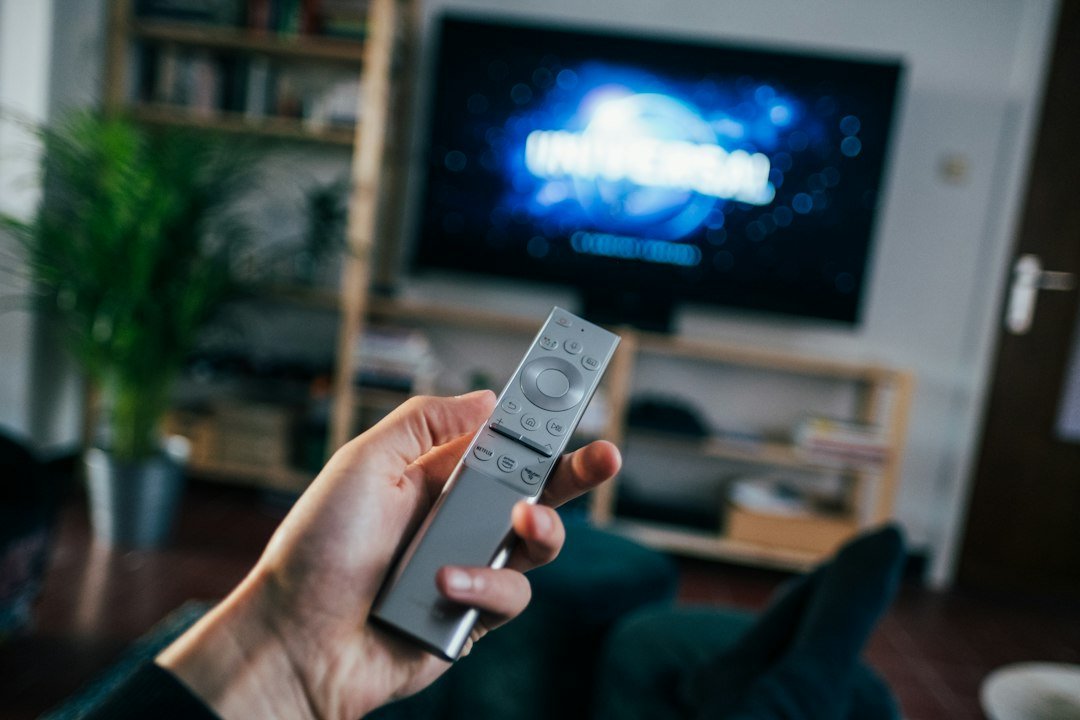
Featured photograph: a smart TV in a living room, used as a contextual example of remote-controlled electronics, not as evidence from a shutdown test. Photo: Jonas Leupe / Unsplash; Unsplash License. This image does not show the particular devices discussed below.
The little gap in the symbol has a history
The International Electrotechnical Commission (IEC) maintains a family of standardized graphical symbols for electrical equipment. Its 2026 graphical-symbol index still distinguishes several that people casually call the power sign:
- IEC 60417-5007: a vertical line for ON;
- IEC 60417-5008: a circle for OFF;
- IEC 60417-5009: the familiar broken circle with a vertical stroke, titled Stand-by;
- IEC 60417-5010: a complete on/off push-push symbol associated with a two-position switch.
The distinction mattered when a switch disconnected the mains versus when a product merely entered a lower-power state. A separate electrical-safety question is whether a device provides a physical isolation mechanism. A printed symbol, by itself, is not proof of the condition of every internal circuit. The safety implications depend on the product and the applicable standard—not just the outline of the icon.
Lawrence Berkeley National Laboratory traces standardized on, off and standby symbols back to the mid-1970s and notes that the now-familiar power symbol has long been used to toggle a range of power states. The confusion was recognized by energy researchers long before today’s viral videos. Read the laboratory’s explanation of standby-power terminology.
Did engineers change the rules in 2004?
Yes—but that claim needs a crucial correction. The relevant development was IEEE 1621-2004, which aligned guidance with the way the symbol was being used on consumer electronics. A 2014 proposal to encode the IEC power symbols in Unicode, coauthored by a Lawrence Berkeley researcher, quotes IEEE 1621’s reasoning: the broken-circle mark had become widely understood as a general power control even when its off state drew some electricity. The same work documents a crescent-shaped sleep symbol.
That is not the same as saying the IEC simply erased the old standby meaning. Indeed, the IEC’s own 2026 index still lists symbol 5009 as ‘Stand-by.’ The video gets the technological shift broadly right but compresses distinct standards bodies and their terminology into a tidy story.
The TV that looks off but remains ready
Consider a television you can wake with its remote. For an infrared remote to turn the TV on, something in the receiving circuitry must remain capable of responding while the display and its high-power systems are inactive. Network-connected televisions may also offer wake-on-network or other quick-start features, depending on settings and model.
That does not mean the entire television is operating normally. A device can be in a genuinely low-power state with only a small circuit enabled. The U.S. Department of Energy calls electricity consumed by devices that appear off standby power, and IEC 62301 provides a measurement method. Actual power consumption varies by product and mode; there is no honest universal number for ‘off.’
There is a legitimate privacy discussion here too, but it must not be confused with a measurement of electricity. A live standby receiver does not, by itself, establish that a microphone is recording, a camera is watching or a manufacturer is secretly collecting data. Those questions require their own evidence. We examined related claims in Apep Bar’s earlier investigation into Samsung TV tracking and microphone allegations.
Why some iPhones can still be found after shutdown
Here’s the unsettling-sounding detail that is actually documented. Apple’s Find My safety guide, updated in September 2026, says a supported iPhone with Find My enabled may remain locatable through the Find My network for up to 24 hours after power-off or disconnection from the internet. Apple also describes how to temporarily turn off that capability from the shutdown screen and how to disable the Find My network in Settings.
That is an intentional limited-function design, not evidence that an iPhone’s screen, operating system and every radio remain fully active after shutdown. And the video’s suggestion that payment chips keep functioning after a deliberate shutdown blends together two different features.
Apple’s security documentation on Express Cards with power reserve says selected transit, payment and access cards can sometimes work when the phone’s battery is too low to run iOS. It also explicitly says this feature is not available after an ordinary user-initiated shutdown. The distinction matters. ‘Low battery and iOS not running’ is not the same condition as ‘user selected Power Off.’
Finding a lost phone and choosing not to broadcast a Find My signal are competing user interests. Apple provides settings for that trade-off; people with safety or location-privacy concerns should review them.
On some Windows PCs, Restart really is a deeper reset than Shut down
Microsoft documents another apparent contradiction. When Fast Startup is enabled, choosing Shut down can log users out while preserving the Windows kernel session in a hibernation file to accelerate the next boot. By contrast, Restart does not use Fast Startup and performs a full boot cycle. This is why a restart may resolve a driver or update problem that a normal shut-down-and-power-on sequence does not.
The evidence comes from Microsoft’s own Fast Startup technical guidance and its system power-state documentation. The latter distinguishes a hybrid shutdown, a soft-off state (S5) and a mechanical-off state (G3). Even S5 does not mean every computer’s power supply is physically isolated from the wall.
This is not true of all machines in all configurations. Fast Startup can be disabled or unavailable; a hard power switch, removing power or unplugging a device changes the electrical situation. And a phone running on an internal battery cannot be understood by analogy with an unplugged desktop.
What ‘off’ really tells you—and how to check
The most useful question is not whether the power icon is lying. It is which functions remain active, why, and who controls them.
- For smart TVs and consoles: inspect quick-start, network-wake and standby settings. If you want to know energy use, measure the device with a suitable plug-in electricity meter rather than guessing from the screen.
- For Windows PCs: try Restart when you need a clean Windows boot. If you need a full software shutdown and know what you’re doing, Microsoft documents the command
shutdown /s /t 0; save your work first. - For iPhones: review Settings → your name → Find My → Find My iPhone → Find My network, especially if post-shutdown discoverability concerns you. Turning it off can make recovery of a lost phone harder.
- For actual power isolation: consult the device manual. An appropriate unplugging or physical disconnect can remove mains power, but batteries, capacitors and other power sources may still matter. Do not assume a dark display means equipment is safe to service.
The broken circle is not proof that every gadget is secretly operating all the time. It is evidence of a more subtle change: the word off has come to mean different things in product design, electrical safety, software and privacy.
And that raises a better question than the viral video’s headline: when a manufacturer builds a device that can listen for a remote, wake on command or be located after shutdown, who should have the final say over what ‘off’ means?
Primary sources and further reading
- IEC, official graphical-symbol index (2026).
- Lawrence Berkeley National Laboratory, standby-power definitions.
- Eden, Loughry and Nordman, power-symbol Unicode proposal (2014), discussing IEEE 1621.
- U.S. Department of Energy, measuring standby power.
- Apple, Find My and location sharing and Express Cards with power reserve.
- Microsoft, Windows system power states.