INVESTIGATION | APEP BAR | November 5, 2026
What happens when a government promises to protect people from danger—and keeps the emergency powers long after the immediate panic has passed? From the ruins of Oklahoma City to the Patriot Act, from FBI surveillance of dissenters to British online-safety rules reaching American websites, the evidence traces a recurring tension between security and liberty. It does not prove every crisis was manufactured. It does show how real crises can become permanent architecture.
Imagine being required to show government-issued identification before entering a public meeting, reading a controversial pamphlet or speaking under a pen name. Most Americans would regard that as an extraordinary demand. Now translate the meeting into a website, the pamphlet into a post and the pen name into an anonymous account. What once sounded unthinkable has become a serious policy question.
The modern sales pitch is almost impossible to argue with: protect children, fight terrorism, stop disinformation, prevent violence. Those goals can be legitimate and urgent. But there is a second question, rarely presented on the billboard: who controls the system after the emergency passes—and who gets caught inside it?
A new Reason investigation by Zach Weissmueller, published November 5, 2026, offers a timely entry point. It documents pressure from British regulators on U.S.-based websites and reports concerns that transnational advocacy campaigns could push the internet toward broader age verification and identity checks. The video’s most alarming predictions are arguments advanced by its interviewees, not established outcomes. Yet the underlying conflict is concrete: Britain fined the U.S.-based site 4chan in March 2026, and the resulting American court fight has already produced an important ruling.
The emergency formula—and the Hegelian dialectic trap
Critics often describe a familiar political sequence as problem → public reaction → proposed solution: a horrifying event creates a demand for safety; lawmakers respond with powers that would have been politically difficult to enact under ordinary conditions. This is a useful framework for questioning policy incentives, but it is not proof of a secret operation. Nor should it be passed off as a verbatim recipe devised by German philosopher Georg Wilhelm Friedrich Hegel.
The Stanford Encyclopedia of Philosophy explains that Hegel’s dialectical method examines how apparently stable concepts expose contradictions and undergo transformations. The popular slogan “thesis, antithesis, synthesis” oversimplifies that intellectual tradition. Calling every security policy a “Hegelian operation” substitutes a label for the investigation we actually need.
Instead, apply five tests: Was the precipitating danger genuine? What powers were proposed and by whom? Were the powers narrowly connected to preventing the original harm? Did they expire or expand? What evidence demonstrates abuse or benefit? Those questions are harder than a slogan—and far more threatening to unaccountable power.
The rights Americans already lost, long before the internet
The mythology of a free republic sometimes erases its own record. During World War I, the Espionage Act of 1917 and Sedition Act of 1918 punished speech deemed threatening to the war effort; the later Palmer Raids swept up suspected radicals. During the Cold War, blacklists and investigations chilled political expression. These were not inventions of social media. They were older versions of the same dispute over who may speak when authorities declare a threat.
From 1956 into the early 1970s, the FBI’s COINTELPRO counterintelligence program secretly targeted political groups and individuals, including elements of the civil-rights and antiwar movements. The Senate’s Church Committee exposed domestic intelligence abuses involving the FBI, CIA, NSA and other agencies. The government did not merely listen. It sought to disrupt and discredit people whose politics made them inconvenient.
That is the baseline for any serious discussion of government involvement in later events: documented abuse is not a conspiracy theory. But neither is it permission to attribute every unexplained incident to the government without additional proof.
April 19, 1995: 168 dead in Oklahoma City—and a new antiterrorism law
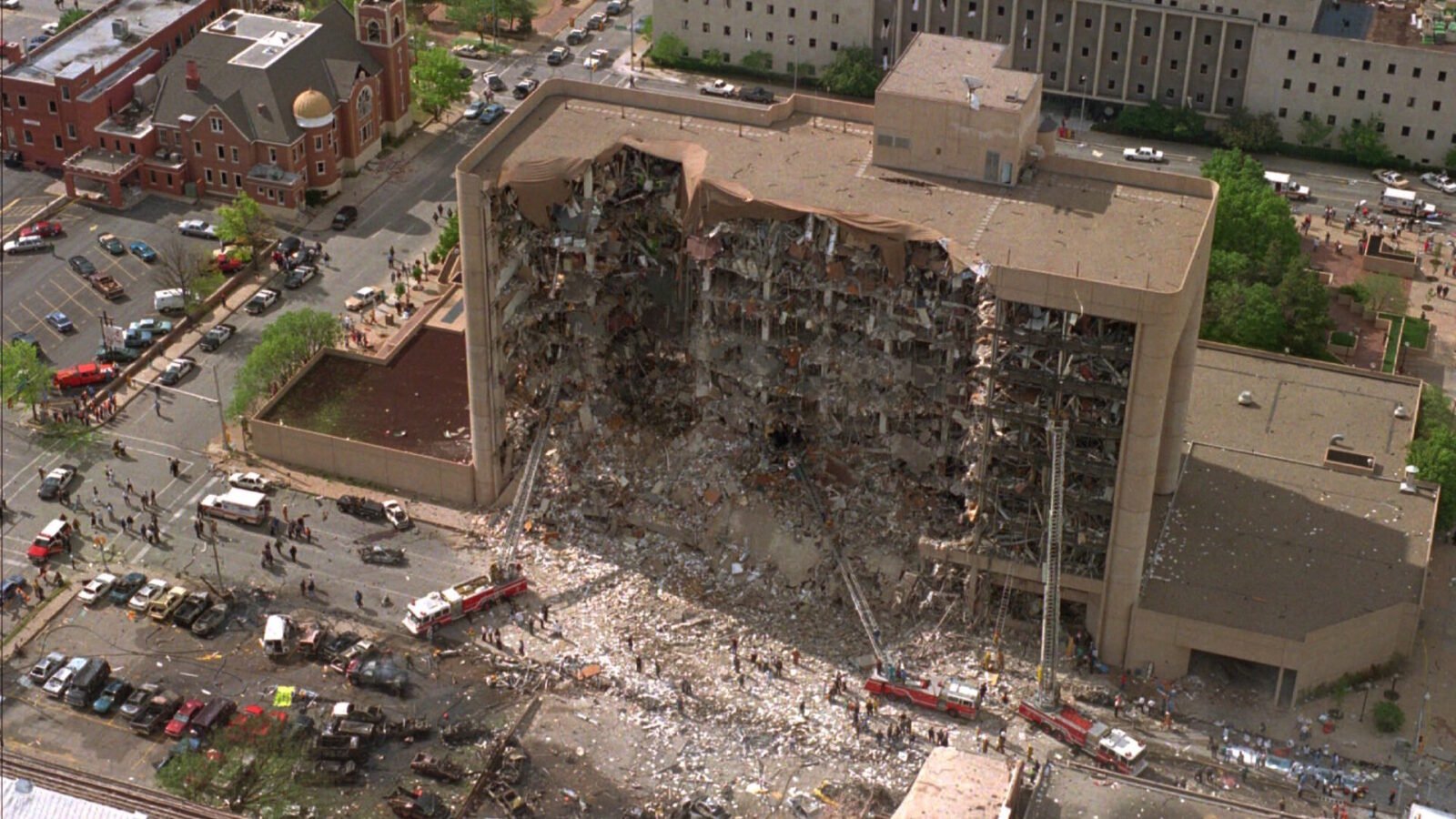
At 9:02 a.m. a truck bomb destroyed much of the Alfred P. Murrah Federal Building. The attack killed 168 people, including 19 children. The FBI’s case history identifies Timothy McVeigh as the bomber and Terry Nichols as a participant in preparing the attack; Michael Fortier knew of the plot and later pleaded guilty in the case. McVeigh was convicted and executed. These are not tentative conclusions.
McVeigh was radicalized in part by government confrontations at Ruby Ridge and Waco. That history matters, but it does not excuse or diminish the murder of federal workers, visitors and children. The victims are the story’s moral center, not supporting characters in an ideological argument.
The political consequences were real. President Bill Clinton signed the Antiterrorism and Effective Death Penalty Act on April 24, 1996. The statute increased terrorism-related penalties and imposed strict deadlines and limits on federal habeas corpus review. Its reach extended far beyond convicted terrorists: people challenging ordinary state criminal convictions also faced a narrower path to federal review. The important question is whether haste in the name of security made it harder to correct wrongful convictions and constitutional errors.
What the sequence proves: a mass-casualty attack helped create political momentum for legislation with durable effects on due process. What it does not prove: that federal officials organized the bombing to obtain those powers.
The informant question: Carol Howe, Elohim City and the warnings dispute
Claims of government involvement are not all equal. An especially concrete dispute concerns Carol Howe, who provided information to the Bureau of Alcohol, Tobacco and Firearms about extremists connected with Elohim City, an Oklahoma religious compound. McVeigh’s defense filings asserted that Howe warned handlers about discussion of attacks on federal buildings before the bombing. A contemporaneous Washington Post account of the testimony reported an ATF handler’s acknowledgment of general warnings, while officials disputed whether Howe supplied actionable, specific advance information about the Murrah attack.
Those distinctions change the allegation. Knowing extremists discussed violence is not equivalent to knowing the precise target and date; maintaining an informant among extremists is not the same as directing the bombing. But an agency that receives warnings has an obligation to explain how they were recorded, assessed and handled. Investigative scrutiny is warranted precisely because the allegation is specific enough to examine.
Nor did the FBI’s evidence handling inspire confidence. A 2002 Justice Department Inspector General investigation documented the late disclosure of more than 1,000 documents in the McVeigh and Nichols cases. The watchdog blamed widespread processing failures and poor supervision; it did not find intentional withholding of discoverable material. That official conclusion should be reported alongside the failure itself, not quietly erased.
This is the defensible finding: informant activity, disputed warnings and serious FBI disclosure failures are documented; government orchestration of the bombing has not been established by credible evidence.
Documentary video: FBI, “The Oklahoma City Bombing: 25 Years Later”, a 2020 memorial tour with voices of people affected. For actual 1995 rescue-and-recovery footage, see the FBI’s archival collection. These videos document the tragedy and its aftermath; they do not resolve the disputed intelligence questions.
September 11, 2001: a catastrophic attack, an intelligence failure and a security state
Six years later, al-Qaeda terrorists hijacked four passenger aircraft, killed nearly 3,000 people and transformed the legal and political vocabulary of American life. The bipartisan 9/11 Commission traced the plot and identified extensive institutional failures. Its chapter on warnings was titled “The System Was Blinking Red.” Intelligence agencies and senior officials received significant warning signals, but failures to share information, follow leads and imagine the attack prevented effective intervention.
This matters for the question of government involvement. U.S. agencies plainly were involved before the attack in the sense that they investigated al-Qaeda, collected intelligence and sometimes missed or mishandled crucial information. That involvement is part of the official record. It is a fundamentally different claim from saying those agencies planned or executed the attacks. The latter has not been demonstrated by credible evidence.
The commission found that al-Qaeda operatives financed the plot and said it found no evidence that the Saudi government as an institution or senior Saudi officials funded al-Qaeda. That conclusion did not rule out every allegation concerning individuals, charities or inadequate Saudi oversight; such questions have remained subjects of litigation and scrutiny. Again: a disputed foreign-support lead is not proof that U.S. officials engineered the attack.
Within 45 days, on October 26, 2001, President George W. Bush signed the USA PATRIOT Act. Congress expanded investigative authorities, information-sharing and national-security tools amid overwhelming public fear. New layers of airport screening, watchlisting, intelligence coordination and executive power followed through additional laws and administrative actions. The National Archives’ 9/11 Commission collection preserves testimony, interviews and hearings that deserve far more attention than internet clip compilations.
Section 215: when the surveillance debate moved from theory to proof
In 2013, Edward Snowden’s disclosures brought the National Security Agency’s bulk collection of telephone metadata into public view. Metadata is not the recorded content of calls, but information about who contacted whom and when can reveal intimate associations and personal patterns. The government’s reliance on Section 215 of the Patriot Act turned an abstract fight over potential surveillance into a concrete dispute over an operating program.
Congress responded in 2015 with the USA FREEDOM Act, which ended the particular bulk phone-records program under Section 215 and introduced more targeted access procedures. That reform deserves credit. It did not abolish all foreign-intelligence surveillance authorities or the wider ecosystem of government and commercial data gathering.
Here the historical cycle becomes unusually clear: an attack produced expanded surveillance powers; an eventual disclosure exposed their breadth; public pressure forced a partial rollback. A functioning democracy can correct itself. The danger is how long the intrusive system operates before the public even knows it exists.
A declassified lesson in why skepticism must be specific: Operation Northwoods
The strongest reason to investigate government conduct is not that every theory is true. It is that governments have sometimes proposed extraordinary deception. In 1962, the Joint Chiefs of Staff produced a now-declassified memorandum known as Operation Northwoods, suggesting manufactured provocations that could help justify an invasion of Cuba. Proposed scenarios included deceptive attacks and staged incidents.
The document is authentic and disturbing. The record does not establish that Northwoods was approved or carried out. And its existence does not magically supply evidence that Oklahoma City or 9/11 was a comparable operation. In fact, using a genuine 1962 proposal as if it solved an unrelated 1995 or 2001 crime is exactly how factual documents become ingredients in misleading narratives.
Northwoods does justify a hard standard: demand records; test official explanations; do not grant institutions automatic trust. But apply that same skepticism to people who sell a conspiracy as settled fact without proving the critical link.
From a single suspect to everyone’s data: the expanding concept of risk
Modern surveillance no longer requires a human officer physically following a target. Networks of automated license-plate readers, location-data brokers, facial recognition tools and advertising identifiers can collect traces on large populations, many of whom are not suspected of any wrongdoing. A different apparatus can then decide which traces look “suspicious.”
Apep Bar has already examined automated suspicions about a driver’s movements, license-plate cameras used in local taxation disputes and the economic incentives behind surveillance contracts. None is identical to the Patriot Act. Together they illustrate a basic change in the logic of policing: information is collected first; explanations come later. The missing public debate is about proportionality, retention, access, errors and independent auditing.
The First Amendment protects unpopular people—and anonymous ones
Anonymous political expression is not a new loophole. The Federalist Papers were published under a pseudonym. Civil-rights organizers and dissidents have relied on privacy to reduce retaliation. On April 19, 1995—the very day of the Oklahoma City bombing—the Supreme Court decided McIntyre v. Ohio Elections Commission, striking down a ban on anonymous political leafleting. It reaffirmed anonymity as an important First Amendment protection.
That right is not unlimited. True threats, criminal solicitation, unlawful harassment, defamation and incitement meeting constitutional standards can have legal consequences. Platforms may also set rules for their own services. But the law distinguishes unlawful conduct from mere criticism, ridicule, dissent or unpopular belief. Those distinctions must not disappear when a conversation moves to a screen.
Britain’s Online Safety Act: from protecting minors to reaching U.S. servers
The United Kingdom enacted its Online Safety Act in 2023. From July 25, 2025, major child-safety duties, including highly effective age assurance for certain harmful material, took effect. Supporters point to the reality of children encountering pornography, exploitation and material promoting self-harm. Those are not imaginary concerns. Critics ask why all adults should shoulder identification burdens to enforce restrictions on minors.
In March 2026, regulator Ofcom announced £450,000 in fines against 4chan for failing to implement age checks, plus separate penalties for other statutory failures. Ofcom treats certain overseas services as within the Act’s reach because they can be used in Britain. That raises a practical question: can one country’s online-safety regime pressure a service operating in another country to change its behavior everywhere?
4chan and the operator of Kiwi Farms sued Ofcom in Washington. On September 15, 2026, a U.S. district court dismissed the case under the Foreign Sovereign Immunities Act. The ruling was about the American court’s jurisdiction to hear a preemptive challenge, not a declaration that British censorship law overrides the U.S. Constitution. Nor did it settle whether a British judgment could ultimately be enforced against American assets. That precise legal uncertainty—not a headline declaring the First Amendment already abolished—is the news.
Southport: the real crime, the false rumor, the arrest
After the July 29, 2024 murder of three girls at a dance event in Southport, England, a false online claim about the suspect’s identity and asylum status spread amid a wave of unrest. Political activist Bernie Spofforth reposted that false identification along with a conditional, inflammatory statement, then deleted it. British police arrested her; the Reason interview reports her account of the detention and its consequences.
Two facts demand equal weight. The disinformation was wrong and spread in the aftermath of a horrendous crime, when communities were already vulnerable to incitement and mob violence. And policing speech carries enormous risks when legal lines between harmful misinformation, incitement and mere offense become blurred. The relevant legal test is not whether a post is distasteful; it is whether an actual offense and the necessary elements can be established. Misleading viral content may be reprehensible without automatically meeting the legal test for criminal punishment.
Europe’s NGOs: lobbying, influence and the missing proof of a master plan
Reason’s documentary interviews Brian Chau of Effort.news, who alleges that networks of European and British-funded advocacy groups helped promote age-verification policies in the United States. The report identifies organizations including 5Rights, Reset Tech and the Institute for Strategic Dialogue, and discusses public funding and lobbying records. Cross-border advocacy and government grants are legitimate subjects for scrutiny—particularly when proposed policies can affect speech and privacy.
But funding, participation in a coalition or a shared policy position do not by themselves prove that an NGO secretly intends to abolish free speech. The Institute for Strategic Dialogue disputed that characterization in its response to Reason, saying it aims to counter manipulation by hostile states and violent extremism. A serious inquiry should publish the precise grants, registered lobbying activity, legislative text and evidence of coordinated influence, and give the organizations a chance to respond. It should not treat an alarming accusation as a finding merely because a skeptical interviewee says it convincingly.
There is a concrete mechanism worth investigating without assuming a conspiracy: multinational platforms may standardize products and moderation systems across jurisdictions to minimize compliance expense. Rules written for one market can then shape the experience of people outside it. This is regulatory spillover, and it can happen even without an international cabal.
The European Union: a regulatory giant with an overseas footprint
The EU’s Digital Services Act, Article 2, covers certain intermediary services offered to people in the EU even when the provider is established elsewhere. Its architecture includes transparency requirements and measures against illegal content and systemic risks. Critics warn that large compliance penalties and vaguely described risk categories may encourage over-removal and affect expression beyond Europe; defenders argue the law also makes powerful private platforms more accountable and includes procedural safeguards for users.
Those different features need to be examined separately. A transparency requirement is not the same as an identity mandate. A prohibition on illegal content is not automatically a ban on political disagreement. The danger arises when regulatory demands, enforcement discretion and platform incentives combine to remove lawful speech with too little public explanation or effective appeal.
Australia, China and the many versions of a ‘safer’ internet
Australia’s under-16 social-media-account restrictions took effect December 10, 2025. Its regulator says covered platforms must take reasonable steps to stop under-16 accounts. Crucially, Australia specifically prohibits platforms from requiring government-issued ID as the only path to prove age. Some age-estimation systems may still rely on facial analysis, behavior and other personal signals. The policy shows why technical details matter: not all age assurance is the same as a universal national-ID requirement, but supposedly privacy-preserving alternatives can introduce new monitoring questions.
China represents a far more coercive model, where real-name rules, platform restrictions and direct state control shape political expression. It would be inaccurate to pretend Australia’s child-account restrictions or EU platform regulation are identical to China’s political censorship. The meaningful comparison is narrower: how easily can identity and behavioral information be consolidated, how independently are rules reviewed, and can people challenge decisions without fear of retaliation?
The international threat to Americans is not that every foreign law becomes binding U.S. law. It is that U.S. companies operate globally, foreign authorities seek compliance, platform design choices travel across borders, and foreign policy innovations are proposed again in state legislatures.
American age-verification laws: the constitutional boundary is moving
On June 27, 2025, the U.S. Supreme Court ruled in Free Speech Coalition v. Paxton that Texas could require certain commercial websites containing sexually explicit material to verify adult visitors’ ages. The Court acknowledged burdens on adults but applied intermediate scrutiny in this context and upheld the statute. That is a substantial development for online access and privacy.
It is not a blanket Supreme Court authorization to demand government ID from everyone before they post about politics or read news. The decision concerns specified adult-content websites and an interest in shielding minors from material considered obscene for them. Still, it demonstrates how policies designed around a narrow category can establish technology and compliance norms that other lawmakers may seek to expand.
Defenders of age checks should be pressed on efficacy, alternatives, data minimization, data retention, risks to abused minors and vulnerable adults, and whether the same protection can be achieved with less invasive tools. Opponents should acknowledge genuine harms to children rather than mocking them as inventions. The best question is not whether protecting children is worthwhile; it is why the proposed mechanism deserves the personal information it demands.
Government censorship by proxy: when ‘please remove’ becomes coercion
Constitutional protection can be weakened without Congress passing a statute that literally says “censorship.” Officials may encourage, request or pressure private entities to silence critics. The legal issue is whether those communications are voluntary persuasion or coercion backed by government power.
In NRA v. Vullo (2024), the Supreme Court unanimously reaffirmed that officials may not coerce private businesses to punish advocacy they dislike. The ruling did not resolve the underlying allegations as proven at trial; it held that the complaint plausibly alleged unlawful coercion. In Murthy v. Missouri (2024), the Court described extensive contacts between federal officials and platforms over COVID-19 and election misinformation, but dismissed the particular injunction claims on standing grounds; it did not deliver the sweeping merits judgment that either side sometimes claims.
This matters across political tribes. The right to criticize vaccines, elections, wars, corporations, religion or a president must not depend on which party occupies the White House. The same rule should protect the advocate a reader dislikes most.
The parallel dystopias: 1984 and Idiocracy
George Orwell’s Nineteen Eighty-Four warns of pervasive observation, manipulated language, institutionalized forgetting and enforced conformity. Mike Judge’s 2006 satire Idiocracy imagines a society weakened by spectacle, advertising, degraded public reasoning and contempt for expertise. The works describe different dangers: one is an explicit regime of domination, the other a culture too distracted and incurious to govern itself intelligently.
Modern technology can combine elements of both. Platforms reward outrage and certainty; people learn to package disagreements as moral emergencies; automated systems collect and sort attention; authorities request greater control over the informational mess. The result can be self-reinforcing even if no single mastermind designed it. A population drowning in manipulated content may demand someone clean the information stream, while the proposed cleanup system gives gatekeepers extraordinary power.
Yet analogies have limits. Americans can still sue officials, investigate agencies, publish opposition newspapers, encrypt communications and organize peaceful protests. Those protections are meaningful. Claiming we already live under Orwell’s fully totalitarian regime ignores the freedoms that remain—and the practical tools citizens can use to defend them.
Who benefits? Follow the institutions and the incentives
The cast is wider than a single secret government: security agencies gain investigative capacity; elected officials gain credit for decisive action; technology vendors gain contracts; identity-verification companies gain customers; large platforms sometimes gain regulatory barriers that smaller competitors cannot afford; advocacy groups gain policy influence and funding. Genuine victims and families may receive better safeguards, too. A law can bring real benefits and unacceptable costs simultaneously.
The most revealing question is often not “Who planned the tragedy?” but “Who wrote the resulting bill, who supplied its language, who received new authority, who profited from implementation and who checks whether it works?” That is a traceable investigation—with names, votes, budgets, contracts and evidence.
A crisis-to-power ledger: the laws and the limits
- 1917–1918, wartime speech restrictions: federal criminal statutes used against antiwar expression; later history and jurisprudence narrowed broad punishment of dissent.
- 1956–1970s, COINTELPRO: domestic political surveillance and disruption exposed through records, reporting and the Church Committee.
- 1995–1996, Oklahoma City → AEDPA: terrorism penalties expanded while federal habeas review was restricted.
- 2001, 9/11 → Patriot Act: expanded investigative authorities, with consequential secrecy and later litigation; additional national-security laws and institutions followed.
- 2013–2015, Snowden → partial reform: disclosure of NSA bulk telephone metadata collection eventually helped produce the USA FREEDOM Act’s restrictions.
- 2023–2026, UK Online Safety Act: age-assurance and safety duties, with monetary enforcement against a U.S.-based service and unresolved cross-border constitutional questions.
- 2025–2026, U.S. age-verification cases and laws: the Supreme Court upheld Texas’s specific adult-content age-check law; wider online anonymity disputes remain unsettled.
- 2025–2026, Australian social-media minimum age: new under-16 account restrictions with explicit limits against mandatory government-ID-only verification.
There is no single straight line where every freedom is lost forever. Courts have stopped some overreach; whistleblowers have exposed programs; legislatures have reversed some policies. But the cumulative record gives ample reason to demand sunset clauses, independent oversight, transparent enforcement and proof of effectiveness before emergency powers harden into ordinary administration.
What resistance would actually protect liberty?
First, require evidence before authority. Legislators should publish the harms a proposed rule addresses, demonstrate likely effectiveness and show why less intrusive alternatives fail. Second, build expiration dates and audit requirements into extraordinary powers. A decade-old emergency should not be allowed to self-renew by bureaucratic inertia.
Third, protect anonymous political speech and privacy-preserving age assurance. Where age checks are necessary, demand minimal collection, no permanent identity dossier, independent testing, meaningful appeal and strong penalties for misuse. Fourth, resist coercive backchannels. Disclose official requests to platforms, preserve records and provide judicial review without exposing legitimate ongoing investigations.
Fifth, protect the press and whistleblowers. Democracy cannot evaluate hidden programs without lawful reporting, accessible records and oversight that functions even when findings embarrass those in power. Sixth, avoid the trap of believing only one party is capable of abuse. Authority granted to today’s preferred officials will be available to tomorrow’s opponents.
Finally, keep the standards of proof consistent. Do not accept a government’s assurance merely because it comes stamped “national security.” Do not accept a dramatic alternative explanation merely because it seems to expose the government. Both are claims to be tested.
The unanswered question
Oklahoma City and 9/11 were crimes with real perpetrators and real victims. Their aftermath also produced durable expansions of state power, some of which later prompted serious findings of abuse or overbreadth. European and Australian online-safety experiments now pressure a global internet at the same moment American courts are revisiting the tradeoff between privacy, identity and child protection. This is not evidence of one continuous secret operation. It is evidence of a recurring political mechanism worth confronting.
The promise is always safety. The invoice is sometimes paid in rights. What would change if every new emergency law had to prove—publicly, measurably and repeatedly—that it protects people more than it empowers the institutions that enforce it?
Question. Investigate. Reconsider.
Watch the evidence: verified videos
- Reason, “Europe’s Plot To End Americans’ Online Anonymity” (Nov. 5, 2026). Contemporary reporting and advocacy arguments about UK enforcement, NGOs and identity; analysis and interviews, not proof of the interviewees’ most expansive allegations.
- FBI, “The Oklahoma City Bombing: 25 Years Later” (2020). Memorial visit and firsthand accounts of the bombing’s aftermath.
- FBI archival Oklahoma City rescue-and-recovery footage (footage recorded April 1995; published in archive 2025). Documentary images of the actual response.
- 9/11 Commission public-hearing video archive (2003–2004). Original recorded hearings and transcripts, including intelligence and emergency-response testimony.
Primary documents and further reading
- U.S. Senate, Church Committee investigation — domestic surveillance and political interference.
- FBI, Oklahoma City bombing case history — perpetrators and victims.
- McVeigh defense filing, Carol Howe and advance-warning allegations — claims made by counsel, not judicial findings.
- DOJ Inspector General, delayed FBI evidence disclosure (2002).
- Public Law 104-132, AEDPA (1996).
- The 9/11 Commission Report (2004).
- Public Law 107-56, USA PATRIOT Act (2001).
- ODNI, USA FREEDOM Act implementation (2015).
- National Security Archive, Operation Northwoods memo (1962).
- UK government, Online Safety Act guidance.
- Ofcom, 4chan enforcement decision (2026).
- U.S. district court, 4chan v. Ofcom dismissal (Sept. 15, 2026).
- McIntyre v. Ohio Elections Commission (1995) — anonymous political speech.
- Free Speech Coalition v. Paxton (2025) — age verification.
- NRA v. Vullo (2024) — government pressure against speech.
- Murthy v. Missouri (2024) — platform contacts and standing.
- Australia eSafety age-restrictions FAQ (updated 2026).
- Stanford Encyclopedia of Philosophy, Hegel’s Dialectics.
- Reason original investigation and interviews (Nov. 5, 2026).
Editor’s evidence note: The labels “documented,” “alleged” and “unproven” are deliberate. Neither the recorded existence of an informant nor a proven intelligence failure constitutes proof that U.S. authorities planned Oklahoma City or September 11. The article examines how authorities responded to and sometimes benefited institutionally from events without treating benefit as proof of authorship.