APEP BAR INVESTIGATION | November 4, 2026
A proposed four-million-square-foot server campus and gas plant south of Boise is a test of the Trump administration’s new public-land push. The property is federal, the prospective operator is private, and the question of who gets a say has not been settled.
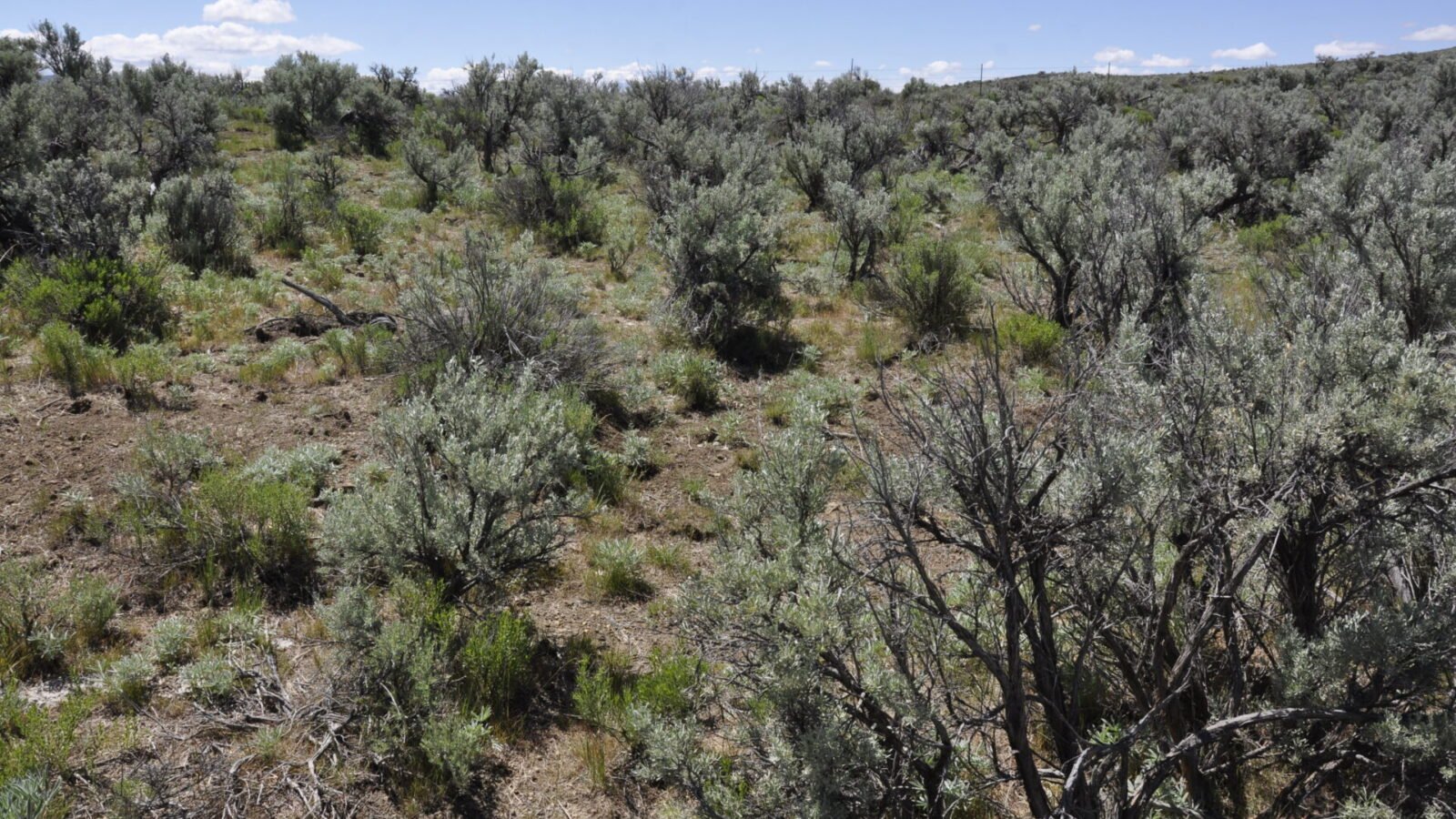
Featured photograph: actual southwestern Idaho sagebrush steppe (L. Ridenhour / U.S. Bureau of Land Management, public domain). Contextual terrain, not the proposed Rhea project site.
On a stretch of sagebrush south of Boise, a plan is taking shape that could put a four-million-square-foot data center and a natural-gas generating plant on land owned by the American public. Not a private industrial park. Federal land, administered by the Bureau of Land Management.
The applicant is Rhea Data, a subsidiary of energy developer Arevia Power. The proposed location is near Blacks Creek Reservoir and Interstate 84, not far from Meta’s recently opened Kuna data center. Local reporting and BLM statements describe a project area of roughly 3,700 acres, including associated infrastructure and rights of way. The sprawling project is not yet approved. Its size, power arrangements, water needs and final boundaries remain subject to change. The Idaho Statesman reported the preliminary specifications, while BoiseDev published BLM’s express warning that detailed design elements were unconfirmed.
The question isn’t just whether another data center can be built. It is whether a politically unpopular project becomes easier to move forward when the landlord is Washington.
A four-million-square-foot proposal, not a finished deal
BLM’s Four Rivers Field Office received the Rhea proposal in August 2025 and later requested additional information, according to the Idaho Statesman. The preliminary concept includes multiple buildings, power infrastructure and a possible natural-gas plant; KIVI reported a proposed 600-megawatt data-processing capacity. That number is a reported design estimate, not a measured operating demand or a promise of an on-site plant of the same capacity.
The scale is striking. The complex has been compared with Meta’s Kuna facility and described as more than five times as large in total building floor area. But floor area is not land area: four million square feet describes proposed buildings, while approximately 3,700 acres refers to land associated with the overall application. Neither figure means 3,700 acres are already sold, leased or cleared.
BLM officials told local outlets the application was still in early planning and anticipated an eventual Notice of Intent to initiate formal public review. They said the review would address other land uses, cultural resources, nearby recreation and the applicant’s water and cooling requirements. It is precisely this unresolved stage that makes public scrutiny important.
The executive order that opened the door
On July 23, 2025, President Donald Trump signed Executive Order 14318, ‘Accelerating Federal Permitting of Data Center Infrastructure.’ It instructs agencies to facilitate large AI facilities and supporting energy projects, speed eligible reviews and make appropriate federal sites available for authorization. Section 9 directs Interior and Energy to offer site authorizations consistent with existing law.
The administration’s case is straightforward: America needs vast computing and electricity infrastructure to compete in AI, and slow permitting can delay investment, jobs and technological capacity. The White House explicitly made that economic and national-security argument. The order also encourages consideration of brownfields and previously contaminated sites. Those are real policy reasons to examine, not proof that any particular undeveloped parcel is appropriate.
But the executive order is not a blanket waiver of environmental law, and it does not automatically transfer public property to a developer. Federal agencies must still operate within statutory requirements. BLM’s published right-of-way guidance explains that substantial construction requires authorization and review for conflicts with land-management plans and existing rights.
The number is now much bigger than 17,600 acres
The source video cites roughly 17,000 acres identified across six Western states. That reflected earlier reporting: The Washington Sun reported 12 proposed sites and infrastructure projects covering 17,600 acres in September. But a subsequent investigation expanded the picture.
On October 20, 2026, conservation group Center for Western Priorities published a tracker assembled from BLM’s Mineral & Land Records System. It identified 35 data-center-related applications or cases covering more than 24,000 acres in Arizona, Idaho, Nevada, Oregon, Utah and Wyoming. At least 17 appeared to concern campuses and another 13 related infrastructure, although some records may describe parts of the same development. Reuters independently reported the group’s findings.
Crucial qualifier: these are applications and recorded cases, not 24,000 acres already awarded. The tracker is maintained by an advocacy organization, not an official BLM approval tally. Its methodology is public, but unclear project labels and missing acreage mean the count is an estimate rather than a complete federal inventory.
What residents fear: water, power bills and a closed door
The site lies in a landscape used for recreation, grazing and wildlife habitat. Black’s Creek Reservoir, shooting access, sagebrush ecosystems and the wider area’s bird life are among the concerns local reporting has documented. The proposed plant could also bring air emissions and new fuel and transmission infrastructure. An environmental study needs to identify the actual effects rather than treating every potential effect as a certainty.
Water use is another unanswered question. Data centers use different cooling systems, with dramatically different withdrawal and consumption profiles. BLM told the Idaho Statesman it still needed specifics about Rhea’s cooling and water demand. Without those details, asserting an exact water footprint would be guesswork.
Residents in the supplied video worry that electricity bills could rise so a private venture can prosper. That is a legitimate question to put to utilities and regulators, but a bill increase attributable to this project has not been established. The answer depends on the final load, how much energy is self-generated, whether grid upgrades are necessary, who finances them and what agreements regulators approve. The developer should be asked to publish those numbers before decision-makers commit public resources.
Boise Mayor Lauren McLean has criticized putting such a large project on public land without stronger rules, while the Idaho Sierra Club has raised objections to the site. Local television reporting recorded both positions. They are evidence of public opposition, not a legal veto.
Can a federal permit bypass local communities? Nevada provides a warning
In the source video, speakers say developers can bypass cities, counties and the public by turning to federally owned land. There is an important truth beneath that fear: the federal government, rather than a city planning commission, may be the key land-use decision-maker. But describing the process as legally exempt from all public review would be wrong.
Nevada has already supplied a sharp test. BLM approved the Townsite Data Center near Boulder City after relying on earlier environmental analysis for a different, solar project. The city and conservation groups challenged that decision. In October 2026, the Interior Board of Land Appeals set the approval aside and sent the proposal back for further examination. Nevada Current documented the reversal; BLM’s project record identifies the authorization at issue.
That case does not predetermine Idaho’s outcome. It does demonstrate why environmental analysis, local consultation and the right to challenge federal decisions are more than bureaucratic decorations.
An election issue that outlives Election Day
In the video, 2026 independent Senate candidate Todd Achilles objects to private control of public acreage without local scrutiny. His opponent, incumbent Republican Jim Risch, is described by the video’s producers as not responding to their request for comment. That statement describes the producers’ outreach, not every position Risch has taken on land policy. Boise State Public Radio separately interviewed Achilles about public-land protections in the run-up to the November 3 election.
There is a larger issue than any candidate: Who receives the economic upside of federal land use, and which costs remain with the communities around it? Proponents can argue that AI infrastructure brings jobs, tax receipts and new energy investment. Critics can reasonably demand proof of those benefits alongside enforceable guarantees concerning habitat, public access, utility costs and transparency.
A proper hearing should begin with the underlying application and a plain-language accounting: land acreage, legal authorization, construction schedule, power-generation capacity, grid interconnection, cost allocation, cooling-water source, air emissions, wildlife impacts, Tribal consultation and opportunities for public comment. Apep Bar’s recent investigation of shifting data-center campaign promises makes the same point from another direction: the real test comes after the applause for a shiny new facility.
Public land is not free land. The unresolved question is whether taxpayers get a transparent, enforceable deal before a private data center gets access to it.
Watch: Field report from Idaho
The following More Perfect Union video, shared with Apep Bar, contains interviews and views of the area described by the producers. It is reporting about a proposal; it is not footage of an operating Rhea data center. Claims in the video are evaluated against independent documents and reporting above.
More Perfect Union field report about the Idaho proposal; footage does not show an operating Rhea data center.