A salt-loving microorganism spent 160 days in a laboratory environment built to imitate a hypothetical refuge beneath Mars. Instead of merely hanging on, it grew.
That is the finding of a peer-reviewed study published November 5, 2026, in Applied and Environmental Microbiology. Researchers led by Adam Robinson, with Scott M. Perl and colleagues, cultivated Haloferax volcanii at extremely low pressure in highly salty, oxygen-free liquid containing chemicals relevant to Mars. They recorded evidence of active metabolism and increased biomass over 160 days. The result is not proof of Martian life. It does make the search for possible life beneath the Red Planet’s surface a little harder to dismiss.
There is a twist: one of the chemicals that helped the microbe grow was perchlorate—a compound that can be hazardous to many forms of life and that spacecraft have detected in Martian soil. An apparent poison, under the right circumstances, became part of the organism’s energy-producing chemistry. The conditions, however, were deliberately more comfortable than much of real Mars.

The organism is not a Martian—and not even a bacterium
Haloferax volcanii is an archaeon, a member of a major domain of cellular life distinct from bacteria. On Earth, it thrives in extremely salty settings. In this experiment, its ability to tolerate brine made it a useful stand-in for testing a question scientists cannot yet answer on Mars itself: could any kind of microbe reproduce in a protected, salty underground niche?
The research does not show that this Earth species exists on Mars. Nor does it prove that a native Martian organism would use the same biochemical machinery. It tests the physical and biological plausibility of life under a particular set of conditions.
What the researchers actually built
For five months, researchers kept microbial cultures in a carbon-dioxide-rich, oxygen-free chamber at 24 millibars of pressure—a small fraction of normal Earth sea-level pressure. The growth medium contained approximately 225 grams of sodium chloride per liter, about seven times saltier than typical seawater, along with laboratory-supplied organic nutrients. The cultures were held at about 21°C (70°F).
Each growth treatment was supplied with nitrate or perchlorate, substances the organisms could use as alternative electron acceptors during oxygen-free respiration. In other words, the researchers did not merely sprinkle a toxin into a dish and watch nature perform a miracle: they supplied a carefully balanced chemical environment in which a specialized organism could metabolize without oxygen.
In the low-pressure treatments, optical-density measurements increased significantly when nitrate or perchlorate was provided. Those chemicals also declined in concentration, whereas comparable cell-free controls did not show significant chemical loss. Cultures lacking the added alternative electron acceptors remained viable but showed no comparable significant growth.
That combination—an increase in culture density and consumption of electron acceptors—is strong evidence of metabolism-associated growth. The paper also acknowledges that direct cell counts and additional biomass measurements would further strengthen future experiments. Growth at Mars-like pressure was substantially slower than in the Earth-pressure controls.
The sticky surprise: biofilms and preserved water
Microscopy uncovered another intriguing response. Under low pressure, the growing archaea formed dense aggregates embedded in biofilm-like material. Such structures can protect microorganisms in hostile environments. They may also have helped the culture retain moisture, although the researchers do not claim they proved the exact mechanism.
After 160 days, the experimental liquids had lost less than 4% of their water. The combination of high salinity and potentially protective microbial films helps explain how these particular laboratory brines remained liquid under reduced pressure. The researchers also detected pigments known as carotenoids using Raman spectroscopy. Those molecular signatures can matter to future life-detection instruments, although the signals changed under different chemical treatments.
The authors’ actual scanning electron micrographs, including a 12,000× view of cells embedded in biofilm, appear as Figures 5 and 6 of the open-access study. These are images of Earth organisms in a laboratory experiment—not samples collected on Mars.
Why scientists are looking under Mars rather than across its surface
NASA’s Phoenix lander discovered perchlorate in Martian soil, and other missions have detected related chemical evidence. Perchlorate can lower water’s freezing point, which makes salty liquid-water scenarios scientifically interesting even on a cold planet. That does not establish that habitable underground pools exist today.
The exposed Martian surface remains especially hostile to organisms known on Earth. Its intense ultraviolet radiation, dryness, oxidizing chemistry and very low pressure create challenges that this experiment did not combine. Previous research has shown that perchlorates exposed to simulated Martian ultraviolet light can become particularly damaging to microbes, making a radiation-shielded niche a very different proposition from an open landscape.
For that reason, the study considers a hypothetical shallow subsurface microenvironment, not the whole planet. Its 24-millibar pressure was chosen to investigate conditions that could occur in protected salt-mineral pockets. Researchers have not identified the exact long-lived liquid-water pockets this experiment imitates.
The four catches that should survive the headline
- It was warm. At 21°C, the cultures were warmer than most of Mars’ present shallow subsurface. Repeated freezing and thawing were not tested.
- It was fed. The researchers supplied nutrient-rich media, not the sparse and uncertain supply of accessible organic compounds on present-day Mars.
- It was shielded. The experiment did not impose the full combined effects of real Martian surface radiation, dust chemistry, temperature swings and water scarcity.
- It was Earth life. One well-studied archaeon growing in a simulated niche cannot establish the existence, origin or likelihood of living Martian organisms.
These are not fatal flaws. They are the boundary conditions of an experiment designed to isolate a specific scientific question. The next work proposed by the authors includes freeze–thaw cycles, more Mars-relevant nutrients and regolith simulants.
A finding that also complicates planetary protection
There is a second implication, almost as fascinating as the possibility of extraterrestrial biology. If some Earth microorganisms can grow in certain simulated Martian refuges, future spacecraft and human explorers must take contamination seriously. We might someday have to distinguish native life from biology that arrived on our own hardware.
Apep Bar has previously examined debates over how life began on Earth and new missions designed to study the Martian environment. This study belongs to the same larger mystery, but it answers a narrower question: can cellular metabolism continue when multiple Mars-relevant stresses act together? For this particular organism and lab setup, the answer was yes.
That is not a Martian discovery. It is an expansion of the list of places where it may be worth looking.
So the unanswered question is not whether the experiment created a tiny Martian. It is whether Mars still conceals a natural refuge anywhere close enough to the lab’s conditions for biology to take hold.
Sources and image note
- Robinson A. et al., Cultivation of halophilic archaea in shallow subsurface Martian conditions has implications for extant life on Mars, Applied and Environmental Microbiology, November 5, 2026. Full study (open access; CC BY 4.0).
- University of Florida, interview and research announcement, November 2026.
- NASA Phoenix mission: subsurface ice and perchlorate findings.
- Perchlorates on Mars enhance the bactericidal effects of UV light, Scientific Reports, 2017.
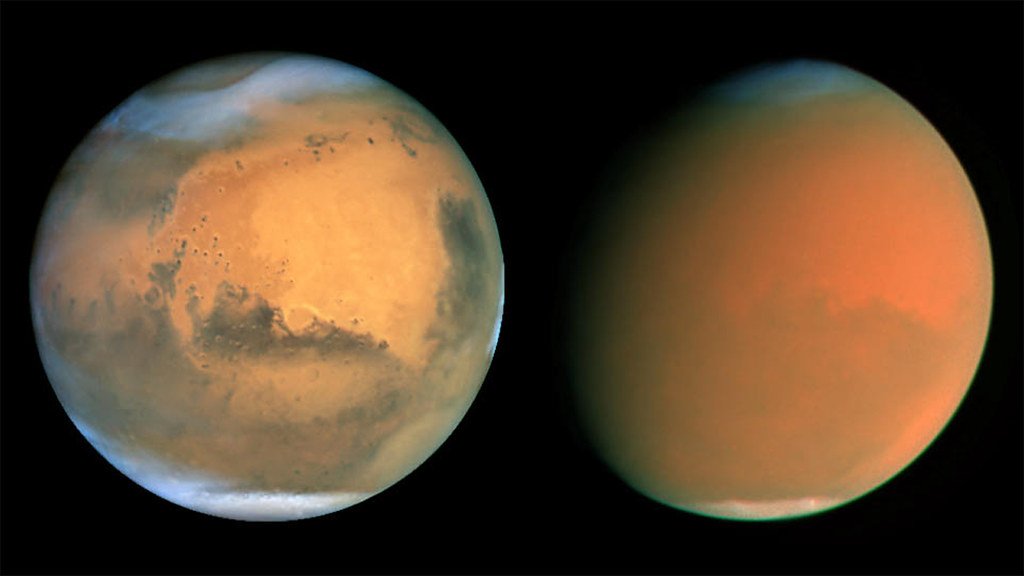
Featured-image context: The genuine telescopic view of Mars is credited to NASA Hubble, “Mars Before and During Global Dust Storm,” licensed under CC BY 2.0. It depicts Mars, not the study’s experimental cultures. Actual experimental electron micrographs are linked above in the primary paper.