A car built around one missing wheel became a British institution. Then television convinced the world it could barely stay upright. The Reliant Robin’s real story is more interesting: a practical little car helped generations of motorists reduce the cost of getting around, while an unusual legal classification, fibreglass bodywork and a stubbornly enduring reputation turned it into one of Britain’s best-known automotive oddities.
And two details often go wrong in the retelling. The Robin did not mean owners paid no road tax. And the blue three-wheeler terrorized by Mr. Bean was not a Robin.
A delivery van born before the Robin
Reliant’s three-wheel idea began long before its best-known model. According to the Reliant Motor Club’s historical archive, former Raleigh employee T. L. Williams and E. S. Thompson built an early Reliant three-wheeled delivery van in Tamworth, England, in the 1930s. The first vehicle was licensed on 1 January 1935; a passenger car, the Reliant Regal, arrived in 1952.
The formula evolved. By the 1960s, Reliant was pairing reinforced fibreglass bodywork with a steel chassis and small engines. This was no disguised motorcycle with doors attached. It was a genuinely car-like machine, tailored to a niche other manufacturers largely ignored.
Why three wheels made financial sense
When the Robin appeared in 1973, its appeal wasn’t just eccentricity. Being light, small and comparatively economical to run mattered to households watching every pound. The three-wheel format also put qualifying vehicles in a different British vehicle-excise-duty classification from conventional cars, offering a tax advantage; some owners also benefited from the motorcycle-licence rules then in force.
But describing it as a way to avoid car tax entirely misses the point. The advantage was generally a lower tax category, not tax-free motoring. Britain still lists a separate vehicle-tax class for qualifying motor tricycles, though today’s rates and licence entitlements should not be projected backward onto a 1973 purchaser. Licensing categories have changed repeatedly, and cheaper insurance was never guaranteed for every driver.
The price was compelling in its own right. Classics World reports that an early basic Robin cost £801, with the better-appointed Super version costing £48 more. Designed by Tom Karen of Ogle Design, the original Robin launched with a 750cc engine; a larger 850cc unit followed in 1975. It was available in saloon and estate forms and offered enclosed, weatherproof transport without the expenses associated with many full-sized cars.
Did the Robin really fall over at every corner?
Here is the engineering compromise: the Robin had one wheel at the front and two at the rear. The triangular wheel layout affects how lateral loads behave in a turn, so its handling cannot simply be treated as identical to that of a conventional four-wheel car. But that is a long way from saying an ordinary Robin inevitably tips over at every roundabout.
Top Gear made the myth unforgettable when Jeremy Clarkson repeatedly rolled a Robin on camera. Years later, Clarkson acknowledged that the team had altered the vehicle to encourage those tumbles. The stunt remains funny. It is not a controlled safety test of a standard, unmodified Robin.
That distinction matters. A three-wheel layout has real handling trade-offs, but a modified car tipped repeatedly for entertainment tells us little about how a carefully driven production example performs in ordinary use. The TV segment helped create the reputation it appeared to document.
The Mr. Bean mix-up
The Robin also gets blamed for an entirely different three-wheeler’s television misfortunes. Mr. Bean’s familiar pale-blue victim, repeatedly shoved out of the way by his Mini, was a Reliant Regal Supervan III—a predecessor from the Regal family, not a Robin. Likewise, the yellow van from Only Fools and Horses was a Regal Supervan. The two vehicles look similar enough that the Robin name became shorthand for almost any old Reliant three-wheeler. A history of three-wheelers on screen details the persistent confusion.
Two cultural jokes, one famously misidentified car, and a mountain of memes: that is quite a lot for a cheap runabout to carry.
A remarkably long second life
The original Robin ran from 1973 to 1981, when the Rialto replaced it. But the Robin name returned in 1989. Reliant developed a new-look Mk3 in 1999, with its own production ending in February 2001. B&N Plastics then produced a licensed successor, the Robin BN-1, before that attempt stopped in 2002. These dates come from the Reliant Motor Club’s chronology; calling 2002 the end of the original manufacturer’s production would be misleading.
The car survived because it offered something real: economical, enclosed transport for owners willing to accept an unusual design. A television joke can last forever, but it cannot explain decades of buyers on its own.
So which is the stranger part of the Robin’s legacy—that Britain made a three-wheeled car into an everyday transport solution, or that its biggest cultural claims to fame came from a modified stunt car and a completely different model?
Watch the Robin—and the legend
Video: BBC Studios / Top Gear: “Rolling a Reliant Robin” (2010 television comedy segment featuring a modified Robin; not a representative stability test). The short explainer supplied with this story offers a quick overview of the car’s appeal.

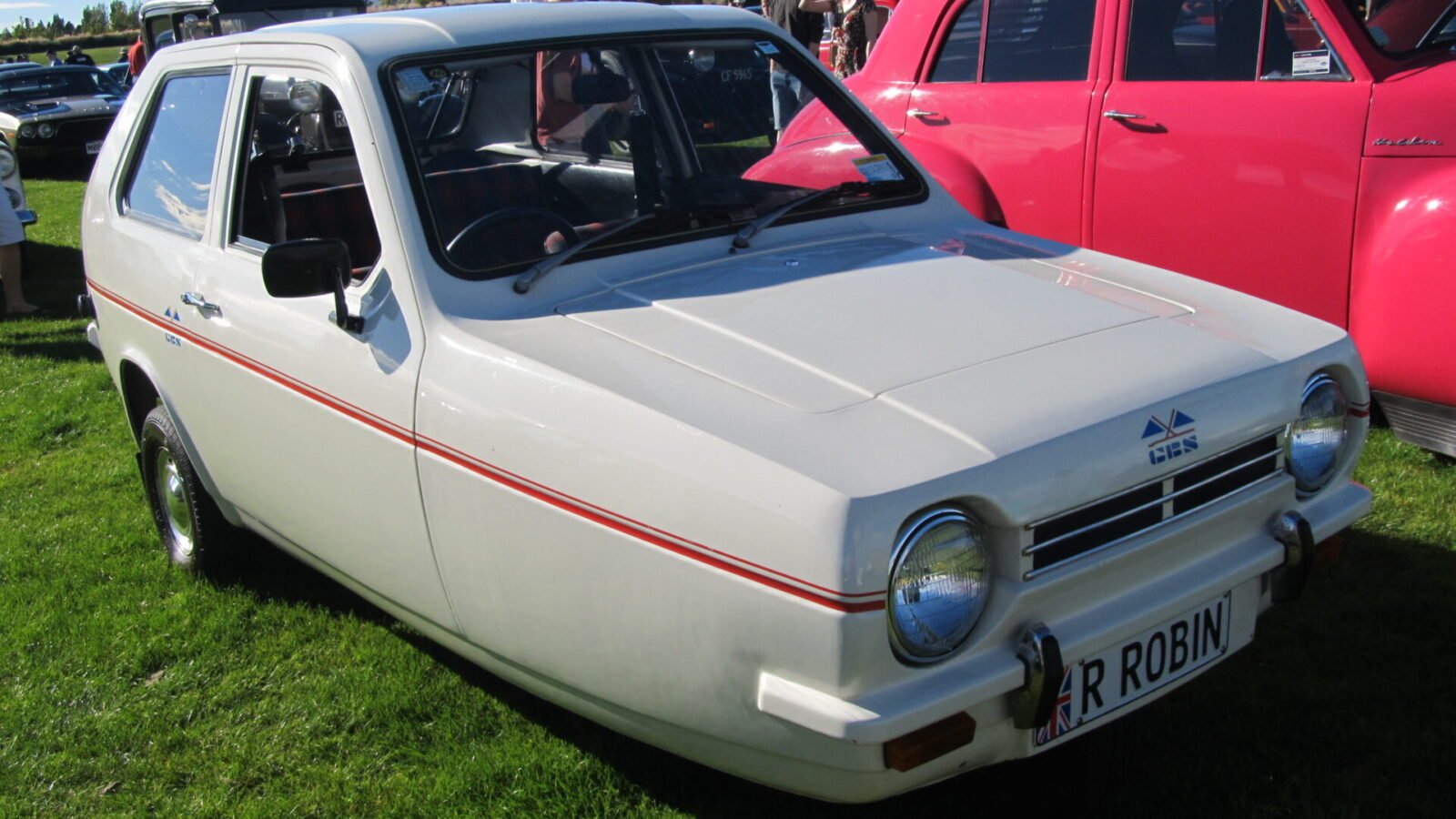
Featured photograph: A real 1978 Reliant Robin Super “GB Special,” photographed by Riley (NZ Car Freak) in New Zealand; original image and credit, CC BY 2.0. The photograph documents the model; it is not from the television stunts.