INVESTIGATION & ANALYSIS | November 10, 2026
Two customers describe strange Amazon order cancellations involving powerful NVIDIA hardware. One calls it a “watch list.” The available records tell a more complicated—and still troubling—story about the future of independent computing.
There is a peculiar kind of freedom in a machine that sits on your desk. You buy it, you turn it on, and you can run software without first asking a remote service to approve your request. That promise is central to the appeal of local artificial intelligence. It is also the reason a series of canceled Amazon orders is attracting attention far beyond the small market for expensive desktop AI systems.
On November 1, AI creator Nick Saraev reported that Amazon canceled four orders for NVIDIA DGX Spark computers and then closed his customer account. Screenshots reviewed by Tom’s Hardware showed a total of seven units across the orders. The reporting described an Amazon email referring to previous account-verification attempts but giving no specific reason for the closure.
A second technology heavyweight reported an unnerving experience of his own. Tim Sweeney, the chief executive of Epic Games, said Amazon continued accepting ordinary orders but canceled them before delivery after he attempted to purchase two NVIDIA GPUs. Crucially, Sweeney said his account was not closed. The cases have similarities, but they are not identical.
The viral conclusion is much more dramatic: people who try to buy substantial AI computing power are being added to a secret list. That allegation has not been established. Amazon has not publicly supplied a detailed explanation for these particular cases in the reporting reviewed for this article, and there is no documented evidence linking the two customers to a government or corporate hardware “watch list.”
What happened to Nick Saraev?
Saraev’s initial public complaint said he was four orders into an attempt to buy DGX Sparks and Amazon would not let him complete the purchases. A later November 1 post said the account itself had been closed. The screenshots reproduced in the technical press reportedly show canceled orders and a notice that the buyer had not been charged. His account-closure email referred to verification, without identifying the underlying concern. These are claims supported by the displayed correspondence and reporting, not an independently audited history of Amazon’s internal systems.
The distinction between four orders and seven computers matters. Four separate orders were placed, but the images indicated multiple units in some orders. This was not the same as a shopper attempting to buy one graphics card. With Tom’s Hardware reporting a DGX Spark list price of approximately $6,950—and higher marketplace listings—seven units would represent a high-value transaction. Large or repeated purchases might attract an automated fraud, payment or resale review even if the purchaser had a legitimate purpose. That is one plausible explanation, not a verified finding about Saraev.
None of this makes an unexplained account closure harmless. A retailer that can cancel purchases and close an account without a useful explanation creates a real transparency problem, especially when customers depend on the same account for unrelated orders and services. But an unexplained decision is not, by itself, proof of a deliberate effort to suppress individual computing power.
Tim Sweeney says his regular Amazon orders were canceled too
Sweeney’s account adds weight to the question of whether expensive NVIDIA purchases may trigger unusual retail scrutiny, but it does not prove that both customers encountered the same mechanism. According to his statement reported by Tom’s Hardware on November 3, Amazon accepted his normal orders before canceling them near their expected arrival dates following an attempt to buy two NVIDIA GPUs.
We do not have Amazon’s internal risk assessment, a formal policy notice identifying these buyers as restricted, or verified evidence that the company is refusing all purchases of such equipment. Indeed, DGX Spark units were still listed for sale, according to the same report. A widespread hardware ban and several alarming customer-support failures are very different stories. The evidence currently supports the latter possibility much more directly than the former allegation.
Why the DGX Spark matters: AI that runs at home
Unlike an ordinary desktop PC, NVIDIA’s DGX Spark is designed for demanding local AI work. NVIDIA lists its Grace Blackwell GB10 platform, up to 128 GB of unified memory, a 20-core Arm CPU and up to one petaFLOP of FP4 AI compute under specified precision assumptions. Its hardware guide describes running and adapting large models without relying entirely on a distant server.
That matters for privacy, resilience and bargaining power. A local system can keep some sensitive data and processing on equipment the owner controls. It can make experiments possible without recurring per-request cloud charges, though electricity, maintenance, software and the substantial purchase price remain real costs. Cloud services can still be cheaper or more capable for particular workloads, and running a model locally does not automatically make its software secure or private.
The two models of computing can coexist. The tension begins when the available hardware, its price, the software ecosystem and the retail channels that supply it are concentrated in a handful of companies.
What Sam Altman actually said about your PC’s memory
Just days before the Amazon complaints, OpenAI CEO Sam Altman made remarks about DRAM allocation on Cheeky Pint, the October 29 interview with John Collison. His argument was that in a supply-constrained world, memory used only a small fraction of the time in personal computers might achieve higher overall utilization in busy data centers. Tom’s Hardware covered his remarks on October 30.
It is fair to challenge the assumption that maximum hardware utilization is the only measure of public benefit. Private ownership, offline availability, convenience and the ability to experiment without a cloud subscription have value too. It is not accurate, however, to report that Altman formally proposed outlawing home computers or banning private RAM ownership. He did neither in the cited interview.
Nor did the argument end with the viral clip. On November 4, Altman publicly pushed back on that interpretation and said he wanted people to have as much memory in their own PCs as they wished. The Verge reported his response. His clarification does not resolve the conflict over who can afford scarce memory, but omitting it would distort the record.
Apep Bar previously examined RAM shortages, graphics-chip competition and who controls your PC. The Amazon reports bring the ownership question down from the level of industry speeches to a simpler practical test: can a customer actually obtain and keep control of the machine they want to buy?
Is there an AI-compute “watch list”?
There is no public evidence in these cases of a list targeting people because they wish to run AI locally. Saraev used the term in a social-media post; it is his inference, not an established fact. Other explanations—automated transaction-risk screening, unusual ordering patterns, identity verification, anti-scalping rules or concerns about resale and export compliance—are conceivable. Without records from Amazon, none can be confirmed as the reason in his case.
The distinction is especially important because advanced semiconductor products do exist within a broader regulatory and commercial environment. Export controls and retailer fraud-prevention systems are real; that does not show that a specific U.S. customer was blocked for political, surveillance or competitive reasons. It would be an error to turn a general possibility into a factual allegation.
The journalism question is not whether a dramatic theory can be imagined. It is what evidence would test it: the precise account-closure reason, the transaction-review criteria, any applicable restrictions, data about comparable purchases, and the outcome of appeals.
Orwell, ownership and the question nobody answered
“Nothing was your own except the few cubic centimetres inside your skull.” — George Orwell, Nineteen Eighty-Four
Orwell’s line works here as a literary warning about power, not as documentary evidence that Amazon is running a political surveillance program. The point is sharper without overclaiming: the more daily life depends on accounts, licenses and remote approval, the more consequential an opaque denial becomes.
Meanwhile, the AI infrastructure buildout is creating a separate fight over land, electricity and who benefits from centralized capacity—an issue Apep Bar explored in its reporting on European data-center protests. Consumer access and community infrastructure are two sides of a larger debate about who gets to decide where computing power lives.
For now, the verified story is limited but important: a buyer says seven desktop AI units were canceled and his account closed, while another prominent buyer reports disruptions after attempting to order GPUs. The reasons remain unexplained in public. No proven watch list. No proven coordinated plan to abolish local AI. But also no satisfying public accounting of what happened.
The unanswered question: When retailers have the practical power to decide who gets advanced computing hardware, what explanations and appeal rights should buyers be entitled to?
Watch the source material
Viral commentary, not independent proof: “Amazon Restricting Access to AI Compute Hardware” (YouTube Short). The clip recounts Saraev’s and Sweeney’s claims and makes a broader interpretation that has not been verified.
Primary interview: Cheeky Pint’s full Sam Altman interview, October 29, 2026. The relevant discussion of compute begins at approximately 25 minutes; the widely circulated memory comment is around 29 minutes.
Sources and documentation
- Tom’s Hardware, November 3, 2026: order screenshots, reported email, Sweeney’s response and Amazon’s lack of an explanation.
- NVIDIA: DGX Spark official product specifications; NVIDIA documentation.
- Cheeky Pint, October 29, 2026: complete Sam Altman interview.
- The Verge, November 4, 2026: Altman’s clarification on PC memory.
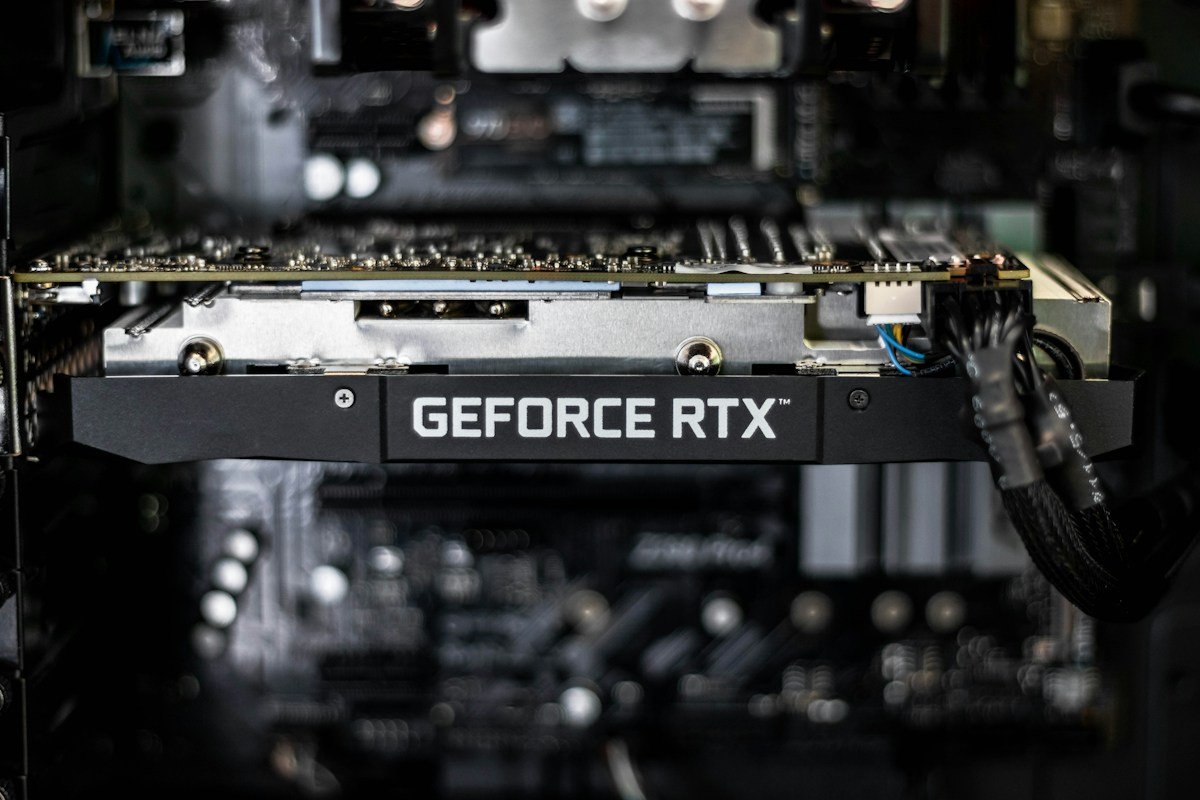
Featured photograph: Real NVIDIA GeForce RTX 2060 graphics card photographed by Christian Wiediger / Unsplash; used under the Unsplash License. Original photo. Contextual hardware photo only: it is not a DGX Spark or a photograph of the disputed Amazon orders.