NEWS ANALYSIS | November 6, 2026
Imagine spending nine years maintaining free software, gathering hundreds of supporters, and resolving dozens of bugs. Then imagine being told your project no longer belongs in a community devoted to open-source software—because you built it alone.
That is one of the contradictions exposed by new rules announced on October 24, 2026, in Reddit’s r/opensource forum. The headline controversy is a sweeping prohibition on projects made with, powered by, or intended for artificial intelligence. But the smaller print reaches much further: new projects, solo maintainers, applicants seeking collaborators, and people who need translation may also be turned away.
The essential distinction: this is a moderation decision governing one subreddit. It is not a ban on open-source code, a policy of Reddit as a whole, or a change to software licenses recognized by the Open Source Initiative. Nonetheless, it raises a provocative question about what happens when a community devoted to openness starts tightening the gate.
What the moderators actually announced
In a Reddit post titled “Your tokens aren’t valuable: No more AI”, moderator u/Wolvereness said AI was incompatible with the particular community and introduced conditions for projects promoted there. The announcement laid out these tests:
- AI involvement: projects that use AI, were built using AI, or are intended for AI are disallowed, with AI-oriented Model Context Protocol (MCP) servers cited as an example.
- Project maturity: promoted projects should have been actively maintained for at least one year, not merely created a year earlier.
- Contributors: they should have multiple contributors—described as “subjectively 3+”—and an existing community.
- Project type: common student-style projects, including basic note-taking apps and PDF viewers, are excluded; the forum will no longer field ordinary requests for maintainers or contributors.
- Accounts and language: posters are expected to have Reddit accounts at least a year old with meaningful prior activity. The announcement told people who do not speak English to find another community because moderators said they could not distinguish AI-written text from AI-translated submissions.
Projects still need a qualifying open-source license. Incorporated nonprofit organizations may obtain advance approval for exemptions from the project and account minimums. The policy also threatens permanent bans in some circumstances, including unwanted large-language-model output and certain attempts to appeal after posting.
There is a legitimate problem behind the reaction. A forum flooded with effortless automated project advertisements, unreviewed code and repetitive pitches can become much less useful to actual developers. Moderator time is finite. But these rules go beyond filtering demonstrably poor-quality submissions: they impose tests of age, team size and language that have no necessary connection to the reliability of the code itself.
The nine-year project that fails the new test
One commenter in the original discussion described a project maintained for nine years with more than 300 GitHub stars and dozens of resolved issues, yet only one contributor. Another described a three-year solo project with roughly 1,000 stars. These are the developers’ own accounts, not independently audited project metrics, but they illustrate an obvious edge case.
The new conditions create a circular problem. To introduce your project to the subreddit, you should already have collaborators and a community. Yet finding those collaborators and building that community is precisely why an independent developer might want to post there. A year-old solo utility can be useful; a rushed project with several contributors can still be dangerous. Neither a birthday nor a contributor count is a security review.
When a commenter suggested easing the contributor requirement, Wolvereness said an adjustment might be reasonable after seeing how the rules worked. Another moderator, u/ssddanbrown, said they had not been consulted and publicly objected to the language restriction, according to The Next Web’s reporting and linked discussion.
How can anyone prove software never touched AI?
A second controversy is enforcement. A developer might use an AI assistant to generate an entire application without understanding it. Another might write a mature project by hand and use a language model to suggest tests or check one suspicious function. Under a literal reading, both can fall under the same AI-related prohibition.
Asked about the distinction, Wolvereness acknowledged in a Reddit reply that there was no objective way to implement the policy and argued that moderators needed discretion to remove spam. That admission makes the issue less about a precise technical standard than about the judgments of the people enforcing it.
The Linux kernel is a revealing comparison. Its official guidance for AI coding assistants contemplates AI-assisted work while requiring human responsibility for contributions, license compliance and verification. The moderator clarified that Linux would pass the maturity requirements and, under a subjective reading, would be allowed. Claims that r/opensource actually banned Linux are therefore not supported by the moderator’s stated position.
That leaves an asymmetry: an established giant may be given the benefit of nuance, while a smaller developer has no such assurance.
The language rule makes the contradiction harder to ignore
Some of the strongest criticism focused not on AI-generated code but on language. The announcement reasoned that moderators could not reliably distinguish writing generated by AI from writing translated with AI and therefore told non-English speakers to go elsewhere.
Software development is international, and translated documentation and discussion can help people contribute across borders. A rule against low-effort machine-written promotions is one thing; excluding someone who relies on translation to communicate is another. Critics argue that the policy transfers the burden of identifying spam to people who may already face language barriers.
This is also not a rule about what legally qualifies as open source. The Open Source Initiative’s definition addresses freedoms to use, modify and redistribute software and expressly rejects discrimination against persons or fields of endeavor in software licensing. It does not require Reddit communities to accept every post. The point is philosophical rather than a claim that moderators broke an open-source licensing rule.
Reddit’s rebellion—and the deeper AI dilemma
The backlash prompted the appearance of alternatives including r/TrueOpenSource and r/OpenSourceAIAllowed. The original moderator’s post later linked to rival forums as places for people affected by the new policy to go. Both The Verge and The Register documented the argument in late October.
Neither camp has a monopoly on a reasonable concern. Contributors can be exhausted by untested, machine-produced patches that leave humans with all the work of finding the defects. Equally, tools for code analysis, accessibility and translation may make participation possible for people who would otherwise be excluded. A blanket rule can reduce moderation workload while also discarding projects worth discussing.
A more discriminating alternative would judge the submission: require a clear license, a reproducible build, basic testing, disclosed AI assistance, evidence of maintainability, and a truthful description of what the author personally verified. Such tests are not foolproof, and moderators are free to choose a simpler standard. But they measure work more directly than a project’s age, the number of people attached to it or the language a developer first learned.
For ordinary users of open-source tools, the software has not stopped working, and developers have not lost the right to release it. What may be lost is one prominent avenue for discovery, feedback and collaboration. The unsettling question is whether a community can protect itself from a flood of synthetic content without also locking out the very humans it was created to support.
Watch: “Open Source Locking Down”

Primary sources and further reading
- r/opensource — moderator announcement and public replies, October 24, 2026 (primary record).
- Open Source Initiative — The Open Source Definition (primary standard).
- Linux Kernel Documentation — AI Coding Assistants (primary developer guidance).
- The Verge — reporting on the policy and backlash, October 25, 2026.
- The Next Web — moderator disagreement and enforcement discretion, October 26, 2026.
- The Register — solo developers and new project restrictions, October 26, 2026.
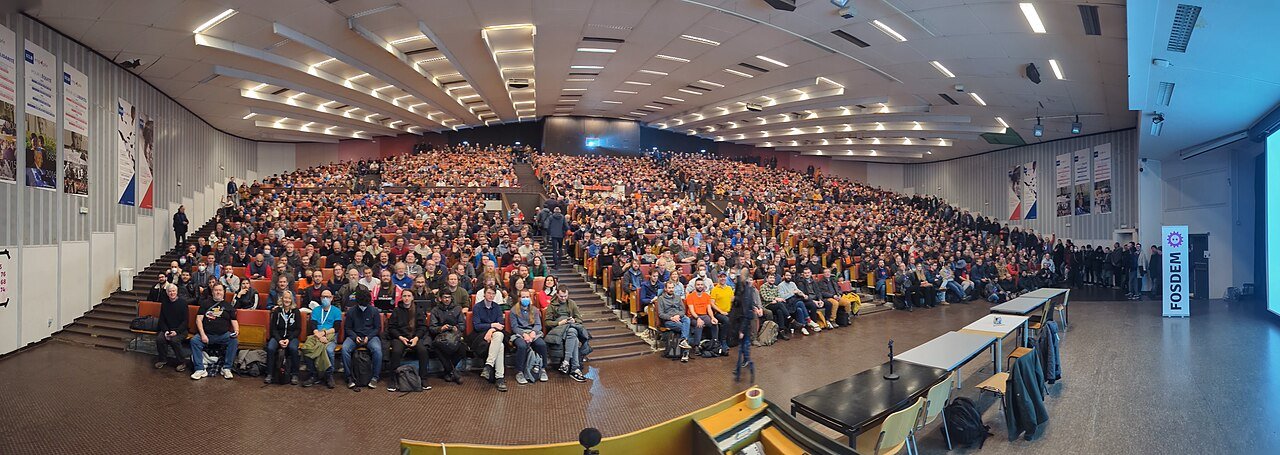
Featured photograph: Actual audience at the FOSDEM 2025 open-source software conference in Brussels, February 1, 2025. Photo by RichiH / Wikimedia Commons, CC BY-SA 4.0. Resized to 1,280 pixels wide; not a photo of the Reddit moderators or the October 2026 policy decision.
Related Apep Bar reporting: AI Code Has a Physical Bill and Proton’s AI Push Sparks Security Backlash.