One of the AI boom’s least visible costs may be hiding in the code repository. On October 28, 2026, Microsoft-owned GitHub disclosed that it had added 4 million CPU cores, 160 petabytes of high-speed storage and 50 terabits per second of network capacity so far in 2026. This is not a speculative estimate from a viral clip. Those figures appear in GitHub’s own announcement at GitHub Universe.
The company says AI coding agents are changing how fast software is produced and how often repositories are updated. But a bigger question follows: When making code becomes cheaper and faster, who pays for the computers needed to store, test, move and secure it?
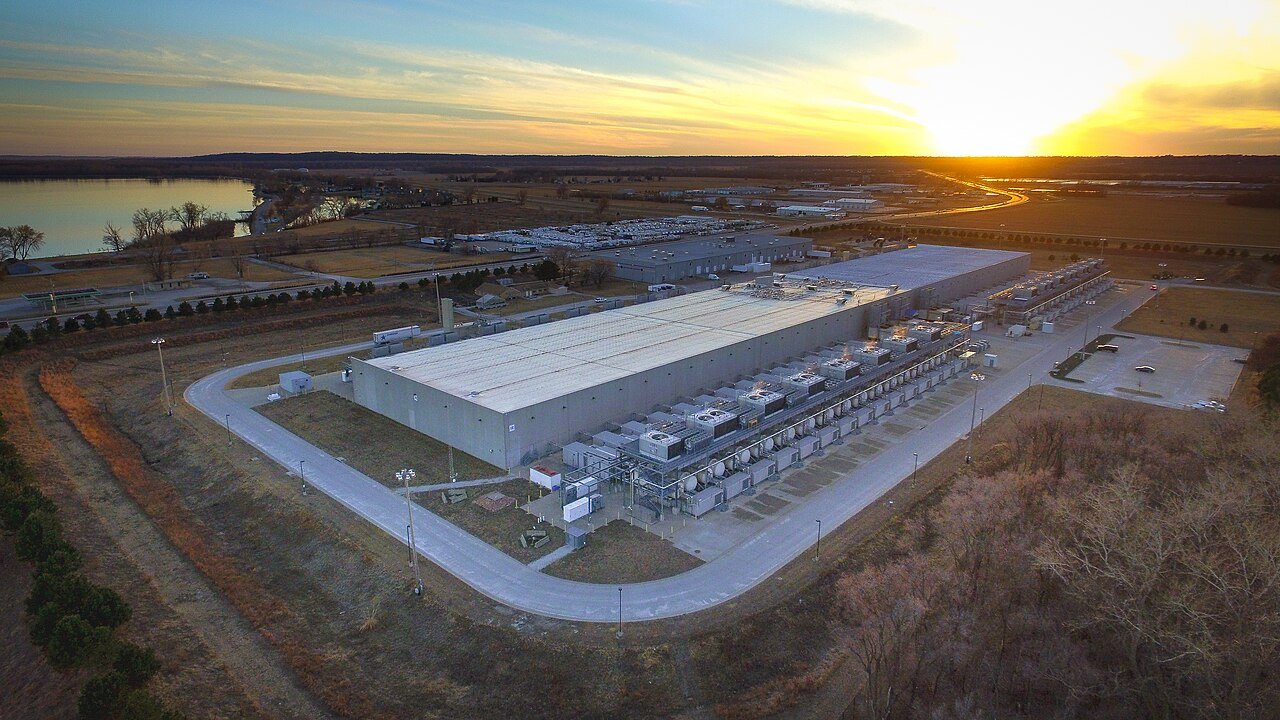
Image context: The featured image is a real aerial photograph of Google’s Council Bluffs, Iowa, data center, taken by Chad Davis. It illustrates physical computing infrastructure; it does not depict GitHub’s facilities. Credit: Chad Davis / Wikimedia Commons, CC BY 2.0. Original photograph and attribution.
First, what GitHub’s numbers actually say
According to Octoverse 2026, developers pushed code to GitHub 17.9 billion times during the 12 months ending September 30, 2026. That is more than the 5.2 billion pushes in the comparable 2024 period and 6.7 billion in 2025, combined. Some online retellings describe the 17.9 billion as activity “so far this year,” but the annual reporting window is a rolling October-to-September period. This distinction matters.
| GitHub activity | 2024 | 2025 | 2026 |
|---|---|---|---|
| Code pushes | 5.2 billion | 6.7 billion | 17.9 billion |
| Commits | 10.0 billion | 12.9 billion | 34.3 billion |
| Merged pull requests | 402 million | 538 million | 1.3 billion |
| GitHub Actions jobs | 8.0 billion | 14.0 billion | 45.4 billion |
Source: GitHub Octoverse 2026, which restated comparable prior-year figures; each period runs for 12 months ending September 30. Public and private repository activity is included in these measures.
A push sends code updates to a repository; a commit records a particular change; a pull request proposes changes for review or merging. These are not interchangeable metrics. And none measures the number of useful, correct, production-ready programs delivered.
Why AI agents change the infrastructure math
Traditional coding is limited in part by a human’s typing, testing and review time. An autonomous coding agent can work across files, make repeated changes, run tests and produce new commits while a developer supervises several tasks. It may also push updates much more frequently than a human ordinarily would.
GitHub reports that more than 40% of pull requests were started by agents by September 2026, up from 17% in March. New repositories featuring an agent configuration file averaged eight times as many commits as other newly created repositories. These are signs of a profound shift, although the latter comparison alone does not prove that an agent caused every extra commit: teams that choose agents may differ in project size, behavior and goals.
The hidden multiplier is the machinery each push can wake up. A code update can trigger automated tests, security scans, dependency checks, builds, deployments and repeated reads by other agents. GitHub’s engineering explanation of agent-scale development warns that a single push can multiply into thousands of reads. That means the load is not merely the bytes of code saved to disk; it includes the work required to inspect, process and distribute that code.
Four million cores does not mean four million new physical chips
GitHub’s headline capacity figures deserve precise language. The company reported additional CPU cores, not four million separately purchased servers or four million complete processors. The announcement does not supply a hardware inventory or a breakdown between physical and virtualized capacity. Its 160 PB figure describes high-speed storage capacity, while 50 Tb/s describes added network capacity—not a measurement of data transferred every second, nor a direct electricity-consumption figure.
These distinctions are not pedantry. They are the difference between understanding the scale of a computing platform and inventing a bill that has not been published. GitHub’s announcement does not disclose the capital spending, operating expense, water demand or electricity consumption attributable specifically to these additions. It also does not say every added core exists solely because of generative AI. Regular developer growth, reliability needs, existing service migrations and AI-agent traffic can all affect capacity planning.
Nevertheless, GitHub itself explicitly attributes a major change in the shape and volume of software development to agents. That is consequential even without a credible dollar figure.
Why buying more machines was not enough
The other surprise is architectural. GitHub is migrating toward a multi-region deployment on Microsoft Azure, while redesigning Git storage to separate its compute resources from durable storage and reduce the coordination needed for a write. Its November 5, 2026, technical account of the new architecture describes internal tests supporting 5,000 concurrent agents and 7,200 pushes per second to one repository. Those are internal test results, not a guarantee that every production repository already performs at that rate.
Put simply: storing more code is one challenge. Keeping thousands of independent software agents from stepping on one another while updating the same project is another. GitHub says its new design lets the system scale pieces independently, instead of forcing every component to work harder together.
Did AI cause GitHub’s outages? The evidence is more complicated
The source video mocks GitHub’s reliability, and GitHub has documented real failures. Its August 17, 2026, outage lasted seven hours and 47 minutes and affected its website, APIs, authentication, Actions and other services. Its August availability report recorded five incidents of degraded performance and describes ongoing capacity, migration and resilience work.
But an outage during an AI coding boom is not, by itself, proof that AI directly caused that outage. Failure modes can include networking, databases, deployments, dependencies, retry storms and migration problems. GitHub’s own incident reports identify concrete causes and repairs; those should outrank a sweeping assertion that the platform simply “cannot keep up.” The supported conclusion is more measured: escalating demand is forcing substantial changes, while the company has also had serious operational failures.
The environmental and security bill is still largely unitemized
All this extra work involves processors, drives, networking equipment, power and cooling somewhere in a physical infrastructure chain. But GitHub’s capacity announcement alone cannot tell us how much additional electricity or water was consumed. A credible environmental calculation would need measured utilization, equipment efficiency, workload location, cooling design and the electricity mix—not just a core count or total storage capacity.
There is also a less photogenic cost: oversight. More commits and pull requests mean more material to review, more software-supply-chain changes to assess and potentially more automated checks. More activity can indicate productivity, but it may also raise maintenance burdens. Neither outcome can be established from push counts alone.
These questions connect to Apep Bar’s earlier reporting on claims about AI’s wider hardware supply chain and public resistance to large data-center developments. GitHub adds another dimension: the AI infrastructure question does not end at the chatbot. It extends into the ordinary-looking repositories, tests and build systems behind every application.
What the viral clip gets right—and what it leaves out
The short video that prompted this investigation correctly relays GitHub’s three infrastructure figures and the astonishing 17.9-billion-push total. But it blurs the annual reporting window, implies a more direct explanation for all reliability problems than the evidence supports, and uses a video-game download analogy that depends on an assumed game size and idealized network throughput. A theoretical 50 Tb/s increase is not a promise of real-world download speed to any one customer.
For readers, the real revelation is stranger than the punchline: an AI agent can generate an inexpensive-seeming change on a screen, yet a chain of remote systems may then have to store it, test it, scan it, replicate it and serve it back to other agents. The code appears digital. Its consequences are stubbornly physical.
The open question: if the next wave of coding tools makes creating software nearly frictionless, will the industry finally publish transparent measures of the resources—and human review—needed to keep that software running safely?
Primary sources and further reading
- GitHub Universe 2026: Infrastructure investment announcement, October 28, 2026.
- GitHub Octoverse 2026: Activity figures and reporting definitions, October 28, 2026.
- GitHub Engineering: Building Git infrastructure for agent-scale development, October 2026.
- GitHub Engineering: Inside the new Git storage architecture, November 5, 2026.
- GitHub CTO: The August 17 outage and work ahead, August 20, 2026.
- The New Stack: GitHub’s 2026 growth and capacity investments, October 28, 2026.
- Source commentary video: GitHub infrastructure and AI code growth (YouTube Short). The video is commentary, not original footage of infrastructure additions; details were checked against GitHub’s reports.