INVESTIGATION | November 21, 2026
One alleged impostor became a director of nursing. Another treated thousands of Florida patients before receiving probation. A repeat offender crossed state lines even after admitting fraud. The question is not simply how individuals fooled employers—but how the systems intended to verify them failed.
At a Wisconsin nursing home, the person in charge of the nurses was, prosecutors allege, not a nurse at all.
Angel L. Jacobson was hired at River’s Bend Health Services in Manitowoc on December 30, 2025, and moved up through unit manager and interim director before becoming director of nursing in September 2026. A credential-screening alert finally brought the arrangement into question. By then, a paystub cited in a criminal complaint placed her gross earnings at $131,289.34.
Prosecutors say Jacobson had used the name, qualifications and registered-nurse license number of another person with a similar name. She is charged with theft by false representation over $100,000, identity theft for financial gain and practicing nursing without a license. These are allegations, not findings of guilt: the case, Manitowoc County Circuit Court 2026CF000623, remained pending as of November 21. Read the published excerpt of the November 13 criminal complaint and the court-record summary.
Wisconsin: The promotions that came before the credential check
The complaint lays out an uncomfortable progression. Jacobson allegedly used the real nurse’s educational history and credentials on her application. She later told investigators she had seen substantial pay offered for nurses and needed money. Asked how she settled on the identity, the complaint attributes to her a remarkably casual explanation: “I thought, close enough. Nobody will notice.”
According to the complaint, the promotions were dated April 18 (unit manager), July 12 (interim director of nursing) and September 6 (director of nursing). The record describes duties including nursing assessments when a resident fell or experienced a change of condition. Those are not merely administrative functions; they can affect escalation of care, physician notification and decisions made by other staff.
On September 29, a credential vendor flagged the Wisconsin RN number as inactive. Investigators say the genuine license holder had acquired a Texas multistate credential, and the Wisconsin record no longer appeared active. Follow-up checks with licensing authorities found personal identifiers that did not match Jacobson’s. She was suspended September 30 and her employment ended October 2. The complaint also says an earlier employer had rejected an attempt to move into an RN role because of a license review. The contrast is striking: one employer’s verification reportedly stopped advancement; another employer allegedly promoted her repeatedly.
Jacobson reportedly said she had emergency medical technician training and learned from nurses around her. Neither experience nor confidence, however, is equivalent to graduating from an approved nursing program, completing supervised clinical education and obtaining legal licensure. The complaint says she acknowledged lacking both an RN and LPN license. NBC 26’s local reporting independently details the facility’s response.
River’s Bend informed residents and families that its clinical review found no evidence or indication of resident harm, and that it reverified other clinical workers’ credentials. A former caregiver interviewed by NBC 26 disputed the adequacy of care for a resident, alleging neglect; that account does not establish that Jacobson caused a particular medical injury. The known facts warrant investigation without converting an allegation into a proven patient-harm finding.
Florida: An impostor helped care for 4,486 people—and received probation
In Palm Coast, Florida, Autumn Bardisa was hired by AdventHealth Palm Coast Parkway as an advanced nurse technician. Investigators say she claimed to be on the path to RN licensure and later supplied the number of a real nurse who shared her first name. She reportedly explained away the different surname by claiming she had married, but never supplied the requested marriage certificate.
That discrepancy remained unresolved until a possible promotion prompted a coworker to look more closely. The hospital terminated Bardisa in January 2025 and contacted law enforcement. The Flagler County Sheriff’s Office concluded she had participated in services involving 4,486 patients between June 2024 and January 2025 without a valid nursing license. The number refers to people involved in medical services, not 4,486 confirmed injuries.
Unlike the still-pending Wisconsin case, the Florida matter has a documented disposition. On April 7, 2026, Bardisa pleaded no contest to unlicensed health care practice and fraudulent use of identification. A judge withheld adjudication and ordered five years of probation and 50 hours of community service; the agreement also required an apology to the nurse whose number was used and forfeiture of the nursing license Bardisa had obtained after her arrest. She was barred from practicing during probation. These details come from the sheriff’s April 8 case update.
The contrast is sobering. An initial gap in identity verification persisted long enough for thousands of patient encounters; the legal outcome, after the fraud was exposed, was probation rather than imprisonment. Whether that punishment was sufficient is a matter of public debate, but the sentence and the scope of the care documented by investigators are distinct facts.
Michigan, Illinois and California: A repeat impersonator and a 75-month sentence
Leticia Gallarzo illustrates another failure mode: detection at one facility did not necessarily keep an impostor out of the workforce elsewhere.
Federal prosecutors said Gallarzo assumed a Michigan RN’s identity, made a false license and diploma, and worked at a nursing home from August 2022 to May 2023. She performed assessments, administered medications, started IVs and eventually became a unit manager. Her clinical performance drew concern, and a prospective employer discovered the false identity.
She pleaded guilty to federal offenses in 2023. Yet federal authorities said that while awaiting sentencing, she fled and once again obtained positions representing herself as a physician assistant and registered nurse in Illinois and California. Authorities ultimately located her near Los Angeles. In January 2026, a federal judge sentenced her to 75 months in prison. The Justice Department described this as her third conviction for falsely representing herself as a nurse, after earlier cases in Michigan and Texas. Prosecutors said their investigation had not found anyone physically harmed, an important limitation that does not erase the risk posed by untrained clinical decisions. Source: U.S. Attorney’s Office, Western District of Michigan.
This is more than a cautionary story about forged paperwork. A person who had already encountered the criminal justice system for nursing impersonation was reportedly able to return to clinical work across state boundaries. That raises difficult questions about cross-state alerts, how contract employers screen recruits and whether hiring processes identify a person behind a document.
Pennsylvania: Multiple aliases, staffing agencies and a search for more employers
In July 2025, Pennsylvania State Police publicly asked nursing homes, rehabilitation facilities and staffing agencies to review their records for Shannon Nicole Womack. Police alleged that she had used numerous aliases to gain employment as an LPN, RN or nursing supervisor; they also described fraudulent documents and a false company used to place herself into jobs.
Authorities initially reported at least ten known aliases, while news coverage of the broader investigation described approximately twenty aliases and seven Social Security numbers associated with her. Those figures describe investigative findings at different points, not a court verdict. Police announced charges including identity theft, forgery and endangering a care-dependent person. This report found no verified final disposition and therefore does not describe Womack as convicted. Read the Pennsylvania State Police appeal.
The use of staffing agencies adds a second layer of vulnerability. A facility may think the agency has completed identity checks, while the agency assumes the facility will catch any problem. A person who frequently changes facilities can leave before discrepancies trigger an inquiry. The lesson is not that contract nurses are suspect; it is that every organization handing off credentialing responsibility needs a documented answer about who actually performed it.
Tennessee and Arkansas: Prosecutors allege more than 30 health care jobs
Federal prosecutors in June 2026 charged Heather May Wilbanks Greene of Arkansas with two counts of identity theft and one count of wire fraud. They alleged that she used the license numbers of two real nurses from September 2020 through October 2023, never finished nursing school and never passed the NCLEX-RN, yet obtained employment at more than 30 facilities including nursing homes and correctional institutions in Tennessee and Arkansas.
The Justice Department alleged that she administered medication, evaluated patients and accessed confidential medical data, receiving roughly $200,000 in compensation. The claims are from an indictment; they are not established facts or a conviction. Prosecutors said the charged offenses carried potential federal penalties of up to 20 years in prison if convicted. Source: U.S. Attorney’s Office, Western District of Tennessee, June 23, 2026.
Thirty-plus positions, if proven, would represent dozens of opportunities to discover a mismatch. It would also mean patients and their records moved through a web of employers with no obvious single party responsible for seeing the whole pattern.
Operation Nightingale: When the degree itself is for sale
Identity theft is one route into a nursing job. Another is a fraudulent educational history attached to the applicant’s own name.
In January 2023, federal investigators announced Operation Nightingale, a scheme involving more than 7,600 fraudulent nursing diplomas and transcripts issued through three Florida-based schools. Prosecutors said buyers had not completed required instruction and clinical work, but used the documents to qualify for the NCLEX. Some passed the exam, obtained state licenses and secured jobs. That distinction matters: a credential can be formally issued and still rest on fraudulent prerequisites. The existence of a license alone does not resolve the underlying training question.
The original DOJ announcement named Siena College, Palm Beach School of Nursing and Sacred Heart International Institute; the schools later closed. The DOJ subsequently announced guilty pleas and convictions, and in September 2025 announced additional charges against twelve defendants. The diploma count is an estimate of fraudulent records in the investigated scheme—not proof that 7,600 people were working at patients’ bedsides, nor evidence that all were responsible for injuries.
Why does it matter if a purchaser eventually passed the NCLEX? Because nursing education also includes supervised clinical judgment, medication safety, hands-on procedures, communication and escalation under stress. A licensing examination is not a substitute for an entire program of approved clinical preparation. Legitimate graduates and patients both have something to lose when the educational baseline is falsified.
A nurse with no ICU experience is a different problem
The supplied YouTube video, I Worked With A FAKE ICU Nurse…, introduces an important distinction that sensational coverage often blurs. In the anecdote recounted there, a travel nurse reportedly had a legitimate nursing background in long-term care but misrepresented intensive-care experience during a COVID-era assignment. The account describes questions about ventilator suction and arterial lines, an unsafe patient transport and fabricated references. The narrator also recounts a separate incident in which a nursing assistant allegedly let coworkers believe she was a registered nurse.
These are first-person social-media accounts, not independently verified findings, and neither establishes an incident at the Wisconsin facility. Yet the distinction is essential: falsely claiming a nursing license, buying credentials and exaggerating ICU competence involve different types of misconduct and potentially different legal consequences.
Critical care is not a room where any licensed nurse can safely improvise specialist expertise on day one. A legitimate RN transferring from another specialty can be trained and oriented. The failure occurs when employers or staff bypass the verification and competency assessment needed for the actual assignment. Conversely, being a certified nursing assistant is legitimate and valuable; it simply does not confer the RN scope of practice.
Contextual video: Watch the nurse’s account of alleged ICU-experience misrepresentation. This is commentary and personal recollection, not footage of Angel Jacobson or independent documentary evidence of the cases above.
The consequences spread beyond the person who used the false name
1. Patient safety and clinical decisions
The harm can arise before anyone recognizes an emergency. Assessments after falls, recognition of sepsis, accurate administration of medication, management of IV access and reporting a change in condition all depend on training. In a nursing home, the director also affects supervision, staffing and accountability. A risk of injury is not the same as proof that an injury occurred. But a missing qualification removes a safeguard patients were entitled to expect.
2. The real nurse whose identity was taken
The licensed nurse may have to explain suspicious employment history, defend the integrity of a professional record and correct mismatched identification information. Misattributed care, employer records or complaints could create lasting administrative burdens even when the nurse committed no wrongdoing. Regulators and employers should treat the real license holder as a potential victim, not automatically as an accomplice.
3. Employers, insurers and taxpayers
Facilities may face investigations, remediation costs, staffing disruption, repayment disputes, civil litigation or regulatory scrutiny, depending on what can be proven and which state and payer rules apply. An insurer’s coverage and a facility’s liability are not automatically void simply because a credential was false; those questions turn on contracts, causation and law. Claims for professional services may require retrospective audit. In long-term care, families may need reassurance grounded in independent review rather than assurances alone.
4. Patients’ privacy
Some alleged impostors accessed records, medications and patient histories. The Greene indictment explicitly includes access to confidential medical information. That creates a privacy-investigation problem in addition to a clinical one: who had access, what was seen, whether information was improperly disclosed and what notifications the law requires.
5. Public confidence and the profession’s reputation
Most nurses complete demanding education and work under licensure and oversight. Impostor cases should not be used to smear an entire profession. They do, however, make a credible promise—“the person in scrubs has been trained and legally vetted”—harder to take on faith, especially for vulnerable patients and families.
How could a license check still miss an impostor?
State license databases are intended to tell employers whether a license exists and whether it is in good standing. They are not magic identity scanners. A fraudster may provide a real license number that belongs to somebody else. A hurried checker can see a valid entry and stop before matching the person, official identifiers and education history.
Alabama’s Board of Nursing is unusually explicit: its Nursys guidance says public QuickConfirm is not appropriate for employers to validate identity and advises employers to use the e-Notify system after hiring to check identifying data and receive license alerts. The National Council of State Boards of Nursing’s 2024 fraud-detection guidance also recommends verifying schools, checking references with former employers, reviewing transcripts for discrepancies, enrolling nurses in e-Notify and investigating inconsistencies rather than dismissing them.
An effective response therefore involves several independent checks: matching the applicant’s legal identity to the license record; contacting issuing boards and educational institutions through independently obtained contact details; validating specialty experience for ICU or other high-acuity posts; checking references rather than relying on numbers supplied by the applicant; and subscribing to continuing notifications when licenses change. A promotion should trigger the same scrutiny of the position’s legal requirements as an initial hire.
Not every mismatch is fraud. Marriage, name changes, interstate relocation and licensing-data delays occur. The answer is prompt, respectful verification—not presuming that the worker committed a crime because a database appears inconsistent.
What families and patients can do—and what they cannot do alone
Patients can ask a facility what role a staff member holds and who supervises them. Public records at Nursys QuickConfirm or a state’s nursing board may help confirm a named nurse’s license status. But those tools cannot, by themselves, verify that a person standing at a bedside is the named license holder. Families with specific concerns should document dates and interactions, alert the facility’s clinical leadership, and contact the appropriate state health department or nursing board. Anyone facing an immediate care emergency should seek urgent clinical help rather than waiting on a licensing search.
Responsibility belongs principally with health care employers, staffing agencies and regulators—not with ill patients expected to perform detective work while awaiting treatment.
The unanswered questions
Wisconsin’s criminal case has not been decided. River’s Bend says its review found no resident harm. Those statements must be maintained alongside the allegations, rather than flattened into a tidy story about either a harmless deception or a proven catastrophe.
But the national record raises harder questions. How many employers verify the person behind a valid license number? Why can credential problems surface only after promotions or complaints? How can agencies prevent people from hopping across facilities and state lines? And when a fake nurse is finally discovered, who audits every assessment, medication record and supervisory decision that came before?
America has extensive mechanisms to license nurses. The cases above suggest the vulnerable link may be the moment an employer decides that an official-looking credential is enough.
Question. Investigate. Reconsider.
Source documents and further reporting: Wisconsin criminal complaint excerpt | Wisconsin court record | NBC 26 local reporting | Flagler sheriff: Bardisa case disposition | DOJ: Gallarzo sentencing | Pennsylvania State Police impostor alert | DOJ: Greene indictment | DOJ: Operation Nightingale | NCSBN fraud guidance.
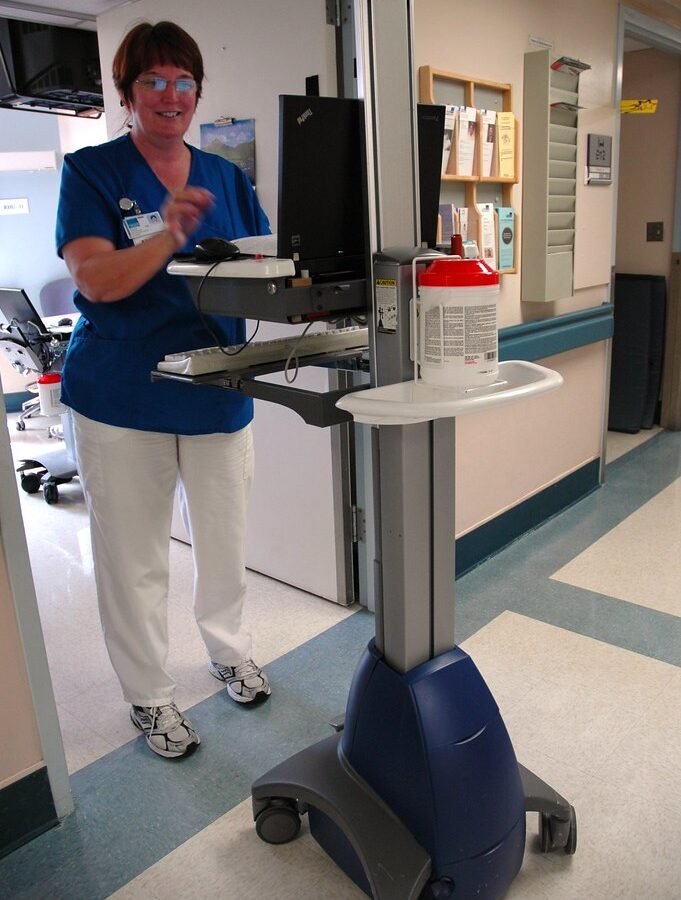
Featured photograph: A real nursing workstation at Virginia Mason Hospital, Seattle, photographed by Wonderlane (CC BY 2.0). Contextual image only; not River’s Bend Health Services and not evidence of any alleged misconduct. License.