The International Centre for Radio Astronomy Research announced on November 12, 2026 that researchers had linked mysterious radio pulses to an unusual stellar pair more than 5,000 light-years away. The system includes a white dwarf spinning roughly every eight minutes and a Sun-like companion.
What the evidence shows
The result belongs to a broader class of long-period radio transients, whose relatively slow repetition has prompted investigations into the nature of their sources. ICRAR described the detection as the first reported radio pulses from a white dwarf orbiting a Sun-like star. Multiple observatories helped researchers connect the signal with the stellar system.
What remains uncertain
Periodic emission is not evidence of a technological transmitter. Magnetic interactions and other astrophysical processes can generate repeating radio signals. Determining the exact mechanism requires further observations and detailed physical modeling.
The Apep Bar question
The unusual timing makes the system a useful laboratory for understanding how stellar remnants and their companions can generate radio emissions under unfamiliar conditions.
Sources
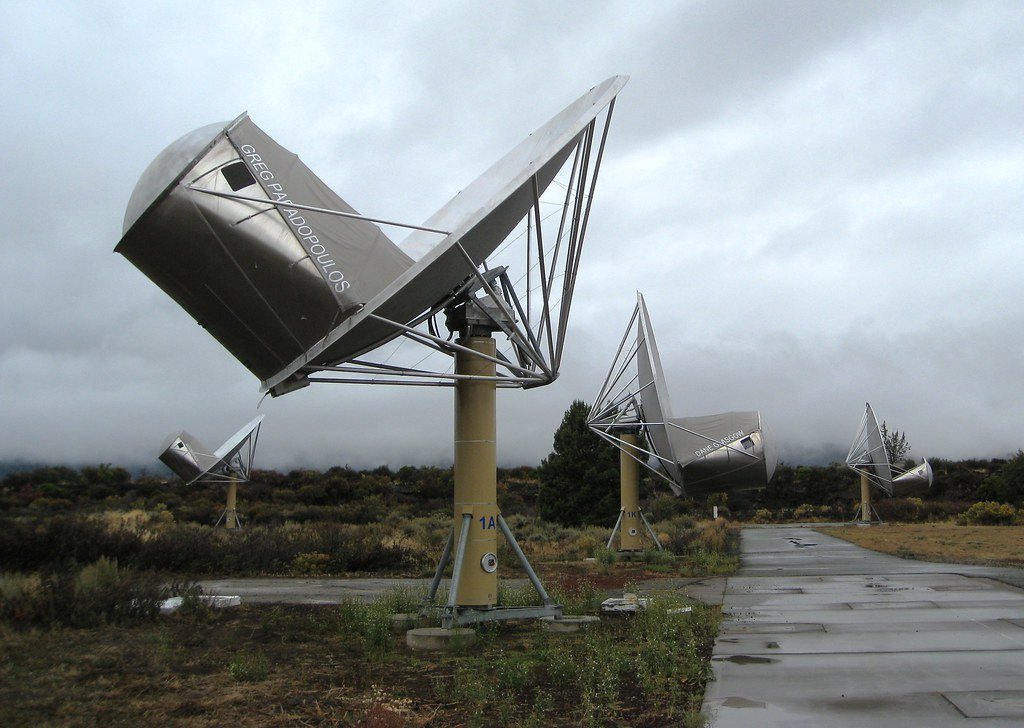
Featured image: Radio telescope array, contextual photograph, not the specific radio-pulse detection instrument. "Radio Telescope Array" by Clinton Steeds is licensed under CC BY 2.0. To view a copy of this license, visit https://creativecommons.org/licenses/by/2.0/.