For five centuries, the Andes kept the evidence frozen. Now a toxicology study is revealing what some children consumed before being sacrificed—and what the most dramatic headlines still cannot prove.
A few strands of hair can survive long after an empire disappears. In the case of children sacrificed on sacred Inca mountains, those strands have become chemical records of their final months.
On November 3, 2026, researchers published a study in the journal Antiquity examining hair and nail samples from eight mummified people found at high-altitude sites in Peru and Argentina. The evidence points to widespread use of coca leaves, alcohol consumption in some cases, and a trace of harmine—a compound associated with plants used to prepare ayahuasca—in one person’s nail. But the findings do not establish that the children were deliberately given a hallucinogenic ayahuasca drink. The scientific distinction matters. Read the peer-reviewed study.
Original study: Read the full, open-access Antiquity research article (Socha and colleagues, November 3, 2026). DOI: 10.15184/aqy.2026.10439.
Children sent to the gods
The Inca state performed ceremonies known as capacocha (also spelled qhapaq hucha), in which children and young women were offered to important deities. In Andean religious thought, mountains were sacred presences; these individuals were understood by participants as intermediaries between the living and divine powers. Some journeys stretched across vast distances and ended at elevations where thin air and freezing conditions pose a danger even today.
The deaths were real. So were the beliefs, political authority and community pressures surrounding them. Archaeology can examine how these ceremonies worked without romanticizing the killing or reducing those who died to museum objects.
For this investigation, a team led by Dagmara Socha of the University of Warsaw examined individuals associated with Ampato, Sara Sara, Chuscha, Quehuar and Llullaillaco. Seven were female and one male. Sites included some of the best-preserved Inca bodies ever recovered. The different preservation histories and body tissues would eventually prove crucial when interpreting the results.
What the laboratory actually detected
The scientists used liquid chromatography–tandem mass spectrometry, a sensitive analytical technique that separates compounds and identifies them from their chemical signatures. Hair and nails contain keratin, a protein that can retain traces of substances ingested during life.
Here are the strongest results, with the important caveat that the eight individuals did not all provide the same type of sample:
- Coca: All six hair samples contained cocaine, a naturally occurring alkaloid of the coca leaf, along with its metabolite benzoylecgonine. That is evidence consistent with chewing coca leaves; it is not evidence that the children used modern processed cocaine powder.
- Alcohol: The researchers detected the marker cocaethylene in hair from Chuscha and Llullaillaco. The body produces this compound when alcohol and cocaine are present together. The likely historical drink was chicha, a fermented maize beverage, although the chemical finding alone does not identify a particular drink.
- Harmine: One nail sample, from the individual known as the Ampato Maiden or Juanita, contained a very small amount of harmine. The paper associates this compound with plants such as Banisteriopsis, traditionally used in preparations of ayahuasca.
- Other hallucinogens: The team did not detect mescaline, N,N-DMT, bufotenine or several other targeted psychoactive substances in the samples tested. A negative result is not proof that these were never used, particularly if use was isolated or a compound did not preserve well in keratin.
In other words, the team studied eight people, but the statement about coca applies to six tested hair samples; the remaining two individuals were represented by nail samples. Some news coverage has blurred that denominator. The journal’s own announcement summarizes the broader interpretation, while the research article’s tables and methods show why the sample types should be kept distinct.
The most revealing centimeter of hair
One especially poignant result comes from an approximately eight-year-old girl recovered from Chuscha in Argentina. Researchers analyzed her hair in one-centimeter segments, using growth as an approximate timeline.
Coca-related compounds appeared across the segments. But cocaethylene—the sign of coca and alcohol exposure together—appeared only in the segment closest to her scalp, representing approximately the final month of life. The authors suggest that something changed as the ceremony approached. Perhaps the child was given chicha during the final phase of a prolonged journey. That reading is plausible, not certain: metabolism, preservation and the limited sample mean a strand of hair cannot reconstruct every event.
Historical chronicles describe coca leaves as ceremonial offerings and chicha as a drink used at ritual gatherings. Coca can also help people cope with fatigue and the demands of high-altitude travel. None of these observations tells us how a specific child understood what was happening.
Was ayahuasca part of the ritual? A clue is not a recipe
The most eye-catching part of the research is the trace of harmine in Juanita’s nail. Harmine is an alkaloid found in certain plants associated with ayahuasca preparations. In some preparations, harmine acts as a monoamine oxidase inhibitor, making orally consumed DMT psychoactive when paired with an appropriate source plant.
But the 2026 analysis did not detect DMT. It did not identify a beverage, measure an intoxicating dose or establish hallucinations. The researchers also reported that nail contamination complicated interpretation and that hair and nails can preserve compounds differently. They discuss other possible plant sources of harmine. An earlier 2022 study of Ampato victims proposed ayahuasca-related use; the latest results add evidence to that research history, not proof of one uniform psychedelic ceremony across the empire.
This is where a dramatic phrase such as “children were given hallucinogens” risks turning a chemical possibility into a reconstructed experience. The evidence is more interesting when the uncertainty stays visible.
Medicine, ritual control—or both?
The authors propose that psychoactive substances may have helped children endure painful and exhausting journeys, soothed them during ceremonies or had spiritual meanings tied to particular mountains. Coca was also an important offering within Andean religious life. The different chemicals found at different sites may point to ceremonies shaped by local deities and traditions, rather than one empire-wide formula.
There are alternative explanations for some differences. Certain compounds persist better than others; graves have different histories; only one or two people represent some mountains; and hair segments were not always measured in identical ways. The study cannot confidently separate cultural differences from those analytical limits.
The broader achievement is methodological: older tests sometimes failed to identify coca markers in these same remains. Improved laboratory sensitivity has now recovered information that previously appeared absent. It is a striking parallel to Apep Bar’s earlier reporting on how chemical analysis has decoded ancient Egyptian embalming recipes. In both cases, small molecular traces complicate the stories preserved in written records.
The children behind the evidence
The mummies have become famous for their preservation. Yet the extraordinary science should not eclipse the lives cut short. The surviving hair reveals exposure to substances; it does not reveal consent, reassurance, fear or what any individual was told. Claims about their emotions must remain speculation.
Five centuries after these ceremonies, the question is no longer simply what substances ancient ritual specialists possessed. It is why different children experienced different preparations—and how far science can responsibly go in interpreting their final months.
Watch: The Children of Llullaillaco, explained by their museum
The Museo de Arqueología de Alta Montaña in Salta, Argentina, preserves and studies the Llullaillaco finds. Its official 2020 introduction offers historical and archaeological context. This is museum background footage, not video of the 2026 laboratory study.
Video: Museo de Arqueología de Alta Montaña (MAAM), April 7, 2020. Contextual educational material on the Llullaillaco children.
Sources and further reading: Socha and colleagues, Antiquity (2026); Antiquity journal’s research release; Scientific American coverage; earlier Ampato toxicology research (2022).
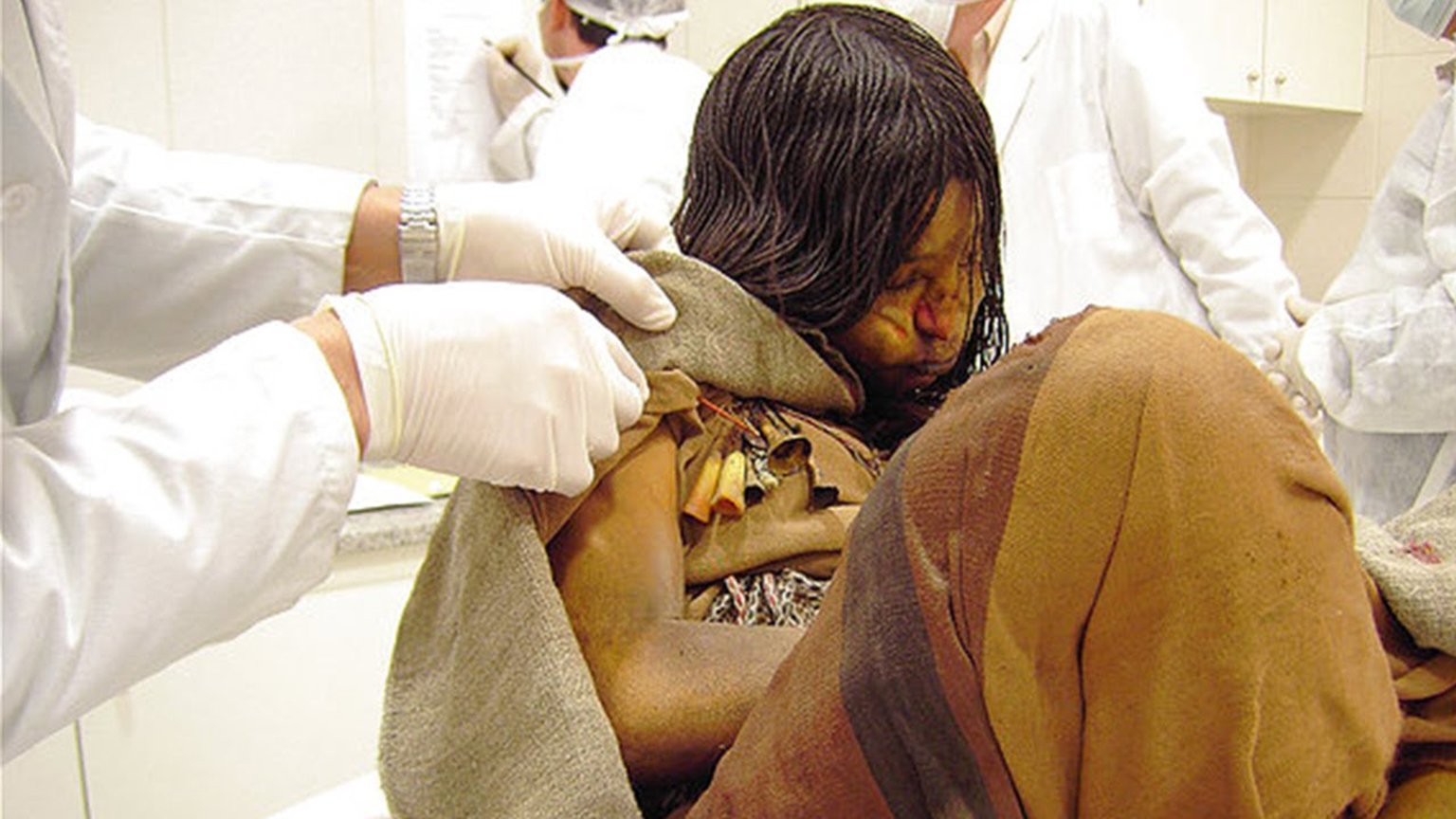
Featured photograph: La Doncella, one of the three children recovered on Mount Llullaillaco in 1999, displayed at the Museum of High Altitude Archaeology, Salta, Argentina. Photograph by grooverpedro / Wikimedia Commons, licensed under CC BY 2.0. Contextual image of a Llullaillaco child—not a photograph of the Ampato Maiden whose nail contained harmine.
Apep Bar question: If a hair sample can tell us what a child consumed 500 years ago, what evidence would we need before claiming to know what that child experienced?
Question. Investigate. Reconsider.