One hundred and fifteen million years after a young dinosaur died in what is now northeastern Brazil, researchers say its fossilized leg still contains chemical fingerprints associated with blood. It sounds like the first act of a science-fiction movie. The actual science is stranger—and more careful.
In a study published online November 2, 2026, in Proceedings of the National Academy of Sciences (PNAS), an international team led by Curtin University reported heme-related compounds and microscopic, red-blood-cell-like structures inside the vascular canals of an Aratasaurus museunacionali limb fossil. The researchers argue these are mineralized remnants of ancient blood cells—not liquid blood, and certainly not a vial of dinosaur DNA.
Independent specialists say the biochemical evidence is intriguing, but they question whether the structures truly are red blood cells. That distinction matters: a discovery can be important without every interpretation being settled.
A dinosaur leg that kept a secret
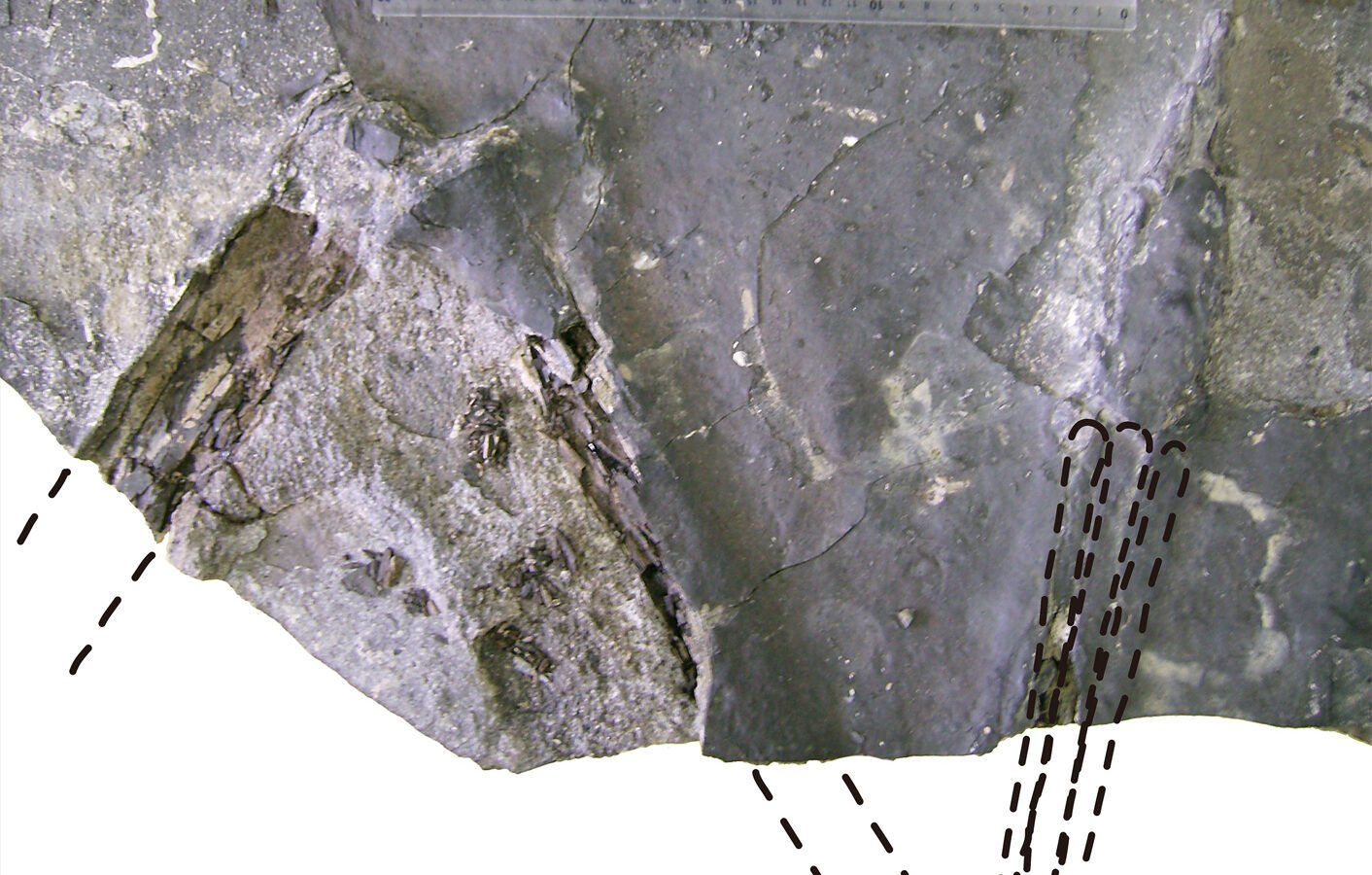
The fossil belongs to Aratasaurus museunacionali, a relatively small meat-eating theropod that lived during the Early Cretaceous. Its partly articulated right hind limb was recovered in 2008 from the Romualdo Formation near Santana do Cariri in Ceará, Brazil. The individual was a juvenile, roughly 3.1 meters (10 feet) long and about 34 kilograms (75 pounds), according to estimates drawn from the fossil.
The specimen was described as a new dinosaur species in 2020. That earlier work already told paleontologists something about its anatomy and growth. The new study asked a different question: could chemistry from its living tissues persist in the rock?
Researchers examined thin sections and found numerous oval microscopic structures tucked inside vascular canals—the spaces once associated with blood vessels in bone. These are exactly the kinds of places where blood-derived material might plausibly become trapped during fossilization. But shape and location alone cannot establish what the objects once were.
The chemical fingerprint: heme, not a tube of blood
The team combined microscopy with high-performance liquid chromatography–mass spectrometry, which separates and identifies compounds by their chemical characteristics. They reported heme B and chemically altered heme-related molecules in the dinosaur bone. Heme is an iron-containing molecular component of hemoglobin, the protein that transports oxygen in vertebrate red blood cells.
Crucially, the surrounding rock provided a different pattern dominated by plant- and microbial-pigment signatures. The researchers use this contrast as an argument that the heme-related traces originated in the bone rather than simply entering from its surroundings. They also used Raman spectroscopy and transmission electron microscopy to connect chemical and elemental signals with the microscopic structures in place, rather than relying only on an extract of the entire sample.
The analysis reported a mineral called hausmannite, a manganese oxide associated with the structures. The team proposes that early mineralization, rapid burial, low oxygen and microbial activity helped protect or replicate delicate biological features. It is a preservation hypothesis, not a recipe that has been proven to work in every ancient fossil.
Researchers also detected amino acids associated with collagen, another clue that some molecular information may endure deep into geological time. These findings do not mean intact dinosaur blood, whole hemoglobin proteins or dinosaur DNA were recovered. The surviving record is mineralized and chemically transformed. Reuters’ account of the study makes that distinction clear.
Why some scientists are not convinced
There is an inconvenient detail in the images: the reported cell-like structures do not look exactly like the red blood cells of birds and reptiles, dinosaurs’ living relatives. Birds and reptiles generally have nucleated red blood cells, producing a characteristic raised region. Molecular paleontologist Mary Schweitzer, who did not participate in the study, told Live Science that the structures instead appear concave, lack a clear nuclear bulge and differ in size.
Schweitzer accepts the broader possibility that original molecules can survive geological time; her objection is to identifying these particular structures as red blood cells. Similarly, paleobiologist Maria McNamara called the work a comprehensive effort while urging caution about the cell interpretation, according to Smithsonian‘s November 4 summary.
That is why the precise headline is “strong evidence of ancient blood-related molecular traces” rather than “scientists revived dinosaur blood.” Heme is important, but a convincing chemical signal and a definitive cellular identification are not the same claim. Replication in other fossils and further scrutiny of the microstructures will help test the team’s interpretation.
What this could teach us about dinosaurs
Most fossils tell scientists about form: bones, teeth, locomotion, growth and occasionally skin or feathers. Chemical preservation could add a second archive, hinting at how extinct animals transported oxygen, how their blood chemistry evolved, and perhaps eventually aspects of physiology that skeletons cannot reveal.
But those ambitious questions are for future research. One set of heme signatures does not calculate an Aratasaurus‘s running speed, body temperature or metabolic rate. This discovery expands what may be worth looking for; it does not supply all the missing answers.
Why scientists studying Mars should pay attention—carefully
There is a legitimate astrobiology connection, but not the one implied by the most breathless headlines. If chemically altered remnants of biological compounds can remain recognizable through extreme geological time on Earth, the discovery offers a reason to investigate how potential biosignatures might survive in ancient rocks elsewhere.
That does not mean a future Mars rover should expect to discover hemoglobin, that all life must use heme, or that any detected organic chemical proves biology. Similar compounds can have nonbiological origins, contamination is always a concern, and planetary environments differ greatly. The lesson is methodological: preserve context, compare against surrounding geology, look for multiple independent lines of evidence and test alternatives.
Curtin University’s November 3 release emphasizes precisely this possibility: a better understanding of how molecular structures endure could sharpen investigations of life’s traces beyond Earth.
Watch: The researchers explain the discovery
The following short video is a research explainer associated with Curtin University’s announcement, embedded by Smithsonian. It is contextual coverage, not footage of live dinosaur blood.
Video: “Dinosaur blood – oldest discovery rewrites what fossils can reveal about the past.” Watch on YouTube if the embedded player is unavailable.
What remains unknown
Whether the fossil’s oval microstructures are definitively ancient red blood cells is still open to scientific argument. What exact sequence of chemical reactions protected the heme-related molecules? Would other dinosaur bones, buried in different conditions, yield the same signals? And which laboratory controls best distinguish genuine remnants from mineral look-alikes or contamination?
The most consequential part of this story may not be that scientists have “found dinosaur blood.” It may be that some fossils preserve more chemical information than anyone expected—and that researchers now have better tools for finding out what it means.
Question. Investigate. Reconsider.
Sources and further reading
- Grice et al. (2026), “Heme signatures in mineralized red blood cells within vascular canals of a 115-million-year-old dinosaur bone,” PNAS (DOI: 10.1073/pnas.2614248123).
- Curtin University research announcement, November 3, 2026.
- Sayão et al. (2020), original description of Aratasaurus museunacionali, Scientific Reports.
- Live Science, outside expert criticism, November 2, 2026.
- Smithsonian Magazine, independent assessment, November 4, 2026.
- Actual Aratasaurus fossil photograph, original 2020 study, CC BY 4.0.