TECHNOLOGY & POWER | ANALYSIS | November 3, 2026
Ten developments across artificial intelligence, gaming, graphics hardware and internet policy reveal a larger fight: who owns the computing power we rely on, who gets to use it, and who can change the rules?
The graphics card sitting inside your computer is supposed to be yours. So is the memory you bought, the software you installed, and the games you paid for. But a strange collection of late-October and early-November technology stories suggests that ownership is becoming a more complicated word.
OpenAI’s chief executive argues that scarce memory is used more efficiently in data centers than in home PCs. Anthropic is instructing Claude Code not to recreate existing games. Microsoft has removed a guided way to move data directly between Windows PCs. Nvidia’s top graphics cards have disappeared from its own U.S. marketplace listings while rumors circulate about a replacement. Meanwhile, independent chip ventures are trying, with very different degrees of progress, to make the incumbent less inevitable.
The accompanying reader-supplied video, “Nvidia’s Nemesis Is ALIVE”, groups these stories as a technology roundup. The claims below are assessed against linked reporting, primary records where available, and the important distinction between something announced, something measured, and something merely rumored.
This is not proof of a conspiracy to abolish personal computing. It is evidence of a genuine conflict between centralized platforms and the messy freedom of machines that consumers can control. Apep Bar previously examined the AI industry’s idle-compute problem; the new argument is about where that computing power should live.
Stop Hoarding RAM: Sam Altman Questions the Logic of Memory in Personal Computers
In an interview with the Cheeky Pint channel, OpenAI CEO Sam Altman described the global allocation of limited DRAM to home computers as “quite terrible” when much of it sits idle. His premise was about utilization: a memory chip serving many workloads in a busy data center may accomplish more measurable computing work than one installed in a home PC and used only intermittently. Tom’s Hardware documented the remarks, and Engadget described the backlash.
There is an economic argument here worth taking seriously. Semiconductor supply is finite, especially during rapid AI infrastructure buildouts. If an expensive server runs near capacity, its memory can support more aggregate requests than a gaming desktop that sleeps most of the day. That is a claim about efficiency, not necessarily a command to surrender your RAM.
But it is also a profoundly incomplete account of value. A home computer’s RAM is there when its owner needs it, even without internet access, a subscription or permission from a remote service. Spare capacity is not always waste: fire extinguishers, backup generators and emergency supplies are inefficient if judged only by the number of hours they are active. Privacy, autonomy, response time, and local availability matter too.
There is a commercial conflict of interest. OpenAI sells access to models hosted on centralized infrastructure. Local inference, using hardware people already own, could in some cases substitute for paid cloud services. Altman’s statement does not establish a plan to prevent consumers from buying memory; it does reveal how differently cloud operators and PC owners may define “efficient.”
The real question: Does maximum utilization benefit everyone, or primarily the organization that owns the data center?
No More Gaming Recreation: Anthropic Draws a Line Around AI Game Clones
Anthropic has updated instructions for Claude Code’s Opus 5.5 environment to discourage reproducing a specific existing video game, even if the copied work is renamed. Anthropic technical staff member Addy Osmani confirmed the change and framed it as an intellectual-property protection measure. Original games, genre-based projects and games made with the user’s own designs are intended to remain permitted.
The distinction matters. Building a new platformer with familiar mechanics is not automatically the same act as cloning another company’s characters, levels, assets or code. Developers have legitimate reasons to protect creative work from unauthorized reproduction. AI-assisted copying can reduce the time required to build a lookalike product, creating new pressures on the studios that spent years making the original.
Yet reports from some users claim the restrictions are catching ordinary reverse engineering and troubleshooting as well. Tom’s Hardware documented those complaints, while Ars Technica distinguished the confirmed game-cloning instruction from disputed side effects. Reports of overblocking are not proof that Anthropic has formally banned all reverse engineering.
That gray area is the crucial one. Reverse engineering can support compatibility, accessibility, security research and preservation, depending on the method and law. An overly blunt system can block work that looks similar to infringement at the prompt level but serves a different purpose in the real world. Anthropic’s challenge is to prevent actual unauthorized cloning without turning legitimate software maintenance into collateral damage.
What remains unresolved: How consistently can an AI assistant separate a lawful compatibility project from an infringing recreation?
GOG Wants To Get Physical: Can the Boxed PC Game Make a Comeback?
At the opposite end of gaming’s ownership debate, GOG is considering a return to physical PC editions. Its senior business development and partnerships manager, Marcin Paczynski, described his ideal in a GamesRadar+ interview: customers could choose a game in their GOG library and order a tangible edition delivered to their door.
It sounds delightfully retro. It is also much harder than clicking “burn to disc.” Physical games involve manufacturing, inventory, shipping, support and additional publisher permissions. GOG has not announced an actual sales program, delivery format, pricing or launch date. PC Gamer describes the concept as an ambition, not an imminent product release.
The company’s DRM-free model already offers something important: downloadable installers that can be kept and backed up separately from a storefront. Physical distribution might add resilience, collectability and preservation value. But a box is not a guarantee of unrestricted ownership if the contents still depend on online authentication or license terms. The details—not the cardboard—will decide how meaningful any revival becomes.
GOG’s interest is an instructive counterpoint to cloud-first computing. Where some technology executives see local copies as inefficiency, game preservationists see local copies as the only defense against software disappearing when a service shuts down.
Double Nvidia Performance on Windows? The GPU Unlocker Has a Very Specific Target
Here is a headline that needs immediate qualification: a new UEFI-based tool can substantially improve selected Nvidia graphics cards’ AI tensor-computation performance. That is not the same as doubling frame rates in games.
The open-source nv-uefi-unlocker project runs from bootable media before the Nvidia driver loads, targeting limits affecting certain mixed-precision tensor operations on RTX 20-, 30- and 40-series GPUs. The approach does not require permanent video-BIOS flashing, but the unlock is temporary and may need to be repeated after power-off. Tom’s Hardware reported an example of roughly 65% higher FP16 throughput on an RTX 4060 laptop in developer tests.
Project records show that results vary by board, firmware and workload. A separately documented RTX 4060 laptop test reported about 49% higher FP16 throughput and 57% higher BF16 throughput under its conditions. The project’s compatibility matrix notes hardware exceptions and says RTX 50-series models are unsupported.
Those numbers cannot be casually converted into real-world performance for games, whole AI applications or all GPUs. Tensor operations are only one part of a workload; memory bandwidth, power limits, the software stack and thermal behavior still matter. Firmware-level changes can also create boot, stability and security complications, particularly when Secure Boot or disk-encryption protections are involved. This is experimental enthusiast territory, not a universal performance upgrade that consumers should install blindly.
Still, the project raises a provocative question: if unused capability can be enabled by independent software, how much performance is governed by engineering limits and how much by vendor configuration?
Windows Kills Local PC Migration: The Cloud Becomes the Default Path
Microsoft has removed Windows 11’s recently introduced PC-to-PC Migration experience, which had allowed supported users to transfer files and settings directly from an old computer to a new one over a local network. Unlike a rumor about a graphics card, this has a Microsoft release-note trail. Windows Latest reported that the change made its way through the fall update rollout.
Microsoft recommends Windows Backup, which can restore supported items using a Microsoft account and OneDrive. The free OneDrive storage allowance is 5GB, a potentially awkward mismatch for users whose photo libraries, projects or downloads occupy far more space.
Crucially, the company has not made local copying impossible. USB drives, external disks and network shares remain options. What disappeared was the convenient built-in guided workflow for direct migration. That distinction is smaller than the dramatic headline, but it is significant: defaults shape behavior, especially for people who are not comfortable manually transferring folders and settings.
Microsoft has not publicly established that pushing users into paid storage was its reason for retiring the tool. The observable effect, however, is a narrower path for anyone who wants to move to a new PC without involving a cloud account.
France Internet Tax: A Six-Cent Proposal, Not Yet a Law
French lawmakers voted on October 30 to add an internet-traffic levy amendment to the debate over the 2027 budget. The measure proposes charging content providers €0.055 per gigabyte of data delivered to users in France. The National Assembly vote was narrow: 11 in favor, 10 against. Those figures are documented in the parliamentary record and the amendment text and vote record.
Backers estimate a potential €10 billion annual yield, widely converted to around $11.2 billion in English-language coverage. That is a forecast attached to the proposal, not tax revenue France has collected. Nor is the measure a direct six-cent fee automatically added to every citizen’s internet bill. It would be assessed on providers of content, even though critics worry that companies could respond by increasing prices or reducing services.
The proposal requires internet-access providers to produce aggregated data volumes tied to senders for tax purposes. Its text says the collection should not reveal the content or destination of individual communications, but opponents question the practicality and privacy implications of attributing enormous data flows by company. The government also warned about effects on smaller French content businesses. LCP, the French parliamentary broadcaster, reported that the amendment was unlikely to survive the full budget process.
Status matters: As of November 3, the vote is an intermediate legislative event, not a final enacted tax. It still faces the rest of France’s legislative budget process. But the idea reveals how governments are reconsidering who should pay for the volume of data moving across national networks—and who must measure it.
RTX 5080 MIA: A Missing Store Listing Is Not a Discontinuation Notice
Nvidia’s GeForce RTX 5080 reportedly disappeared from the company’s U.S. marketplace display after a similar removal of the RTX 5090. Tom’s Hardware observed the absence of listings and filters while lower-tier cards remained visible, sometimes labeled out of stock. The publication also identified some RTX 5080 retail offers reaching more than 2.2 times the $999 original suggested price.
That is meaningful consumer evidence, but it has limits. A product vanishing from one manufacturer-operated marketplace does not prove all stores have stopped selling it, that every model costs 2.2 times MSRP, or that Nvidia has formally canceled production. Retailers, distributors and regional inventories can behave differently.
What makes the gap noteworthy is the broader market tension. Nvidia’s AI data-center business has become strategically central, while enthusiast GPU buyers are sensitive to supply, pricing and memory capacity. It is reasonable to ask whether manufacturing decisions increasingly favor higher-margin professional products. It would be premature to treat that hypothesis as a confirmed explanation for the vanished listings.
The company’s next public inventory and product announcements—not forum certainty—will determine whether this is a temporary marketplace oddity or a transition to different cards.
RTX 5080 SUPER: The Rumored 24GB Card Is Still a Rumor
Separate reporting points to an Nvidia RTX 5080 with 24GB of video memory, possibly arriving earlier than previous expectations. Overclock3D traced the claim to reporting focused on Chinese distribution channels, suggesting a December 2026 or January 2027 window rather than a broader first-quarter estimate.
There is no independently verified launch announcement in that reporting. The exact specifications, markets, timing, price and final branding remain uncertain. Calling the product an “RTX 5080 SUPER” may be convenient enthusiast shorthand, but a 24GB RTX 5080 rumor is not proof Nvidia has officially adopted that name.
More memory would address a genuine pain point for people running large models, creative applications or memory-intensive games. It would not automatically transform the card into an RTX 5090 replacement. Video memory capacity, memory bandwidth and processing throughput are different specifications, and extra capacity does not manufacture more compute units.
In other words, the leak might explain some supply behavior—or it might simply be one more rumor feeding on an already anxious market. Until Nvidia makes a formal announcement, the speculative and documented parts of this story must stay in separate boxes.
Lisuan Day One Drivers: A New GPU Contender Learns the Unromantic Work
A challenger does not become credible just by displaying a chip at a trade show. It becomes credible when customers can install games, update drivers and expect problems to get fixed.
China’s Lisuan released a Windows driver update for the LX 7G100 on October 29, according to VideoCardz. Pilot Release 30.0.2260.896 listed 58 changes: 43 fixes, 13 game-performance optimizations and two feature additions. Those additions include a FreeSync control and hardware video decoding support for MPEG-1 and MPEG-2.
The release also claimed a launch fix for Phantom Blade Zero, along with changes addressing various other games. Independent reporting says the action title attracted more than 700,000 concurrent Steam players soon after release, but that player count measures the game’s popularity—not Lisuan GPU sales, driver quality or actual frame rates.
This is encouraging evidence of software maintenance, not proof that Lisuan has caught up with Nvidia, AMD or Intel in performance or driver maturity. The manufacturer supplied no standardized benchmarks for the 13 claimed game optimizations in the report. Independent testing across many games, stable releases and sustained update cadence will be necessary before a new competitor can be judged on equal footing.
Still, a young vendor delivering compatibility fixes close to a major game launch is a more substantial sign of life than a glossy slide promising to revolutionize graphics.
Bolt Zeus Powers Up: Nvidia’s “Nemesis” Is a Test Chip, Not a Finished Rival
Bolt Graphics offers the most dramatic challenger narrative here—and also the biggest gap between headline and finished product. The California startup says the first silicon for its Zeus architecture powered on successfully in October. Engadget reported that the 12nm test chip is approximately 6 square millimeters and draws about 1.4 watts. The company compared that with roughly 35 watts for the FPGA prototype previously used to test its design.
This is a real engineering milestone as reported, because moving from a programmable test platform to functioning fabricated silicon is difficult. Yet the comparison is not evidence that a future Zeus graphics card delivers twenty-five times better gaming performance or energy efficiency than Nvidia hardware. An FPGA prototype and a small custom test chip are not equivalent finished products, and the numbers do not describe a full retail GPU’s workload, memory system or board power.
The company’s hoped-for volume production is not expected until 2028, and a fully competitive hardware platform will also need drivers, developer tools, manufacturing capacity and independent benchmarks. Plenty can change over that interval. The right headline is that another aspiring competitor has demonstrated a working piece of silicon—not that Nvidia has already been beaten.
The prospect is still worth watching. Nvidia’s dominance is reinforced by a software ecosystem as much as by physical chips. A credible alternative would have to compete on performance, cost, availability, and compatibility, rather than a single spectacular engineering claim.
The Bigger Pattern: Who Gets to Own the Future of Computing?
Put these stories together and a pattern emerges—not a coordinated secret plan, but competing answers to a public question.
The cloud argument says concentrating expensive hardware produces more utilization. The local-computing argument says personal hardware has value precisely because it is not always rented from a company. AI coding tools are being shaped by intellectual-property restrictions. Windows has made a simple local migration route less accessible. GOG wants to add physical permanence back to digital games. And in the graphics market, both established vendors and aspiring challengers are testing how much freedom buyers will ultimately have.
Technology companies can have legitimate reasons to manage supply, enforce copyright, secure firmware and streamline services. Consumers can have equally legitimate reasons to demand offline functionality, repairability, choice of software, local privacy and durable access to things they purchased. Those interests are not always enemies—but they are not always aligned.
We should also resist the temptation to turn every uncertainty into a master theory. The Nvidia listings do not prove a production shutdown. A possible 24GB card is not a confirmed product. A UEFI tensor unlock is not a miracle gaming boost. A French budget amendment is not yet a national tax. Bolt’s functioning test silicon is not a shippable Nvidia killer.
The evidence is already interesting enough without those exaggerations. The future of personal computing may be shaped less by who makes the fastest GPU than by a less glamorous question: Will the computer remain a tool its owner directs, or become a terminal through which someone else grants access?
Question. Investigate. Reconsider.
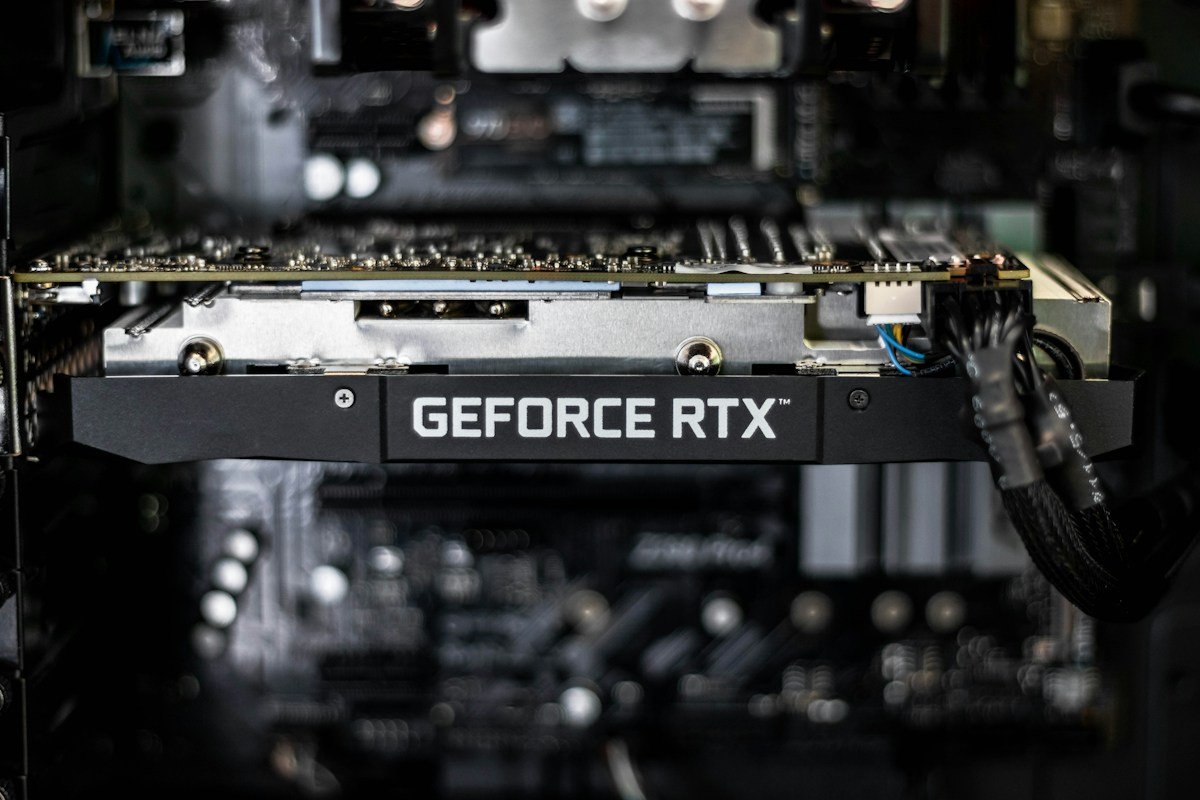
Featured photograph: Real NVIDIA GeForce RTX 2060 graphics card photographed by Christian Wiediger / Unsplash; used under the Unsplash License. Contextual hardware photography, not an RTX 5080, RTX 5090 or Bolt Zeus product photo.
Sources and Further Reading
- Reader-supplied companion video: “Nvidia’s Nemesis Is ALIVE” (contextual roundup; video transcript and runtime not independently verified).
- Tom’s Hardware: Sam Altman on home RAM.
- Ars Technica: Anthropic’s game-cloning guidance.
- GamesRadar+: interview with GOG’s Marcin Paczynski.
- Original nv-uefi-unlocker project documentation.
- Microsoft: Windows 11 release notes.
- French National Assembly: October 30 budget debate and vote.
- Tom’s Hardware: RTX 5080 marketplace report.
- Overclock3D: reported 24GB RTX 5080 timing.
- VideoCardz: Lisuan driver details.
- Engadget: Bolt Graphics’ Zeus test chip.