News Analysis | November 14, 2026
Imagine looking through a stranger’s window at night and seeing a moving pair of spotlights. Not a homeowner. Not a police officer. A small aircraft buzzing through the living room.
That is the deterrent Jamie Siminoff, founder of Amazon-owned Ring, wants to sell. At the company’s November 10 unveiling, he described the effect of seeing “spotlights and something flying across the window” after a Ring doorbell detects activity outside. The proposed guardian is the Ring Drone Cam, a $249.99 flying indoor security camera that can travel to saved points around a home. It is slated to begin shipping in the United States on January 27, 2027—not available for ordinary purchase yet. Amazon confirmed the planned release and price.
But the announcement came with an inconvenient twist: in a CBS News demonstration, a prototype crashed twice, and a subsequent report confirmed that customers will not be able to fly it manually at launch. The machine is designed to patrol a house. The difficult question is whether it is ready to do that reliably—or whether homeowners are being asked to invite another cloud-dependent camera into their most private rooms.
What Ring has actually announced
Ring calls the device a mobile alternative to several fixed interior security cameras. Owners can map their rooms during setup, define viewpoints and patrol routes, and tell the drone to investigate through the Ring app. Linked Ring sensors can initiate an investigation when an alert is triggered. The company says its AI Pilot system combines device cameras, vision models, onboard sensing and cloud processing to navigate. The unit charges in a floor-standing dock and is intended for indoor use only.
According to Ring’s published specifications, the Drone Cam captures 2K video at 1920 × 1920 resolution with a 148-degree field of view. Two LED spotlights illuminate low-light areas. Its rechargeable battery can sustain up to eight minutes of flight under controlled conditions before the drone must dock. Ring says the camera records only while flying and switches off when docked. Unlike the ground-based security robot announced alongside it, the flying camera has no microphone, speaker or siren. Its noisy propellers and lights are supposed to make its presence obvious.
This is not continuous aerial surveillance in the sense of a drone hovering indefinitely over a hallway. Flight time is short, charging takes substantially longer, and patrols follow planned points rather than letting an owner steer freely wherever curiosity leads. Scheduled patrols, stored recordings and other advanced services have subscription requirements; the $249.99 device price is not necessarily the full ownership cost.
The launch-night fantasy meets a wall
In the pitch, an intruder triggers a sensor and a flying camera investigates. In a CBS Mornings segment aired November 10, reporter Jo Ling Kent was given manual controls for a preproduction unit. It crashed twice. CBS reported a collision-avoidance failure during one incident; in the other, the drone struck a wall after a connection problem. Siminoff explained that when connectivity is lost the aircraft is supposed to stop and land. In that demonstration, it did not.
The distinction matters. A preproduction crash does not prove a finished consumer product will be unsafe. But neither is a controlled successful flight proof that the system can routinely handle changing home layouts, obstructing pets, unreliable Wi-Fi or stairs. The Verge reported November 12 that Ring will not provide manual piloting controls at launch, instead relying on preset routes and autonomous navigation. Ring said this is its preferred customer experience; it did not establish that the CBS failure caused the decision.
There is another small but revealing discrepancy. Some launch demonstrations and press accounts suggested a drone capable of moving between floors. Yet Ring’s own support specifications, as available November 14, describe motion detection as “single floor (multi-floor planned)”. Buyers should obtain an explicit answer about what the shipping version will actually support, not assume the most ambitious demonstration describes the day-one feature set.
The privacy paradox: fewer cameras, but a camera that moves
Ring’s strongest argument is straightforward. A single flying camera can look down a hallway, into an entryway or across a room without installing a permanent lens in each location. Its dock physically blocks the camera’s view when the drone is not operating. The company also says recording indicators are visible and videos use its new Throw Away the Key encryption system. These are meaningful product design claims, and they deserve to be tested.
But a moving camera introduces different questions from a stationary doorbell. A doorbell usually faces a known exterior scene. A drone maps and traverses interior space—including rooms guests, children or household workers may reasonably expect not to be recorded. Ring says AI Pilot relies partly on cloud processing, which means an outage or connectivity failure can affect functionality. Consumers should ask what information from the indoor map leaves the device, who can access recordings, how long records persist, and which settings let household members restrict routes.
The privacy concern is not proof of misuse. It is the consequence of moving a networked imaging system from the front porch to the interior of a home. Security claims also need evidence: a buzzing drone could alarm a burglar, but the public announcement does not demonstrate a measured reduction in home break-ins. The deterrence scenario remains a proposition, not a proven outcome.
What the sticker price leaves out
The Drone Cam is listed at $249.99, and its announced US shipping date is January 27, 2027. Yet Ring and Amazon explicitly warn that the device has not received the required Federal Communications Commission authorization and therefore cannot be offered for sale or lease until that process is complete. It is a planned launch, not a purchase that can already be completed.
Ring’s product page also says a compatible subscription is needed for scheduled patrols, while saved-video functionality carries additional plan requirements. Buyers should compare costs and capabilities with a few well-positioned fixed cameras, especially given the drone’s short flight time and dependence on Wi-Fi. And despite a visually dramatic threat response, this device does not physically stop an intruder, call emergency responders by itself or provide two-way audio.
There is also a larger robot in the room
Ring introduced a second product, the Ring Rover Cam, aimed primarily at businesses. It is a wheeled autonomous patrol robot with a siren, two-way audio and video capabilities; Amazon lists it at $999.99 with US shipping targeted for December 16, 2026. Ring is positioning both products as a new “Ring Robotics” category: cameras that come to the suspected problem instead of waiting for the problem to enter their field of view.
That may be the real significance of this launch. The home-security industry is moving from fixed observation to autonomous movement and investigation. Whether the shift delivers better protection, or simply more intimate data collection and new things to troubleshoot, is still an open question.
Watch the evidence
Video: CBS Mornings — Would you let a drone inside your home? (November 10, 2026). This is a news demonstration involving a preproduction device, not independent proof that the final retail unit will behave the same way.
The question before takeoff
A flying camera that can check a triggered window from another room is a genuine technical idea, not just a science-fiction prop. Ring has also shown why the question of reliability cannot be waved away with dramatic lighting and a launch date. Before buying, consumers deserve transparent tests of obstacle avoidance, connectivity loss, room mapping, video privacy and exactly which patrol capabilities ship on day one.
When a home is protected by a camera that can roam through it, who decides where that camera is allowed to go?
Primary sources and independent reporting: Amazon’s November 10 announcement · Ring’s Drone Cam product page · Ring’s support specifications · CBS Mornings video report · The Verge on the demonstration crashes · TechRadar’s interview with Siminoff · Attack of the Fanboy’s original report.
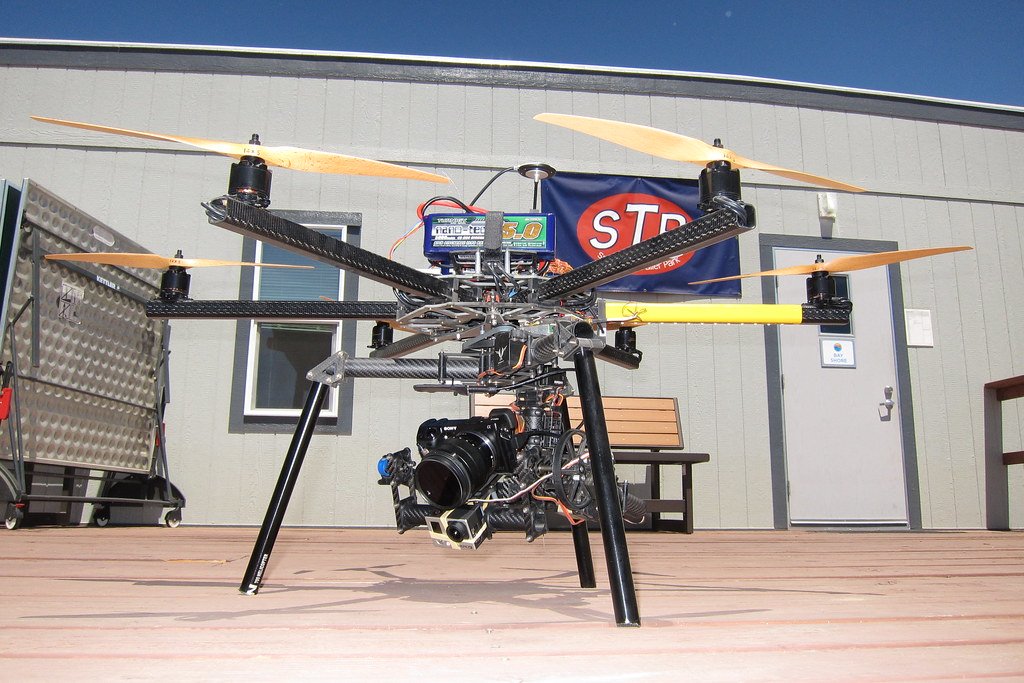
Featured photograph: “Camera Drone” by Chris Hunkeler, photographer’s Flickr profile, CC BY-SA 2.0. This real photograph illustrates camera-drone technology and does not depict Ring’s new Drone Cam.