From Ice Age hunter-gatherers and Anatolian farmers to steppe migrants, Roman cosmopolitans and early medieval newcomers, Europe was transformed by repeated migrations. Its ancient DNA tells a stranger, more complicated story than any single origin myth.
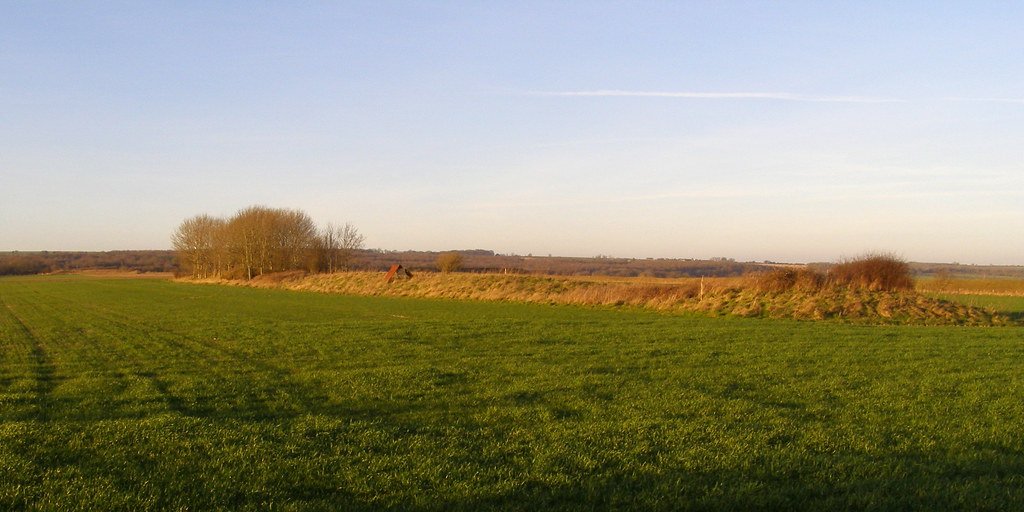
Featured image: Pentridge Neolithic long barrow in Britain, an archaeological monument from the farming-era landscape discussed in this investigation. Documentary photograph by treehouse1977, CC BY-SA 2.0. The monument is contextual; it is not identified here as a source of DNA used in the cited studies.
Europe has a secret buried beneath its ancient settlements, royal genealogies, national borders and carefully preserved historical traditions.
Its people did not descend from one original population that remained unchanged for thousands of years.
Some ancestors survived the last Ice Age in western Europe. Others arrived from the region of present-day Turkey carrying agricultural traditions. Still others came from the grasslands north of the Black and Caspian Seas. Later arrivals brought ancestry connected to Siberia, North Africa, the eastern Mediterranean and numerous parts of Europe itself.
Their descendants mixed, sometimes gradually and sometimes following demographic upheavals so dramatic that the genetic composition of entire regions changed within centuries.
The evidence is not merely an interpretation of pottery, burial customs or ancient legends. Researchers have recovered DNA from actual human remains and compared individuals who lived thousands of years apart.
One discovery is particularly striking.
In Bronze Age Iberia, nearly all previously common paternal lineages disappeared from the studied genetic record during a major demographic transformation. Yet much of the region’s earlier overall ancestry survived.
In Britain, a separate migration transformed approximately 90% of the population’s ancestral gene pool.
And in parts of the Netherlands and Belgium, a population carrying substantial hunter-gatherer ancestry persisted thousands of years longer than expected.
How could such profoundly different outcomes occur on the same continent?
The answers challenge simple accounts of Europe’s origins. They also expose the dangers of turning genetic history into modern racial or national mythology.
1. The Original Europeans Were Already Different From One Another
Long before farming, metalworking, the Roman Empire or any modern European nation, humans were moving across the continent.
Homo sapiens reached Europe more than 45,000 years ago. These early populations encountered changing climates, enormous glaciers and, during the earliest periods, other human groups including Neanderthals.
Europe’s Ice Age population was not genetically uniform.
A major 2023 study in Nature, Palaeogenomics of Upper Palaeolithic to Neolithic European Hunter-Gatherers, analyzed 356 ancient hunter-gatherer genomes spanning roughly 35,000 to 5,000 years ago.
The researchers uncovered several remarkable patterns.
Different populations, similar cultures
During the Gravettian period, approximately 33,000–26,000 years ago, populations across Europe produced related types of weapons, ornaments and artwork.
Archaeological similarities might suggest a broadly unified population.
DNA revealed otherwise.
Individuals associated with the Gravettian culture in western and southwestern Europe were genetically distinguishable from groups associated with the same archaeological tradition in central and southern Europe.
Similar artifacts did not necessarily mean the people making them belonged to the same ancestral population.
The Ice Age changed the genetic map
During the Last Glacial Maximum, approximately 25,000–19,000 years ago, much of Europe became difficult to inhabit.
The 2023 research found that ancestry associated with western European Gravettian groups survived in southwestern Europe and contributed to later Magdalenian populations.
Other genetic lineages experienced severe declines or disappeared from the sampled populations.
After the Ice Age, further population movements transformed the continent again, including a major genetic turnover around 14,000 years ago.
What the evidence establishes: European ancestry underwent repeated transformations long before the arrival of farming.
What remains uncertain: The precise movements, relationships and eventual descendants of many early groups remain incompletely documented because surviving skeletal material is scarce.
2. The Farming Revolution Was Also a Migration Revolution
For generations, archaeologists debated an important question.
Did farming spread across Europe because hunter-gatherers learned agricultural techniques from their neighbors? Or did farmers themselves migrate into new territories?
Ancient DNA demonstrated that the arrival of farming involved substantial population movement.
Beginning around 7000 BCE, farming communities associated with Anatolia and the Aegean expanded into southeastern Europe and, over subsequent millennia, spread across much of the continent.
They brought crops, livestock, new settlement patterns and agricultural knowledge.
Their expansion generally followed two broad routes: an inland route through the Balkans, along the Danube and into central Europe; and a Mediterranean route along coastal regions, eventually reaching Italy, Iberia and other western European territories.
The evidence comes from multiple independent studies.
A 2016 study published in PNAS compared ancient farmers from Greece and northwestern Anatolia with early European farming populations. It found strong genetic connections linking them.
A 2018 study in Nature examined 225 ancient individuals from southeastern Europe and surrounding regions.
It demonstrated that early farmers migrated through southeastern Europe, where different communities experienced varying degrees of interaction with established hunter-gatherers.
The consequences differed considerably. In some locations, migrant farmers contributed most of the subsequent population’s ancestry. In others, hunter-gatherers remained influential through intermarriage and long-term coexistence.
These were not simply people exchanging agricultural ideas. They were people moving, settling, marrying and having descendants.
A particularly revealing example: Neolithic Britain
A 2019 study of ancient British genomes analyzed six Mesolithic and 67 Neolithic individuals.
It found that agriculture reached Britain around 4000 BCE primarily through incoming farming populations with ancestry ultimately connected to the Aegean.
These migrants largely replaced the ancestry of earlier local hunter-gatherer populations.
Unlike several continental regions, Britain showed little evidence of a later resurgence of local hunter-gatherer ancestry during the Neolithic.
The arrival of agriculture therefore involved much more than a change in how people obtained food. It transformed who lived on the islands.
3. The Hunter-Gatherers Who Refused to Disappear
One of the most intriguing recent discoveries overturns the notion that the farming transition followed the same pattern everywhere.
In February 2026, Nature published Lasting Lower Rhine–Meuse Forager Ancestry Shaped Bell Beaker Expansion.
Researchers examined genome-wide data from 112 ancient individuals who lived between approximately 8500 and 1700 BCE in the region surrounding today’s Netherlands, Belgium and western Germany.
They discovered that communities containing approximately 50% hunter-gatherer ancestry survived thousands of years after neighboring regions had experienced substantial ancestry turnover associated with agriculture.
The explanation appears partly connected to geography.
Wetlands, rivers and coastal landscapes offered ways of life that did not necessarily favor the same farming practices spreading through other parts of Europe.
Instead of simply disappearing, local communities incorporated ancestry from incoming farmers, including evidence consistent with the integration of women from farming backgrounds.
Even more surprisingly, some communities adopted elements of the Corded Ware cultural tradition without acquiring much of the steppe ancestry associated with that tradition elsewhere.
People could adopt foreign tools, customs and technologies without being genetically replaced by the people associated with those traditions.
The study also connected these persistent lowland communities with the later Bell Beaker expansion.
The researchers estimated that Lower Rhine–Meuse Bell Beaker populations formed through a combination of Corded Ware-associated migrants and approximately 13–18% ancestry from local populations.
These descendants would participate in migrations that dramatically reshaped Britain.
In other words, people who preserved much older European ancestry helped produce a population that subsequently transformed the ancestry of another region.
History is rarely a straight line.
4. The Steppe Migrations That Reshaped Bronze Age Europe
Another major transformation began in the grasslands north of the Black and Caspian Seas.
Between the late fourth and third millennia BCE, pastoral populations associated with the Yamnaya archaeological complex expanded across substantial areas of Eurasia.
A landmark 2015 study in Nature examined genome-wide data from 69 ancient Europeans.
It showed that individuals associated with the Corded Ware culture in Germany traced approximately 75% of their ancestry to populations genetically related to the Yamnaya.
That proportion was far too substantial to be explained simply by the adoption of foreign pottery or burial customs. The evidence indicated major migration.
The steppe migrants were themselves products of mixture
The Yamnaya were not an isolated, unchanged population.
A 2025 Nature study, The Genetic Origin of the Indo-Europeans, assembled ancient DNA from 435 individuals.
It reconstructed complex ancestral connections between populations around the Caucasus, lower Volga, Dnipro and Don regions.
The researchers proposed that Yamnaya ancestors formed through interactions between populations carrying different eastern European and Caucasus-related ancestries.
Their genetic history was already complicated before their descendants spread westward.
A migration identified through ancient DNA is not necessarily the movement of a single ancient population that had always existed in isolation. Often, the migrants were themselves descendants of earlier migrations.
5. Britain: When Approximately 90% of the Ancestral Gene Pool Changed
One of the most dramatic examples comes from prehistoric Britain.
A 2018 study, The Beaker Phenomenon and the Genomic Transformation of Northwest Europe, demonstrated that the spread of Bell Beaker-associated populations brought high levels of steppe-related ancestry into Britain.
Within a few hundred years, approximately 90% of Britain’s earlier Neolithic gene pool had been replaced.
Consider what that means.
The people who built Britain’s Neolithic settlements and monumental landscapes were substantially different in ancestry from many of those living there several centuries later.
The transformation was demographic, not merely cultural. Yet an important question remains unresolved.
What happened to the earlier inhabitants?
The DNA documents an immense change in ancestry proportions. It does not establish that approximately 90% of living people were killed.
Possible contributors to population turnover include migration, unequal reproductive success, social changes, differences in population growth and the gradual absorption or decline of earlier communities.
Violence and disease may have mattered in particular circumstances, but they cannot be assumed from genetic replacement alone.
A massive change in the gene pool is not automatically proof of a massacre.
The 2026 Lower Rhine–Meuse study adds another layer by identifying likely ancestral connections between the Bell Beaker-associated migrants and populations from the continental coastal lowlands.
Britain’s dramatic transformation may therefore have involved groups whose own ancestry reflected earlier mixtures of farmers, foragers and steppe-related newcomers.
6. Spain and Portugal: The Extraordinary Disappearance of Ancient Paternal Lineages
The Iberian Peninsula provides an equally startling case.
A 2019 Science study, The Genomic History of the Iberian Peninsula Over the Past 8000 Years, analyzed genome-wide data from 271 ancient individuals.
By approximately 2000 BCE, incoming groups carrying steppe-related ancestry had contributed roughly 40% of the region’s overall ancestry.
But the transformation among paternal lineages was much larger.
Nearly all the Y-chromosome lineages common in Copper Age Iberia had been replaced by lineages associated with the incoming population.
A burial that makes the story personal
At Castillejo del Bonete in Spain, archaeologists discovered a Bronze Age man and woman buried together.
Genetic analysis showed that the man carried ancestry associated with the incoming groups, while the woman had ancestry resembling earlier local Iberian populations.
The burial offers a glimpse of the human relationships behind population-wide genetic change.
A Y chromosome follows a particular paternal line. It represents only a tiny fraction of an individual’s complete genome.
A near-total replacement of sampled Y-chromosome lineages does not mean the entire population’s ancestry disappeared.
Was this conquest?
The study established strong evidence of sex-biased admixture, with incoming males contributing disproportionately to later paternal ancestry.
However, the reason remains debated.
Conquest and social inequality are possible hypotheses. So are other demographic and cultural processes affecting marriage patterns and reproductive success.
There is no genetic test that can independently establish whether every such union was voluntary, coercive or arranged through particular social structures.
The archaeological record must be evaluated alongside the DNA. The documented finding is extraordinary enough without adding unsupported claims.
7. Denmark Experienced Two Major Population Transformations
Denmark offers another unusually detailed example.
In January 2024, researchers published 100 Ancient Genomes Show Repeated Population Turnovers in Neolithic Denmark.
They analyzed 100 ancient genomes spanning approximately 7,300 years.
The research revealed two dramatic demographic transitions.
First, hunter-gatherer communities associated with the Maglemose, Kongemose and Ertebølle cultures were succeeded by incoming farmers with Anatolian-related ancestry.
Then, roughly a millennium later, another major change occurred as populations carrying substantial eastern steppe-related ancestry arrived.
The researchers combined genetic evidence with isotopic information about diet and mobility, as well as pollen data documenting environmental changes.
This provided a broader picture than DNA alone.
The arrival of new populations coincided with changes in land use, including agricultural expansion and the creation of more permanent open grazing landscapes.
Migration can reshape not only a population’s ancestry but also its economy, land management and ecological surroundings.
8. Why Sardinians, Basques and Northern Europeans Have Different Ancestry Histories
Europe’s major prehistoric migrations did not produce identical genetic outcomes everywhere.
Different regions retained different combinations of ancestry.
Sardinia: An unusually strong connection to early farmers
A 2020 Nature Communications study analyzed 70 ancient individuals from Sardinia.
The earliest sampled populations had strong connections to Neolithic farming groups from the western Mediterranean.
The island then experienced an extended period of relative genetic continuity, including through the Nuragic Bronze Age.
Later contacts introduced additional ancestry connected to other parts of the Mediterranean.
Sardinia therefore illustrates how geographic isolation can preserve ancestral patterns while still allowing eventual genetic change.
Modern Sardinians are not unchanged copies of Neolithic farmers, but the island provides unusually valuable evidence about early European farming populations.
Basques: Linguistic continuity does not mean genetic purity
The Basque language is distinctive because it is not part of the Indo-European language family.
That uniqueness has sometimes encouraged speculation that Basques represent an essentially unchanged population from prehistoric Europe.
Ancient DNA complicates the claim.
The 2019 Iberian study found that present-day Basques can be modeled as genetically resembling Iron Age Iberian populations that had already acquired substantial steppe-related ancestry.
Their linguistic history is unusual. Their ancestry is not evidence of total isolation from prehistoric migrations.
Basque is therefore a useful example of why language and genetic ancestry cannot be treated as interchangeable.
Finland and the Sámi: Connections reaching toward Siberia
A 2018 study in Nature Communications analyzed ancient genomes from Finland and northwestern Russia.
It found evidence that ancestry connected to Siberian populations entered northeastern Europe at least 3,500 years ago.
This ancestry subsequently contributed to populations across the region, including groups speaking Uralic languages.
The researchers also found evidence that populations related to today’s Sámi lived farther south in Finland during the Iron Age than the Sámi’s present-day principal geographic distribution.
These findings reveal another layer beyond the familiar hunter-gatherer, farmer and steppe model.
Europe’s northeastern history included additional movements and admixture involving populations with deep connections across northern Eurasia.
9. Rome: An Ancient European Capital With Ancestry From Three Continents
Prehistoric migrations were only the beginning.
The rise of large states, trading networks and empires introduced further population movements.
A 2019 Science study, Ancient Rome: A Genetic Crossroads of Europe and the Mediterranean, examined 127 ancient genomes from Rome and surrounding areas.
During the Imperial period, Rome’s population became increasingly diverse, with substantial ancestry connections to the eastern Mediterranean and Near East.
Individuals with ancestry connected to Europe and North Africa also formed part of the city’s genetic landscape.
Later periods saw further demographic shifts.
The result supports what historical evidence already suggested: Rome was an extraordinarily connected city drawing people from widely separated parts of its empire.
Ancient inhabitants of a place cannot automatically be understood as having the ancestry profile of people living in that location today.
Roman identity was political, legal and cultural, not a single genetic category.
10. Anglo-Saxons, Slavs and the Migrations That Continued After the Roman Empire
Even after the Bronze Age and the Roman period, Europe’s ancestral composition continued changing.
Early medieval England
A 2022 Nature study analyzed 460 ancient individuals from northwestern Europe, including 278 from England.
The researchers found substantial migration from continental North Sea regions during the Early Middle Ages.
In the sampled early medieval populations of central and eastern England, continental northern European ancestry averaged approximately 76%, with substantial variation between communities and individuals.
The result provided strong evidence that population movement played a major role in early English history.
It also demonstrated that early medieval identities cannot be reduced to the ancestry of one migrating group.
Slavic-era migrations
A September 2025 Nature study investigated 555 ancient individuals, including 359 samples from Slavic archaeological contexts.
The researchers found major population movements from eastern Europe during the sixth through eighth centuries CE.
In several sampled regions, including eastern Germany, Poland and parts of the northwestern Balkans, the estimated change in the ancestral gene pool exceeded 80%.
Yet the study also documented considerable regional differences and evidence of assimilation.
The emergence and spread of Slavic-speaking societies involved overlapping demographic and cultural processes—not a perfectly uniform migration.
Germanic languages: A new 2026 discovery
An October 28, 2026 study in Nature analyzed 712 newly sequenced ancient genomes alongside 4,009 previously published genomes.
The research identified additional population movements that may help explain how Germanic-speaking societies emerged and spread.
It proposed that ancestry arriving in Sweden from a Baltic-related region approximately 4,000 years ago could have provided one route for the introduction of Germanic languages.
Later movements, including migrations both out of and back into Scandinavia, further complicated the population history.
The researchers cautioned that cultural transmission without major genetic change remains possible in some cases.
DNA can identify movement and ancestry relationships, but language history still requires independent linguistic and archaeological evidence.
11. Did Ancient Migrations Determine European Skin Color, Eye Color and Diet?
Genetic changes did not affect ancestry proportions alone.
Natural selection and migration also influenced the distribution of traits across European populations.
A 2015 Nature study analyzed 230 ancient Eurasians and identified selection signals associated with pigmentation, diet and immunity.
A 2023 study of European hunter-gatherers found significant differences in variants associated with pigmentation between ancient western and eastern hunter-gatherer populations.
Some western hunter-gatherers appear to have carried combinations of variants associated with relatively darker skin and lighter eyes, whereas eastern groups often had different predicted pigmentation profiles.
This challenges the assumption that all prehistoric Europeans necessarily resembled a single modern European appearance.
However, reconstructing someone’s exact appearance from incomplete ancient genetic data remains uncertain.
Why could some adults digest milk?
Lactase persistence—the ability to digest substantial amounts of lactose into adulthood—provides another example.
The mutation patterns associated with this trait changed in frequency over time.
A 2024 Nature study, The Selection Landscape and Genetic Legacy of Ancient Eurasians, used more than 1,600 imputed ancient genomes to investigate selection during the transitions to farming and pastoralism.
It identified selection signals involving the lactase region and other genes associated with metabolism and immunity.
The history of adult milk digestion therefore involves both population movements and evolutionary changes occurring over many generations.
It cannot be explained as a trait automatically possessed by every member of one ancestral migration.
What about disease?
The same research found evidence of selection affecting immune-related genetic regions, potentially reflecting changing pathogen exposure.
It also investigated relationships between ancient ancestry components and some modern disease-associated genetic variants.
An ancestry-associated risk variant is not a diagnosis, and population-level statistical associations cannot reliably predict an individual’s health or behavior without many additional factors.
Migration, environmental conditions, diet, social history and natural selection all contributed to modern genetic variation.
No ancestral population can sensibly be reduced to a collection of supposedly desirable or undesirable biological traits.
12. Did the Steppe Migrations Bring Indo-European Languages?
This is among the most consequential—and controversial—questions in prehistoric European research.
English, Spanish, Greek, Hindi, Persian and numerous other languages belong to the Indo-European language family.
For decades, researchers have debated where the earliest ancestral forms of these languages developed and how they spread.
The genetic evidence for major steppe migrations supports models connecting some Indo-European language dispersals with mobile pastoral populations.
But the exact historical reconstruction remains contested.
The 2025 Nature study on Indo-European origins proposed that the Caucasus–lower Volga region played a central role in the early formation of populations associated with ancestral Indo-Anatolian languages.
Other research has emphasized broader interactions across Anatolia, the Caucasus, the steppe and southeastern Europe.
A 2022 Science study of the Southern Arc demonstrated extensive gene flow between West Asia, southeastern Europe and the steppe.
Its findings also highlighted a difficult question: Anatolian languages such as Hittite belonged to the Indo-European family, yet the genetic history of Anatolia differed from the pattern of widespread steppe ancestry seen farther west.
DNA does not preserve spoken words.
Researchers must combine genetics with linguistic reconstruction, written records where available and archaeological context.
A population carrying a particular ancestry profile cannot automatically be assigned a language. The Basque example makes that limitation especially clear.
13. What Does “Population Replacement” Actually Mean?
Ancient-DNA findings are frequently described using dramatic terms such as replacement, invasion, disappearance and extinction.
Those words can suggest events far more specific than the evidence establishes.
A genetic population turnover means that the ancestry profile of sampled individuals changed substantially between periods.
It does not independently establish the mechanism.
Several processes can contribute.
Incoming populations may have been much larger than the existing community. Intermarriage could have altered ancestry proportions over generations. Differences in fertility, mortality, disease exposure and social organization may have affected which lineages survived.
Some population transformations may have involved conflict or coercion.
Others may have occurred through prolonged interaction and demographic change.
The available evidence must distinguish among these possibilities.
There are further limitations.
Ancient human remains are not distributed evenly across Europe. Burial customs affected which bodies survived and where archaeologists find them. DNA preservation differs by environment, and a cemetery may not represent everyone who lived in the surrounding region.
Genetic models also depend on the ancient reference populations available to researchers.
These reference groups are analytical tools, not perfectly preserved ancient nations or biologically fixed races.
An ancestry component described as “Western Hunter-Gatherer” or “Steppe-related” identifies a statistical genetic relationship to sampled ancient populations.
It does not establish an immutable ethnic identity.
For another example of the limits of interpreting ancient-DNA evidence, see Apep Bar’s investigation of an ancient Nasca burial.
14. The Myth of Ancestral Purity
The broader implications extend beyond archaeology.
Modern political and cultural identities often draw legitimacy from claims of ancient continuity.
Nations emphasize founding peoples, ancestral homelands and uninterrupted descent.
Sometimes these traditions accurately preserve aspects of a region’s history.
But ancient DNA repeatedly reveals stories that are more complicated.
People living in the same territory centuries apart may carry substantially different ancestry profiles.
Communities can preserve languages while their genetic composition changes.
Others may adopt new languages and cultural traditions while retaining substantial ancestry from earlier inhabitants.
The Yamnaya were already genetically mixed before their expansions.
The descendants of Anatolian farmers mixed with European hunter-gatherers.
Some Dutch and Belgian lowland communities retained unusually high forager ancestry while exchanging customs with their neighbors.
Bronze Age Iberia experienced a striking transformation of paternal lineages without eliminating all earlier ancestry.
Britain experienced successive major demographic transitions.
And Rome incorporated people with ancestry connected to regions far beyond the Italian Peninsula.
None of these findings establishes that modern cultural identities are meaningless.
They establish that cultural identity and genetic ancestry are different kinds of history.
A nation, language or shared tradition can endure despite substantial genetic change.
Likewise, people with similar ancestry can develop very different cultures.
Claims of biological purity, uninterrupted descent or a single permanent European ancestral population are not supported by this body of evidence.
15. What Scientists Still Have Not Solved
Despite enormous progress, several major questions remain open.
The fate of earlier populations: When ancestry proportions changed dramatically, how much resulted from migration, mortality, unequal population growth or assimilation?
The role of conflict: Where did violence accompany migration, and where did relatively peaceful interaction produce similar genetic outcomes?
The relationship between genes and languages: Which migrations transmitted languages, and where did languages spread largely without corresponding population movement?
The experiences of women and men: What social relationships produced highly uneven paternal ancestry patterns in some regions but not others?
The regions still poorly sampled: How will new genomes from the Balkans, Mediterranean islands, eastern Europe and other underrepresented locations revise existing models?
The hidden movements between major migrations: How many smaller population exchanges remain invisible because archaeological sampling is too sparse?
The pace of discovery suggests that further revisions are inevitable.
The 2026 Lower Rhine–Meuse study illustrates how new regional evidence can complicate broad accounts established only a few years earlier.
The October 2026 Germanic-language study demonstrates that the history of European population movements remains relevant well beyond the Neolithic and Bronze Age.
The Final Question: Who Were the “Original Europeans”?
There is no single answer.
If the question means the earliest Homo sapiens to arrive on the continent, those populations appeared tens of thousands of years before agriculture.
If it means the principal ancestral populations contributing to present-day Europeans, the answer involves hunter-gatherers, early farming communities, steppe-related groups and many additional populations whose contributions varied by region.
If it means the origins of today’s European countries, languages or cultures, genetic ancestry alone cannot provide the answer.
The most important finding is not that one ancestral group replaced another.
It is that Europe’s population history consists of repeated encounters between groups that were themselves already products of earlier movements.
Some groups persisted. Some expanded. Some became less genetically distinguishable through intermarriage. Others left ancestry that survived in unexpected places.
The surviving DNA reveals dramatic changes, but it also documents connections across territories that modern maps encourage us to regard as separate.
History has often been presented as a sequence of peoples inhabiting clearly defined homelands.
The genetic evidence suggests a different picture: a continent repeatedly remade through human movement.
And perhaps the more interesting question is no longer who the original Europeans were.
It is how many forgotten populations contributed to the people who call themselves European today—and how much of that story remains buried beneath our feet.
Question. Investigate. Reconsider.
Primary Scientific Studies and References
- Lazaridis et al. (2014), Ancient Human Genomes Suggest Three Ancestral Populations for Present-Day Europeans, Nature. Foundational ancestry modeling.
- Haak et al. (2015), Massive Migration From the Steppe Was a Source for Indo-European Languages in Europe, Nature. Evidence of substantial steppe migration.
- Mathieson et al. (2015), Genome-Wide Patterns of Selection in 230 Ancient Eurasians, Nature. Pigmentation, diet, immunity and selection.
- Hofmanová et al. (2016), Early Farmers From Across Europe Directly Descended From Neolithic Aegeans, PNAS. Genetic evidence for farming migration.
- Mathieson et al. (2018), The Genomic History of Southeastern Europe, Nature. Interactions between farmers, foragers and steppe-related groups.
- Olalde et al. (2018), The Beaker Phenomenon and the Genomic Transformation of Northwest Europe, Nature. Major Bronze Age population change in Britain.
- Brace et al. (2019), Ancient Genomes Indicate Population Replacement in Early Neolithic Britain, Nature Ecology & Evolution.
- Olalde et al. (2019), The Genomic History of the Iberian Peninsula Over the Past 8000 Years, Science. Iberian migration and paternal lineage turnover.
- Antonio et al. (2019), Ancient Rome: A Genetic Crossroads of Europe and the Mediterranean, Science.
- Marcus et al. (2020), Genetic History From the Middle Neolithic to Present on the Mediterranean Island of Sardinia, Nature Communications.
- Gretzinger et al. (2022), The Anglo-Saxon Migration and the Formation of the Early English Gene Pool, Nature.
- Lazaridis et al. (2022), The Genetic History of the Southern Arc, Science.
- Posth et al. (2023), Palaeogenomics of Upper Palaeolithic to Neolithic European Hunter-Gatherers, Nature.
- Allentoft et al. (2024), 100 Ancient Genomes Show Repeated Population Turnovers in Neolithic Denmark, Nature.
- The Selection Landscape and Genetic Legacy of Ancient Eurasians (2024), Nature. Selection, ancestral distributions and genetic traits.
- Lazaridis et al. (2025), The Genetic Origin of the Indo-Europeans, Nature.
- Ancient DNA Connects Large-Scale Migration With the Spread of Slavs (2025), Nature.
- Lasting Lower Rhine–Meuse Forager Ancestry Shaped Bell Beaker Expansion (2026), Nature.
- McColl et al. (2026), Tracing the Spread of Germanic Languages Using Ancient Genomics, Nature.
- Lamnidis et al. (2018), Ancient Fennoscandian Genomes Reveal Origin and Spread of Siberian Ancestry in Europe, Nature Communications.