Document-led investigation. One of the strangest details in the Roswell story is not a flying saucer. It is a federal audit that found years of military administrative records had been destroyed without surviving paperwork explaining who destroyed them, when, or under what authority. That deserves scrutiny. It does not, however, demonstrate that the missing files concealed extraterrestrial bodies.
In July 1947, military authorities at Roswell Army Air Field in New Mexico recovered debris reported from a ranch property. The base public-information office described possession of a “flying disc,” then military officials identified the material as balloon-related. That dramatic reversal became one of the central mysteries of American UFO lore.
Project Mogul: the classified explanation
Decades later, the U.S. Air Force traced the recovered material to Project Mogul, a classified early Cold War program using high-altitude balloon trains, radar reflectors and acoustic sensors to help detect Soviet nuclear testing. The Air Force’s Roswell Report describes the research and why project secrecy could complicate public understanding of an otherwise terrestrial object.
A classified surveillance purpose is an evidence-backed explanation for secrecy. It is not proof of every detail of the Air Force’s later reconstruction, nor is it evidence of visiting spacecraft. Establishing the identity of particular 1947 debris requires contemporaneous records and a convincing match to known equipment.
Congress’s independent records search
In the 1990s, Representative Steven Schiff asked federal auditors to examine the paper trail. The then-General Accounting Office—now the Government Accountability Office—reviewed military accident procedures, unit histories, archives and agency files. Its July 28, 1995 report makes a useful antidote to both sensational claims and reflexive dismissal.
The audit located two contemporaneous documents from 1947 referencing the crash. One was the July unit history of the 509th Bomb Group and Roswell Army Air Field, mentioning the recovered “flying disc” and the subsequent radar-tracking balloon identification. The other was a July 8 FBI teletype relaying military reporting about an object resembling a high-altitude weather balloon with a radar reflector.
Those sources corroborate that the episode happened and that the military’s public characterization changed. Neither provides a verified inventory of extraterrestrial parts, a biological specimen, or an independently confirmed nonhuman vehicle.
The destroyed documents — a real limitation, not automatic proof of a cover-up
GAO reported that Roswell Army Air Field administrative records covering March 1945 through December 1949, as well as outgoing messages from a period beginning in October 1946, had been destroyed. Its review found that the disposal forms did not specify the persons or organization responsible, the date or the authority for the destruction.
This is a legitimate records-accountability issue. The missing series span years of ordinary base business, so their absence prevents a complete historical reconstruction. But GAO did not identify the destroyed records as an inventory of alien wreckage. Missing evidence cannot simply be assumed to contain the conclusion one hopes to prove.
The report also discusses military recordkeeping requirements. Air Force officials said that a weather-balloon recovery was not subject to the rules that would have required a formal military aircraft accident report. That matters: failing to find a report that was not necessarily required tells us less than it may first appear.
How widely did federal investigators look?
Auditors contacted the Defense Department, FBI, CIA, National Security Council, Department of Energy and White House science office, among others. The CIA advised GAO that a specific search for Roswell-related records had found none in its databases; other inquiries produced no recovered alien-craft record. The complete GAO report sets out its scope and limitations.
That is not a promise that no additional source could ever surface. An audit can account only for records searched and available. But if someone alleges a secret crash-retrieval program, that claim still requires positive, independently testable evidence. The mere possibility of undiscovered documents is not equivalent to evidence of their contents.
What about the stories of recovered bodies?
Later versions of the Roswell narrative introduce alleged nonhuman bodies, medical examinations and elaborate retrieval operations. These claims arose in a different evidentiary setting from the two original government records GAO identified. A retrospective witness account must be evaluated for timing, corroboration and internal consistency. It cannot become an authenticated 1947 autopsy report simply by being repeated alongside real archival material.
Roswell therefore poses two separate questions. What caused the 1947 debris? The Air Force argued for classified balloon equipment. What happened to the historical records? GAO reported broad record losses and unclear disposal documentation. An unresolved paperwork question is serious but does not itself refute the balloon explanation.
Why the case still matters
A public statement can be mistaken. A classified program can distort public explanations. Records can be lost through poor archival practice. All three can be true without extraterrestrials appearing in the story—and without making the original witnesses liars.
For related Apep Bar reporting, read our examination of modern recovered-craft allegations and why authentic footage is not the same as confirmed origin.
The historical test remains simple: a securely dated object inventory, an independently verifiable sample, chain-of-custody documentation or a contemporaneous photograph directly connected to the recovery would materially change the evidence. Until then, are we investigating Roswell’s records—or asking them to solve a story that accumulated long afterward?
Sources and image note
- GAO/NSIAD-95-187: government records concerning Roswell, July 28, 1995.
- U.S. Air Force: The Roswell Report and Project Mogul records research.
- U.S. National Archives: UFO records and Roswell research guide.
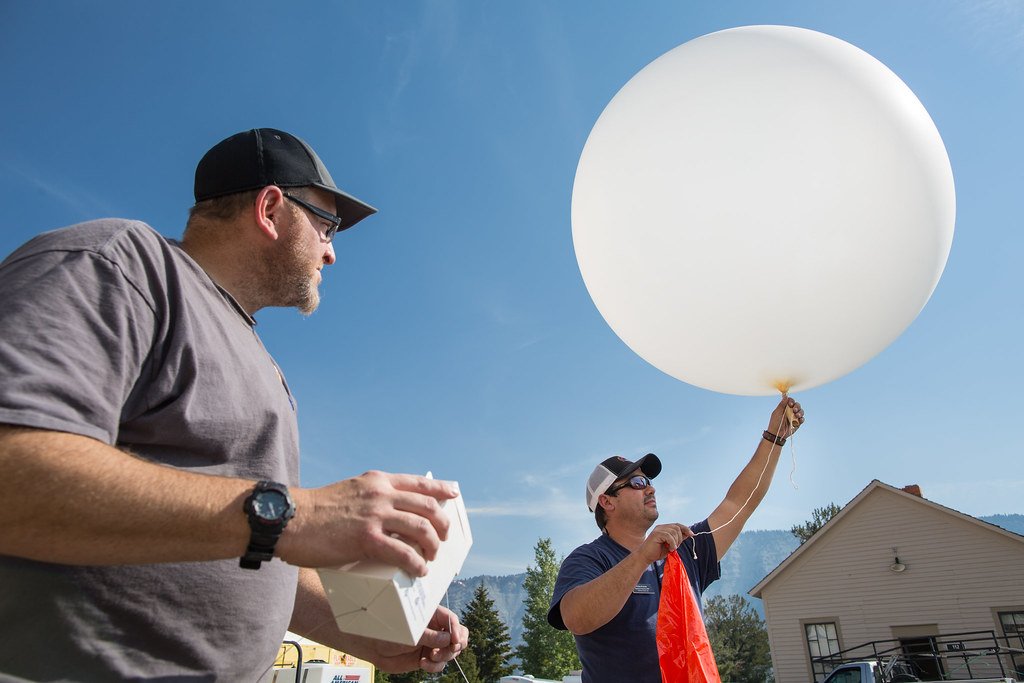
Featured image: a documentary photograph of a modern weather-balloon launch at Yellowstone, included for context. It does not depict Roswell, Project Mogul, 1947 debris or a UFO. Credit and public-domain notice are recorded in the WordPress image caption.