Declassified | Hidden history. The story of Operation Paperclip is often told as a grim Cold War bargain: the United States got German technical talent and looked away from unpleasant pasts. The archived evidence is both more specific and, in important ways, more troubling. The government wrote down screening standards—and then faced pressure to get around them.
The U.S. National Archives identifies the Joint Intelligence Objectives Agency (JIOA) as the body responsible for the foreign-scientist program first known as Overcast and later as Paperclip. It was not merely a rumor about rocket scientists appearing at NASA. Personnel case files, intelligence memoranda, and official reports document the recruitment apparatus and the questions it provoked.
A policy with a loophole built into its mission
In its report on implementing the Nazi War Crimes Disclosure Act, the National Archives traces the program to a July 1945 directive to recruit valuable German and Austrian specialists. In September 1946, President Harry Truman approved an expanded program while restricting admission to nominal rather than active Nazi supporters. The dilemma was immediate: many scientists had belonged to Nazi organizations, and military planners regarded their knowledge as strategic property.
According to the same report, a Justice and State Department screening panel rejected some candidates after examining their histories. The JIOA’s response in certain cases was to request revised security reports from U.S. military authorities in Europe so the scientists could become eligible. That is a documented conflict between a public screening standard and a secret program’s operational ambitions. It should not be paraphrased as proof that every individual dossier was falsified, or that every recruit was a war criminal.
What the actual case files reveal
The National Archives’ RG 330 guide to JIOA records describes personnel dossiers for more than 1,500 German and other foreign scientists, engineers, and technicians associated with Paperclip and similar programs. Another official summary counts 765 specialists brought in between 1945 and 1955 under a specified set of programs. Different definitions and time periods produce different totals; neither number should be treated as a universal tally of proven Nazis.
The files include Georg Rickhey, connected to the V-2 factory at Nordhausen. He was tried and acquitted in a U.S. military war-crimes proceeding; leaving out that acquittal would distort the record. They also include physician Walter Schreiber, described by NARA as involved with experiments on concentration-camp inmates, who later departed for Argentina, and engineer Arthur Rudolph, who left the United States in 1984 after the Justice Department investigated his role in persecution of prisoners at the underground rocket factory.
That range of cases shows why a single label will not do. Membership, allegations, trials, acquittals, documented conduct, and later immigration decisions are not legally or historically interchangeable. The victims of Nazi forced labor deserve accurate accounting, not a dramatic shortcut that treats all biographies as identical.
Why Wernher von Braun’s file is a particularly revealing gap
The most startling archival detail is a small note on the National Archives website: a personnel dossier for rocket engineer Wernher von Braun is not included in the transferred collection. NARA says it was never transferred to its custody. That is a provenance fact, not proof that somebody destroyed the document to conceal a particular crime.
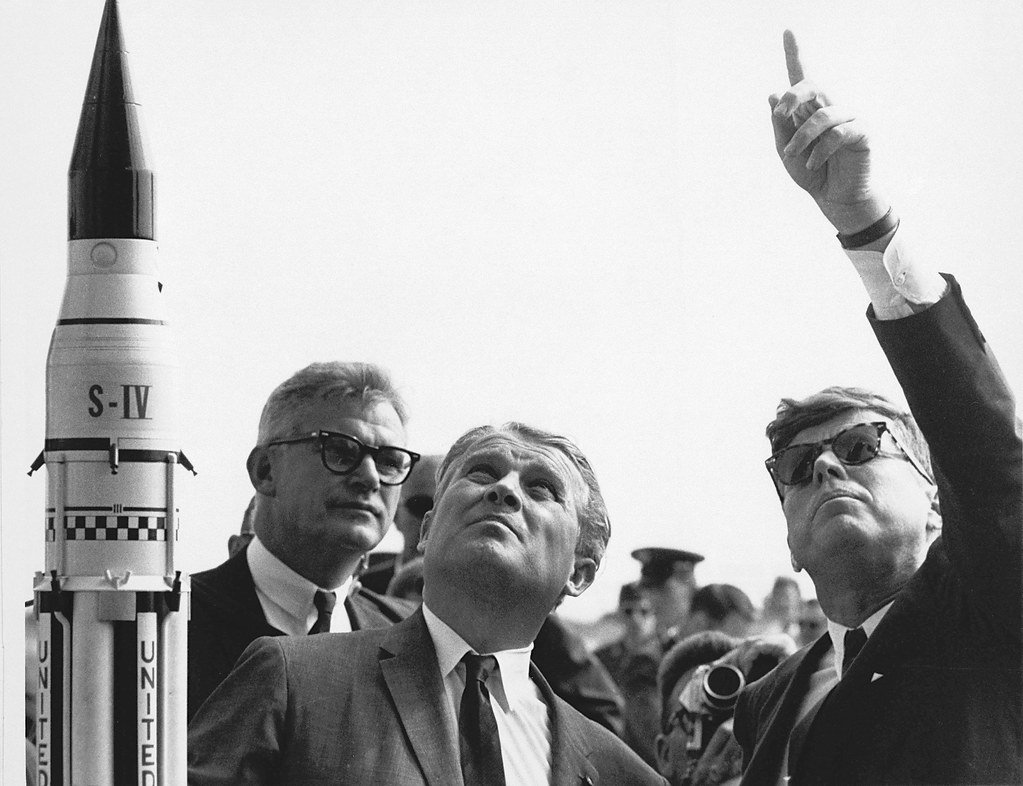
Von Braun’s work as a German V-2 engineer and subsequent role in the U.S. rocket program make him a central figure in this story. NASA’s later Saturn rocket successes cannot erase the forced-labor history of the German weapons program. Nor does a photograph of von Braun briefing President Kennedy answer questions about what every official knew at the moment of his recruitment.
Many popular accounts slide from the existence of a classified recruitment scheme to sweeping claims that the American space program was entirely conceived by former Nazis or that government recruitment proves each scientist committed atrocities. The sources support a narrower, stronger conclusion: Cold War competition created an incentive to prioritize expertise, and officials sometimes sought to revise adverse vetting so prospective recruits could enter.
How declassification changed the evidence
Records released under the Nazi War Crimes Disclosure Act broadened the documentary trail beyond celebratory accounts of American technical achievement. They gave researchers access to policy files and individual cases and forced distinctions between the strategic gains claimed at the time and the wartime histories of the people recruited.
It is reasonable to ask how the United States assessed moral costs when facing a Soviet competitor pursuing technical expertise. But ‘both sides were competing’ is an explanation of incentives, not an ethical defense of suppressing relevant evidence. Equally, the archive itself warns that records may mention victims, investigators, or people with no connection to criminal conduct. Being in a file is not guilt.
Read the source documents: National Archives, JIOA and foreign scientist case files; National Archives, Nazi War Crimes Disclosure Act interim report; historical overview and recruitment context. Apep Bar has also covered an unrelated Cold War operation involving the secret Berlin listening tunnel.
Featured image: actual archival photograph of Wernher von Braun briefing President John F. Kennedy about the Saturn system; public-domain-marked image via Openverse. This is a later photograph, not a Paperclip intake or screening scene.
When military advantage collides with accountability, who decides which history will accompany the expert into the future?