Indigenous Lands, Extraordinary Claims — Part 1 of 8 | November 25, 2026
A television mystery can begin with a map. An investigation needs something harder: a reason to believe that the boundary on that map describes a real phenomenon. The Alaska Triangle provides an unusually revealing test of that difference. Its appeal joins disappearances, strange lights and frightening stories into one landscape. But who gets to explain that landscape—and what evidence survives when the television framing is removed?
Apep Bar has already examined the Triangle’s missing-flight and UFO claims. This follow-up asks a different question: how does modern paranormal entertainment turn inhabited Indigenous lands into a setting for a single mystery? The answer begins by separating a production’s promotional claims from community knowledge and investigative records.
The production pitch is evidence of branding
Ocean Entertainment’s production page identifies its work on The Alaska Triangle for Wild Dream Films and Travel Channel U.S. Its pitch combines alleged unusual lights, missing aircraft, creatures and a hidden alien base. It also raises ley lines and electromagnetic anomalies as possible explanations. That is a useful primary source for what the program sells to viewers. It is not independent confirmation that the proposed forces or underground installation exist.
Putting several claims in one program makes them narratively adjacent. It does not establish that they share a cause. A disappearance requires a case investigation; a light requires an observation record; an alleged physical installation requires location-specific evidence. Each claim must earn its own conclusion before investigators can responsibly connect them.
The same distinction applies to testimony. A sincere account can establish what someone remembers experiencing without settling distance, scale, identity or origin. Dramatic editing may make uncertainty feel cumulative. Scientifically, several unresolved identification problems do not automatically add up to one identified extraterrestrial explanation.
Many peoples cannot become one anonymous legend
The Alaska Federation of Natives’ public introduction describes distinct peoples, cultures and living traditions across Alaska. Its regional account includes Tlingit, Haida, Eyak and Tsimshian peoples in the southeast, Iñupiaq communities in the north and northwest, and Yup’ik and Cup’ik peoples in the southwest. The organization also identifies Athabascan peoples of the interior and Alutiiq/Sugpiaq and Unangax peoples farther south and west.
That diversity matters whenever a paranormal story invokes an unnamed Native belief. Which people? Which publicly attributable source? What did the source actually say, and who supplied the alien interpretation? A modern narrator’s comparison cannot stand in for a community’s explanation. Nor does one individual’s account establish a belief shared by every member of a nation.
This article does not identify spiritual beings with extraterrestrials or reproduce restricted traditions. The public community source establishes a more basic point: Alaska is home to many living peoples whose knowledge cannot be collapsed into atmospheric background for a mystery franchise. Respectful reporting starts with attribution and permission, rather than collecting sacred material to decorate a theory.
Missing-person records answer different questions
Alaska’s Department of Public Safety MMIP resource provides quarterly reporting, investigative information and public resources for missing and murdered Indigenous persons. Its reporting framework concerns case status, demographics and circumstances. Those are practical investigative categories, distinct from the entertainment category of a paranormal triangle.
For any claimed cluster, a researcher needs a consistent geographic boundary, a defined period and comparable case definitions. Reports filed, unique people, resolved cases and people still missing are different measures. A statewide count cannot establish an unusual rate inside a selected shape without a defensible geographic analysis. Even a demonstrated concentration would require further work to identify its causes.
These are methodological requirements, not a conclusion that every case has been explained. The absence of an answer is real; the leap from that absence to alien abduction remains unsupported. Families’ unresolved losses deserve investigative attention without being recruited as evidence for a theory the records do not establish.
What would make the paranormal claim stronger?
A persuasive test would specify the proposed effect before gathering examples. If a particular area supposedly disrupts instruments, researchers would need calibrated measurements, documented equipment behavior, comparison locations and reproducible results. If an encounter involves an object, its evidentiary value depends on the original recording, provenance, observation conditions and independent corroboration.
Community testimony deserves accurate representation on its own terms. It should neither be dismissed because it is Indigenous nor promoted into scientific proof of a claim the speaker did not make. Cultural meaning, personal experience and physical identification can be related subjects while still requiring different forms of interpretation.
Readers interested in seeing the entertainment framing can consult the production page and its linked opening video. That material is contextual television promotion, not footage verifying an extraterrestrial encounter. The distinction is central to this series: we will examine extraordinary claims without allowing publicity to become evidence by repetition.
The most revealing boundary in this story is therefore not a triangle. It is the line between a claim, a source and a conclusion. Keeping that line visible leaves room for discovery while allowing Alaska’s peoples, histories and unresolved cases to retain their own identities.
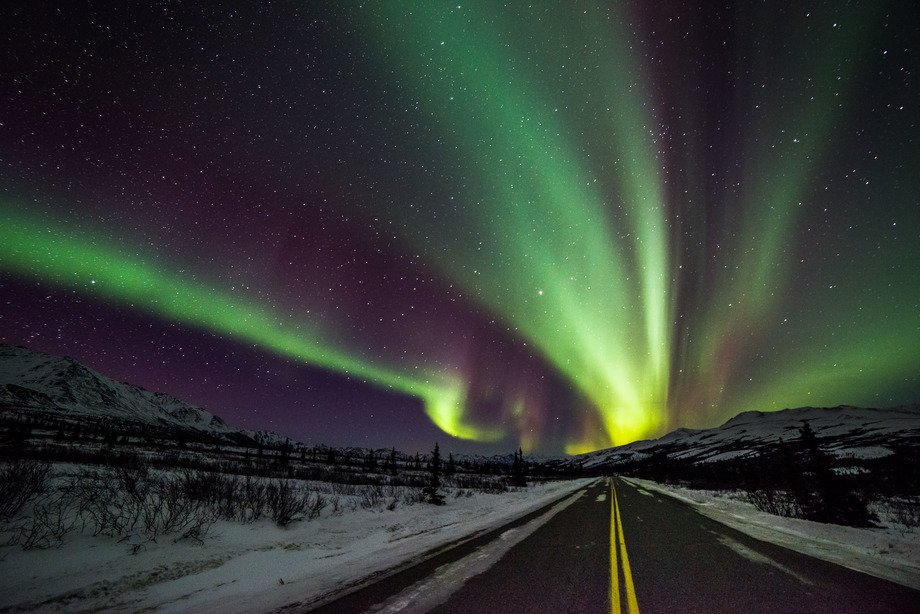
Featured photograph: Natural aurora over Denali, NPS Photo / Kent Miller; public domain under National Park Service usage guidance. Contextual landscape photograph, not a UFO sighting or evidence for paranormal activity. Sources reviewed November 25, 2026.