NEWS WIRE / ALTERNATIVE SCIENCE | November 21, 2026
Two laboratories 195 meters apart. A stream of entangled photons. And a deceptively simple question: can a remote device prove it is standing where it says it is?
Physicists at the National Institute of Standards and Technology (NIST) and collaborating institutions say they have demonstrated a new way to answer that question. The technique, called quantum position verification, uses randomly timed challenges and correlations between entangled particles to distinguish a device operating in an authorized location from one attempting to impersonate it somewhere else.
The experiment was reported in Nature on November 18, 2026, and detailed in a NIST research announcement. It is a genuine scientific advance, but it is not a working app for locating strangers, a replacement for GPS, or a universal defense against every future quantum attacker.
The location problem passwords cannot solve
Imagine a bank permitting a sensitive transfer only from a terminal inside a particular building. Passwords, identity documents and ordinary network records can establish credentials, but a sophisticated adversary may relay messages from somewhere else. A claim about where a digital message originated is not necessarily proof.
Classical position-verification schemes have a fundamental weakness: cooperating attackers can intercept, copy and rapidly relay ordinary information. They can sometimes make a response look as though it came from the intended location. Quantum information is different. An unknown quantum state cannot simply be copied perfectly and distributed to accomplices.
That distinction is the heart of the experiment. It is not magic; it is a way to use physics as a security constraint.
Inside the Boulder quantum test
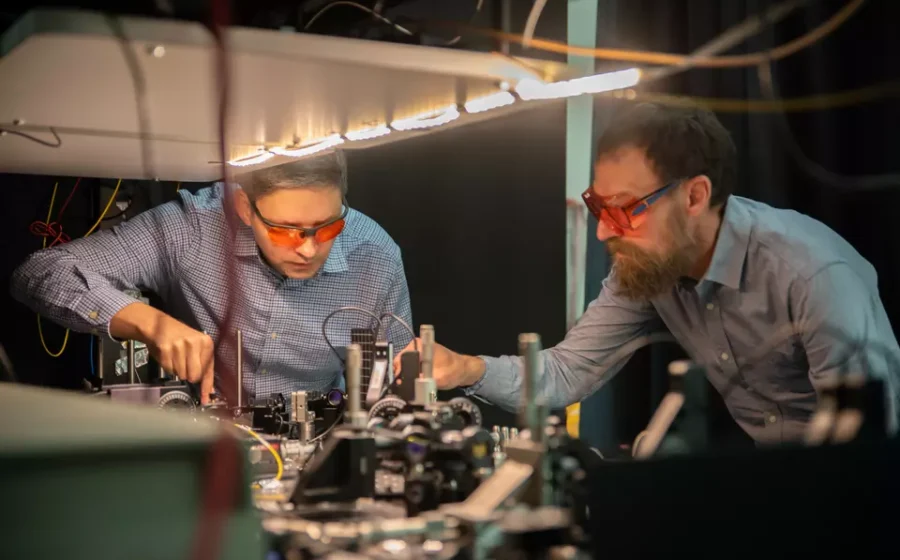
The team installed two trusted verifier stations in a NIST building in Boulder, Colorado, separated by 195 meters (about 640 feet). A third station, the “prover,” sat between them. The verifiers wanted to establish whether responses were really being generated in the authorized region.
One station prepared a pair of entangled photons—particles of light whose measurement outcomes exhibit correlations beyond what classical explanations permit. One photon traveled to the prover, while its partner was retained for a comparison measurement. The verifiers also dispatched unpredictable bits of information, timed to reach the claimed location together.
The prover had to use those bits to choose a photon measurement and send back the outcome immediately. The verifier stations checked two things: whether the response arrived within the light-speed timing constraints and whether repeated measurements produced the expected quantum correlations.
Over many trials, the researchers used a loophole-free Bell test to distinguish genuine entanglement-based correlations from patterns that could be generated by the attacks covered by their security model. NIST credits high-efficiency superconducting single-photon detectors and reliable entangled-photon sources with making the test feasible.
In the published paper, the authors report one-dimensional localization 2.47 times narrower than the best comparable classical region, and a 4.53-fold smaller localization volume when the systems are compared with identical latencies. Those are experimentally defined improvements in a controlled setup—not a claim that someone can be pinpointed to an exact coordinate anywhere on Earth.
The catch: what kind of faker can it actually defeat?
This is where the headline-friendly version of the story needs qualification. The experiment implemented a protocol against adversaries who were only weakly entangled before each trial. The authors describe a broader theoretical protocol with defenses against substantially resourced quantum adversaries, but demonstrating one attack model is not the same as proving that every conceivable coalition of quantum computers can be beaten in practice.
Earlier position-verification theory also established a sobering limit: an adversary equipped with unlimited shared entanglement can defeat general position-only verification schemes. The new result is important because it shrinks the gap between rigorous theory and actual, imperfect laboratory equipment; it does not erase every security assumption.
The researchers call their test device-independent because its security can be certified from observed Bell-test correlations rather than an unquestioning trust in the internal operation of quantum devices. That is a narrower and more defensible meaning than “the hardware can never be compromised.”
Why banks and infrastructure operators are interested
The possible uses are consequential. A future financial network might require evidence that a high-value instruction originated at an authorized trading desk. A power operator might want confirmation that a sensitive command is being issued from inside a protected control room. In principle, location could become a cryptographic access condition rather than a self-reported field.
NIST also points to defenses against certain phishing and impersonation schemes. Yet a location proof would not by itself establish the identity or trustworthiness of a person occupying that location. Someone standing in the right building can still act maliciously; a valid measurement is not a character reference.
There is a second tension worth watching: a capability designed to protect privacy and infrastructure could also be used to restrict access or log where authorized devices operate. Location-based authentication is not automatically mass surveillance, but whoever controls the verifiers and records the results would deserve scrutiny. Apep Bar has examined other technologies that turn physical environments into data, including Wi-Fi movement sensing inside homes. Quantum verification raises a different technical question, but a familiar governance one: who decides when a location must be proven?
From a corridor experiment to the real world
For now, deployment is a long way off. NIST physicist Scott Glancy cautioned that applying the technique in everyday security may be more than a decade away. A large-scale system would require high-fidelity quantum networking, robust equipment, reliable synchronization, and careful handling of loss and errors. The Boulder demonstration was built in a controlled research setting, not across an ordinary commercial internet connection.
As Gizmodo reported on November 19, the result could give future networks a physical basis for rejecting certain false location claims. The more interesting question is what will be required before the approach can secure systems whose operators cannot afford false positives—or false confidence.
Bottom line: Physicists have experimentally demonstrated a quantum advantage for verifying a remote device’s location, within stated security assumptions. They have not invented a universal location lie detector, and they have not put the technology in the field.
When a secure computer says it is inside a bank, can a network eventually demand physical proof rather than accept another digital promise? And when it can, who gets to demand that proof?
Sources and further reading
- Kavuri et al., “Quantum position verification with remote untrusted devices,” Nature, November 18, 2026 (original peer-reviewed research).
- NIST, “Quantum Physics Can Verify a Person’s Location,” November 18, 2026 (institutional explanation and laboratory details).
- Davide Bacco, “Quantum physics can prove where you are,” Nature News & Views, November 18, 2026 (scientific interpretation).
- Open-access research preprint (technical background and version history).
- Gayoung Lee, Gizmodo, November 19, 2026 (original news report prompting this coverage).