An Apep Bar investigation • October 23, 2026
Draw three lines across Alaska and a landscape becomes a suspect. A missing aircraft becomes a clue. An unfamiliar light becomes a visitor. Soon, separate events begin to look like chapters in the same story.
The Alaska Triangle is compelling because some of its ingredients are real: people have disappeared, aircraft have gone missing, and pilots have reported things they could not identify. The harder question is whether those facts belong to one phenomenon—or whether the triangle is doing more work than the evidence.
Following our recent coverage of an ancient Alaska campsite, we turn from what the ground preserves to what the region’s mysteries leave unresolved. This is an examination of historical cases and claims, not an announcement of a new alien discovery.
A triangle drawn around uncertainty
Popular accounts generally place the Triangle between Anchorage, Juneau, and Utqiaġvik, formerly called Barrow. It is a storytelling boundary rather than an official investigative jurisdiction. Even descriptions of its size vary. That matters: a region must have a consistent boundary before anyone can reliably calculate an unusual concentration of incidents within it.
A striking map is a starting point for a question. Establishing an anomaly would require a defined period, verified locations, consistent case definitions, and comparisons that account for travel, terrain, and exposure. Collecting unsettling stories inside a large shape does not by itself establish a shared cause.
Did 20,000 people really vanish?
The widely circulated claim that roughly 20,000 people have vanished in the Alaska Triangle is not a verified count of people who remain missing inside those boundaries. We could not substantiate that interpretation in the official material reviewed for this article. Repetition across mystery websites is not an independent audit.
Alaska’s Missing Persons Clearinghouse is the statewide repository for reported adult and juvenile cases. Its public page says its list is updated daily and explicitly warns that not everyone listed has a separate bulletin. A bulletin count therefore cannot safely stand in for the entire missing-person caseload.
There are several different numbers a responsible investigation must keep separate: reports filed over many years, individual people reported missing, cases subsequently resolved, and people still missing on a specified date. A statewide total also cannot automatically become a Triangle total. The official page reviewed here did not provide a validated historical Triangle series, so we are not substituting a fresh-looking number for an unsupported old one.
The uncertainty in the statistic should not obscure the people behind the records. An unresolved disappearance is a family’s ongoing loss, not evidence of abduction by extraterrestrials.
1972: the flight that never reached Juneau
On October 16, 1972, a chartered twin-engine Cessna carrying House Majority Leader Hale Boggs, Alaska Representative Nicholas Begich, aide Russel L. Brown, and pilot Don E. Jonz disappeared while traveling from Anchorage to Juneau.
The U.S. House historian’s account records difficult weather and an extraordinary search: 40 military aircraft, 50 civilian planes, and more than 3,600 hours of search time. After 39 days without locating the aircraft or survivors, the search ended.
That is a genuine and disturbing historical mystery. It also illustrates the limits of a search. A large operation can fail without a supernatural event having occurred. The surviving uncertainty does not identify the cause, and this case supplies no demonstrated connection to an alien encounter.
1986: a UFO report with a real archival trail
Japan Airlines Flight 1628 belongs in a different evidence category. On November 17, 1986, its crew reported unidentified lights or objects while flying over Alaska. Unlike a story circulating without a record, this encounter has a federal documentary trail.
The National Archives describes FAA holdings concerning the flight, including simulated radar imagery and interview notes involving the three crew members. Those records make the report worth examining. They establish that an encounter was reported and documented; the existence of a government file does not certify the witnesses’ interpretation.
The distinction becomes especially important when a retelling combines testimony, radar references, and dramatic descriptions into a single apparently conclusive scene. What did each person independently observe? What was contemporaneously recorded? What was reconstructed later? Simulated radar imagery should not be casually described as a photograph of an alien spacecraft.
Eyewitness experience deserves attention. Establishing distance, size, speed, and origin requires additional evidence. “Unidentified” describes an identification problem; “extraterrestrial” proposes a specific solution. The archival material identified here does not establish that solution.
2023: an actual shootdown, an incomplete identification
On February 10, 2023, a U.S. fighter shot down a high-altitude object off Alaska. The official announcement described an object at roughly 40,000 feet that posed a potential aviation hazard.
Associated Press reported on February 17 that the search near Deadhorse ended without finding debris. Officials considered the three smaller objects downed that month likely civilian balloons. That assessment was not a recovered-material identification of the Alaska object. Neither does the absence of debris demonstrate an extraterrestrial origin.
This was a separate Arctic incident, not proof that every mystery attached to the Triangle shares a cause.
The environment deserves a place in the investigation
Before invoking a portal, examine what a pilot could see. The National Weather Service’s Alaska Aviation Weather Unit provides dedicated aviation forecasts, including icing and other flight hazards. The FAA’s Alaska safety initiative likewise treats the region as a place requiring practical, specialized flight support.
In a March 18, 2026 update, the FAA explained how weather cameras help pilots assess rapidly changing conditions, including approaching fog. Its network includes mountain passes, remote airports, and rocky coasts. These are concrete responses to observable problems: limited visibility, terrain, and gaps in weather information.
On the ground, cold, water, snow, and difficult access can complicate survival and recovery. Those mechanisms must be evaluated case by case. They are credible avenues of investigation, not permission to declare every missing person an accident victim. Crime and other human causes also require consideration when the evidence warrants them.
Aliens, portals, and the seduction of a single explanation
Extraterrestrial visitation, hidden bases, and dimensional portals offer a dramatic way to connect unrelated mysteries. In the records reviewed here, no verified physical evidence establishes those explanations. A theory gains strength by predicting evidence that competing explanations cannot account for—not by absorbing every gap in the record.
Nor should Alaska Native traditions be used as anonymous atmospheric decoration. A claim about a particular community’s beliefs requires a specific, attributable source and cultural context. This investigation does not turn generic internet “ancient legends” into testimony from Alaska’s diverse Native peoples.
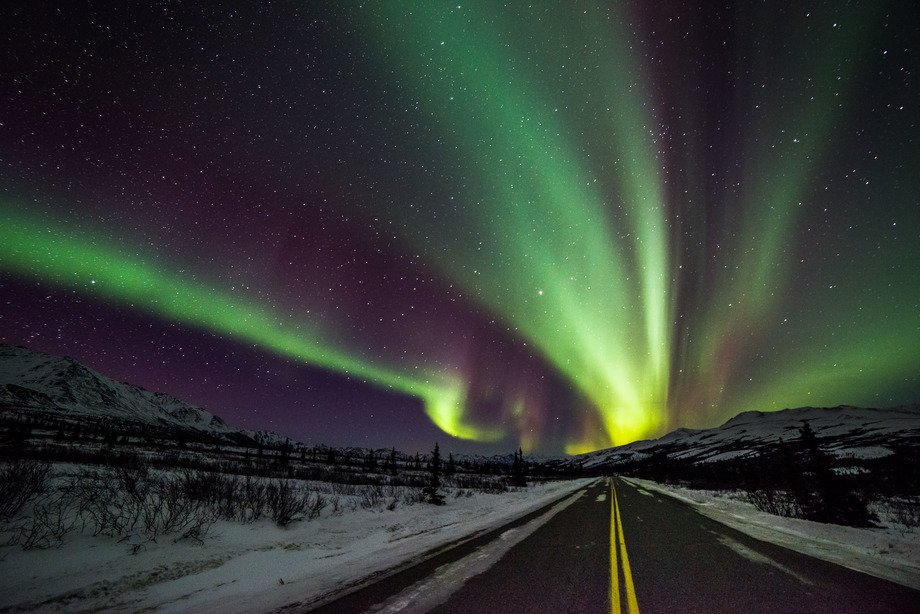
Alaska’s real sky needs little embellishment. The National Park Service explains that long exposures can make aurora photographs brighter and more colorful than the same scene appears to the eye. That does not explain a particular UFO case. It does show why photographs, perception, and physical measurements must be distinguished.
The most interesting investigation leaves room for surprise while refusing to manufacture certainty. Keep the witness statement. Preserve the radar record. Check the weather. Audit the statistic. Let an unanswered question remain unanswered until something better arrives.
Question. Investigate. Reconsider. If the Alaska Triangle is more than a compelling boundary drawn around uncertainty, what evidence would distinguish it from the dangers—and the extraordinary skies—of Alaska itself?
Featured image: Natural aurora over Denali National Park and Preserve. NPS Photo / Kent Miller; public domain under NPS usage guidance. Context photograph, not a UFO sighting or an illustration of an encounter. Sources linked throughout; reviewed October 23, 2026.