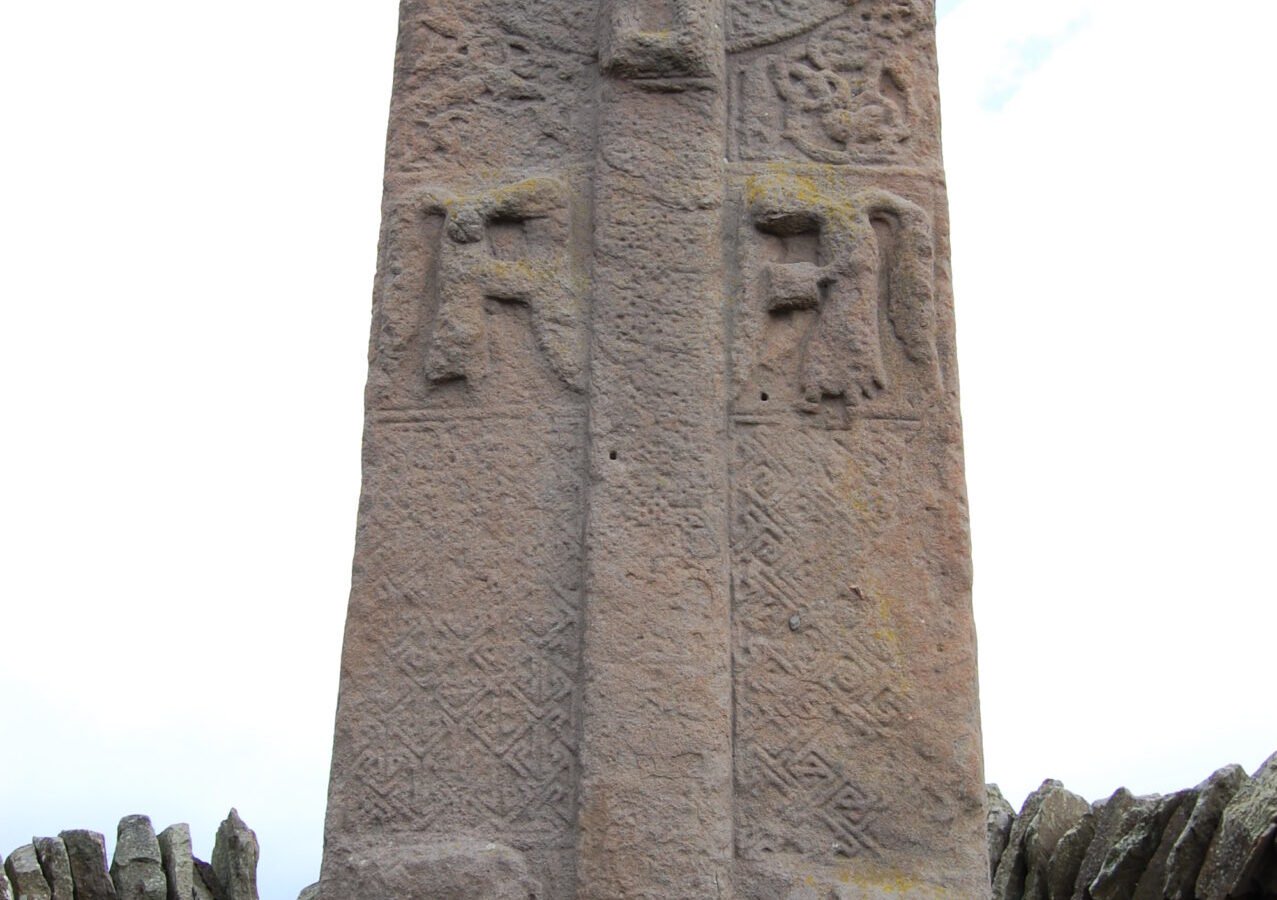
November 6, 2026 — A famous carved standing stone in Scotland has given archaeologists a fresh puzzle: one piece of an older monument was found supporting its base, while a separate carved human face turned up in nearby soil. And the ground itself suggests the stone may not always have stood exactly where people remember it.
Historic Environment Scotland announced the findings on November 5, following excavations by its archaeologists and AOC Archaeology at Aberlemno III, one of the celebrated Pictish stones in Angus.
The fish beneath the stone
Beneath the base, the team found a fragment engraved with what appears to be a salmon—an established motif in Pictish carving. It was apparently reused as support for the standing stone. That is intriguing because a carved fragment does not usually begin life as anonymous structural packing: it had a prior story before becoming part of Aberlemno III’s foundation.
But archaeologists are not yet in a position to say precisely when the earlier monument broke, who reused the piece, or what purpose the original carved stone served. Further analysis of the excavated samples may narrow the chronology.
And the face did not fit
Researchers also recovered part of a carved human head from the topsoil nearby—not from the same spot as the salmon fragment. Its features suggest an Early Medieval origin, but the fragment does not appear to fit Aberlemno III’s existing slab. It could point to another monument or carving in the local landscape. For now, that is a possibility, not a verified hidden statue.
Two additional ground features may represent former settings for standing stones. One interpretation is that Aberlemno III was previously positioned differently, perhaps on the same site. The evidence raises a question about how the monument changed over time rather than supplying a dramatic, complete answer about the Picts.
What is actually known?
These are physical finds reported by Scotland’s heritage authority, not an internet legend about an ancient code. Yet discovery and interpretation are separate stages: a salmon motif is observable, while the original placement, date and cultural meaning of the fragments remain research questions.
Sometimes the most tantalizing secret beneath a monument is not a treasure chamber. It is evidence that its history was rewritten by the people who came later.
Sources and image credit
Historic Environment Scotland, November 5 official announcement · Aberlemno sculptured stones background.
Featured photograph: The real Aberlemno III standing stone, photographed upright in 2009—not the newly excavated fish or face fragments. Kylemunro1 / Wikimedia Commons, public domain.