What did ancient Egyptian embalmers really mix into the substances that preserved the dead? At a workshop in Saqqara, archaeology and modern chemical analysis have begun answering that question—one vessel at a time.
Thirty-one vessels, a lost technical vocabulary
A study published in Nature on February 1, 2023 examined organic residues inside 31 ceramic vessels from a 26th Dynasty embalming workshop. Crucially, some vessels carried inscriptions explaining the substances they contained or the body parts they were intended to treat. By combining those labels with gas chromatography–mass spectrometry, researchers connected ancient words to physical ingredients rather than relying solely on later translations.
The analysis identified mixtures including Pistacia resin, conifer oils or tars, elemi, plant oils, animal fats, beeswax and, in some contexts, bitumen. Treatments varied: embalmers used different preparations for the head and for linen wrappings. These materials had practical properties—some were aromatic or antimicrobial, while waxes and tars could help seal or protect tissues.
When ‘myrrh’ wasn’t simply myrrh
Two familiar Egyptian terms, antiu and sefet, turned out to be especially revealing. The team found evidence that antiu, traditionally translated as myrrh or incense, referred at this site to a conifer-based oil or tar mixture. Sefet appears to have been an unguent containing plant additives. These results complicate any simple one-word translation of Egyptian technical recipes.
A global supply chain before globalization
Some identified substances came from beyond Egypt. The researchers linked the ingredients to Mediterranean trade and possibly tropical forest regions of Asia or Africa. It is evidence for specialized procurement and practical expertise, not proof that every embalmer used exactly the same formula across all periods of Egyptian history.
The researchers studied one archaeological workshop, not every secret of mummification. Still, each labeled jar offers a glimpse into a combination of chemistry, religious practice and long-distance trade that flourished more than 2,500 years ago.
Apep Bar question: How much ancient expertise remains hidden in objects once dismissed as ordinary containers?
Original research: Rageot et al., Biomolecular analyses enable new insights into ancient Egyptian embalming, Nature (2023).
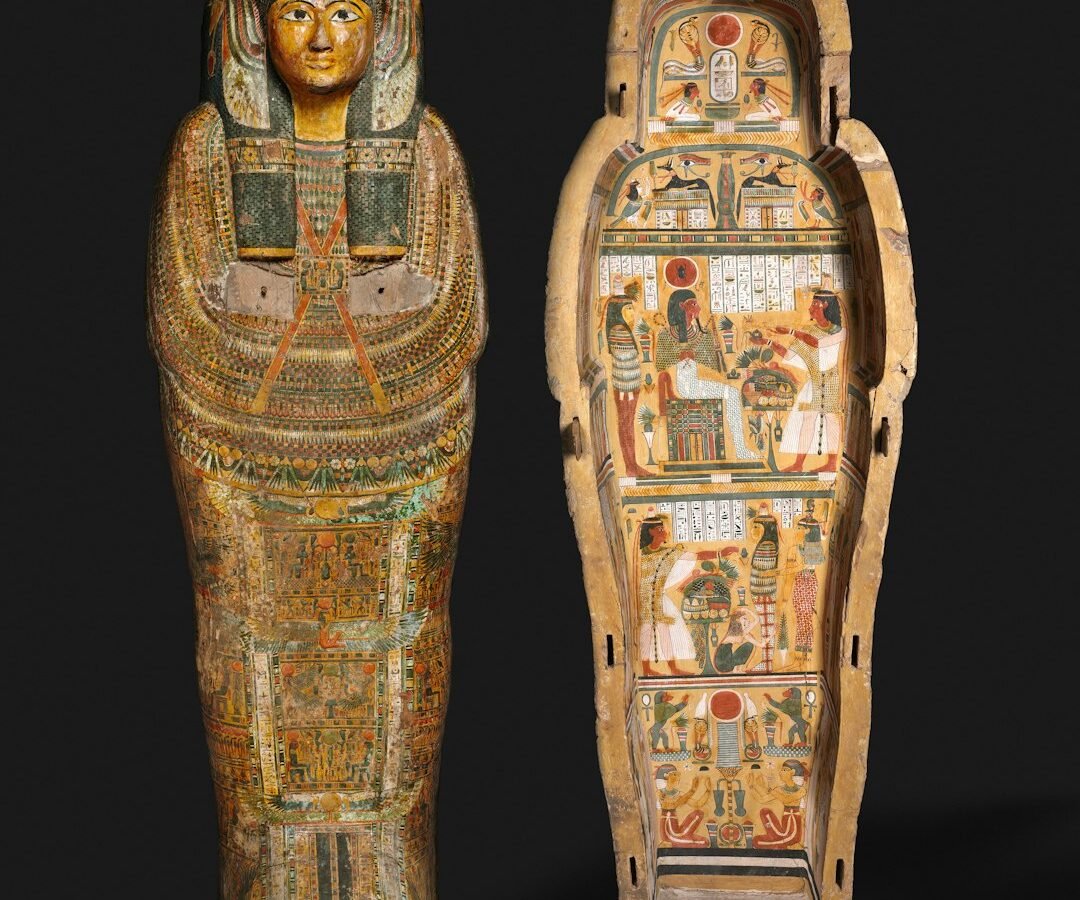
Featured image: ancient Egyptian coffin, Cleveland Museum of Art / Unsplash. Illustrative—not from the Saqqara workshop.
Question. Investigate. Reconsider.