Forget tropical oceans and warm primordial ponds. New research suggests some of the universe’s most intriguing laboratories for life’s beginnings could be freezing alien seas.
Imagine a planet with no continents, no beaches, and an ocean so deep that immense pressure may create exotic layers of ice far beneath the surface.
Now imagine that one of the most promising places for life to begin on this enormous water world isn’t deep beneath the waves.
It’s at the edge of a floating sheet of ice.
A study published on October 23, 2026, in Monthly Notices of the Royal Astronomical Society proposes that sea ice could help create favorable settings for prebiotic chemistry—chemical processes that might eventually contribute to the origin of life.
Researchers Edouard F. L. Barrier, Nikku Madhusudhan and Frances E. Rigby examine a question that seems almost paradoxical: could frozen water help solve a problem created by having too much liquid water?
The Cosmic Problem With Too Much Water
Water is essential for life as we know it. But a gigantic ocean can create a surprisingly difficult chemical problem: the ingredients needed for complex reactions may be far too diluted.
On some water-rich planets, oceans may be tens or hundreds of kilometers deep. High-pressure layers of ice could also separate the ocean from the rocky interior, potentially limiting access to minerals from below.
Even where nutrients are present, they may be dispersed across an ocean of planetary proportions. Several proposed pathways to life require reacting chemicals to be concentrated rather than endlessly diluted.
How, then, could the building blocks of life gather in one place? The new study suggests the answer might be floating right on the surface.
An Alien Freezer That Concentrates the Ingredients
When seawater freezes, many dissolved compounds are excluded from growing ice crystals. These substances can accumulate in concentrated salty pockets and tiny liquid channels called brines.
Those microscopic reservoirs offer a potential advantage: they bring molecules into closer contact, increasing the possibility of reactions that would be unlikely in a giant dilute ocean.
Where freezing and melting repeat, the ice may also create changing chemical conditions, compartments and pools of concentrated material. The authors discuss how incoming starlight could supply an energy source for some of the chemistry.
This doesn’t mean ice is a proven cradle of life. It means that, under the right conditions, ice could help solve one major problem that makes the origin of life difficult to explain on ocean-covered planets: concentration.
Three Alien Worlds Enter the Climate Model
The scientists used a three-dimensional planetary climate model called ExoCAM to simulate scenarios analogous to three known exoplanets:
- TRAPPIST-1 e, a rocky planet orbiting an ultracool star;
- LHS 1140 b, a planet whose possible water-rich composition has attracted interest;
- K2-18 b, a sub-Neptune studied as a possible example of a Hycean planet.
Hycean worlds are hypothetical planets with extensive liquid-water oceans beneath hydrogen-rich atmospheres. They are of interest to astrobiologists, but the actual surface environments of individual candidates remain uncertain.
Under the atmospheric and ocean assumptions chosen for the simulations, all three modeled scenarios produced sea ice in regions of their illuminated hemispheres.
The researchers paid particular attention to the margins where temperatures hover near the freezing point. They call these perifreezing zones—places where ice can form, melt and reform.
In the simulations, these zones covered approximately 2–10% of the planets’ surfaces. Even those fractions can translate into millions of square kilometers of potentially interesting icy terrain.
Crucially, this is a model result, not an observation confirming sea ice on TRAPPIST-1 e, LHS 1140 b or K2-18 b.
Meteorites: An Unexpected Delivery Service?
The study also investigates a wonderfully strange possibility: what happens when fragments of asteroids or comets land on floating sea ice?
Small fragments might stop on top of the ice instead of plunging straight into the ocean. Such debris could bring minerals and other chemical feedstocks into a relatively small area. If melting creates local pools nearby, freeze–thaw cycles could repeatedly change their chemical concentrations.
Picture a cosmic pebble landing on a frozen alien ocean, surrounded by a little patch of water rich in compounds delivered from space. No biological miracle is required for the idea to be scientifically interesting. The significance is that the ingredients might finally be in the same place at the same time.
Of course, the meteorite chemistry, impact rates, local temperatures and actual reactions would still have to cooperate. The paper investigates plausibility; it does not demonstrate that an icy meteorite pool makes life.
What the Study Hasn’t Proved
There has been no detection of extraterrestrial life in this work, and no experimental demonstration that these proposed environments produce living organisms.
The climate simulations used a simplified ocean representation and did not explicitly model full ocean heat transport or drifting sea ice. Those omissions matter because currents and moving ice could change the size, thickness and location of the proposed freeze–thaw regions.
Scientists also still need to establish whether the relevant molecules would be abundant enough, whether useful reactions can persist under cold conditions, and how such reactions could develop into self-sustaining biological systems.
Some proposed prebiotic reactions may be aided by icy concentration; others might stall or demand different conditions. The new hypothesis is an additional possibility, not a replacement for every other origin-of-life theory.
Maybe the Coldest Places Are Worth a Closer Look
For decades, origin-of-life discussions have frequently centered on warm ponds, hydrothermal systems and mineral-rich geological environments. Sea ice suggests that the edge of a frozen ocean deserves a place in that conversation too.
The broader lesson is simple but provocative: liquid water alone may not be enough. A planet might also need an efficient way to bring life’s chemical ingredients together.
Perhaps certain icy shores—on planets that may not have land at all—could provide exactly that sort of chemistry-friendly setting.
Could some of the coldest places in the universe become the first places where life begins?
Sometimes it’s real. Sometimes it’s questionable. Sometimes it’s downright strange. And sometimes … well, it’s Apep Bar.
Question. Investigate. Reconsider.
Sources and Research Notes
Primary study: Edouard F. L. Barrier, Nikku Madhusudhan and Frances E. Rigby, “Sea Ice as an Origin of Life Location for Hycean and Ocean Worlds,” Monthly Notices of the Royal Astronomical Society, published October 23, 2026. Read the original peer-reviewed journal paper.
Manuscript: arXiv:2609.07818.
Editorial distinction: The locations, concentration pathways and model results described here are scientific hypotheses and simulations, not observed evidence of alien life. The three exoplanets serve as modeled analogues; actual planetary conditions remain uncertain.
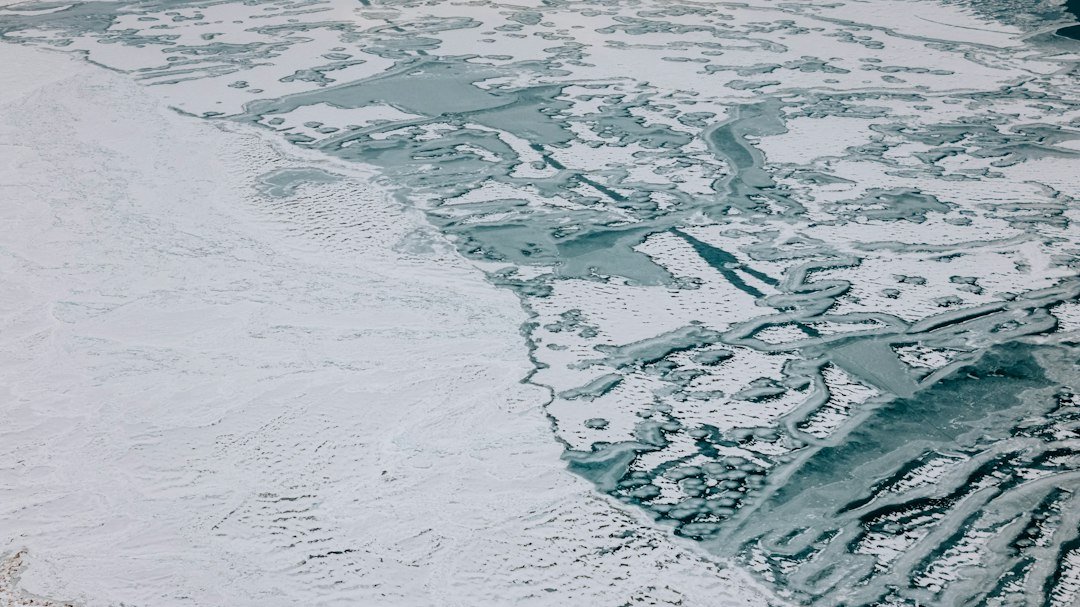
Featured image: Arctic sea ice photographed by Hector John Periquin / Unsplash. Illustrative Earth photograph, not an image of an exoplanet.