What if one of history’s most stubborn codes has been hiding a much simpler problem? For generations, scholars have stared at the Voynich Manuscript’s unfamiliar symbols, peculiar plants, star charts, and bathing figures, searching for a language they can recognize. A 2026 study offers a provocative possibility: the book may have been put together in the wrong order centuries ago.
That does not mean the manuscript has been deciphered. But it may mean investigators have spent decades analyzing a text whose pages were never supposed to be read in their present sequence.
The puzzle inside the puzzle
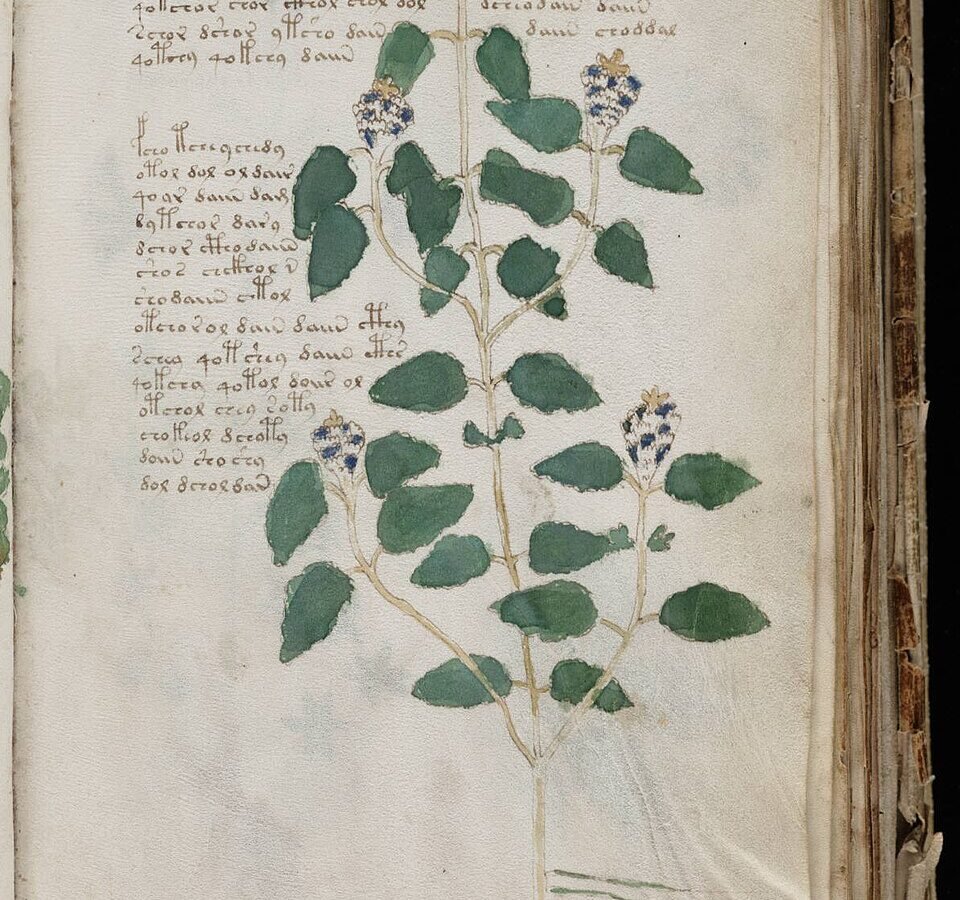
The manuscript, cataloged as Beinecke MS 408 at Yale University, is an illustrated medieval volume written in a script that remains unread. Its pictures appear to depict botanical specimens, astronomical or astrological symbols, bathing scenes, and other subjects whose precise meaning is disputed. The parchment and other physical evidence place it in the early fifteenth-century manuscript tradition, although its author and purpose remain uncertain.
In the 2026 peer-reviewed paper Singulion Structure and the Voynich Manuscript, information scientist Colin Layfield and medievalist Lisa Fagin Davis examined whether the manuscript was originally constructed differently from the book we see today.
What is a “singulion”—and why would it matter?
Medieval books were commonly assembled from parchment sheets folded in half. Those folded sheets, called bifolia, were often tucked inside one another to create groups known as quires. Reading order depended on how the sheets were nested.
Layfield and Davis argue that the Voynich pages may instead have been intended as a series of individual folded sheets—singulions—stacked and read one after another. If someone later nested those sheets in the conventional way before binding them, text that once followed logically could have been separated by several pages.
Imagine dropping a stack of four-page pamphlets, then rebuilding it as if each pamphlet were supposed to fit inside the next. All the words would still be there. The original sequence would not.
The clues are hiding in the art—and in the handwriting
The researchers point to illustrations that appear to continue across the inner edges of pages that are no longer consecutive in the bound book. They also highlight an unusual scribal pattern: previous handwriting analysis identified multiple people working on the manuscript, with most surviving bifolia apparently written by a single scribe even when sheets from different scribes are now nested together.
The team then used latent semantic analysis, a statistical technique that measures patterns of similarity between blocks of text, to compare the Voynich material with two known medieval works: the Aberdeen Bestiary and Speculum Humanae Salvationis. In the known texts, adjacent pages behaved broadly as expected for conventional binding. The Voynich text showed a different pattern, one the researchers interpret as support for the singulion hypothesis.
Crucially, the method is finding statistical patterns in the unknown symbols. It is not translating those symbols or proving what any individual passage says.
Does this finally crack the Voynich code?
No. The researchers acknowledge that repeated vocabulary, chance, or another unknown feature of the text could contribute to their results. They also caution that even if the folded sheets were originally separate, there may not be a single correct order for every section.
The findings therefore offer a testable explanation for the book’s strange physical arrangement, not a verified reading of its contents. Scholars could revisit earlier analyses, examine transfers of paint and stains between pages, and see whether alternative sequences make the manuscript more coherent.
There is an irony here: the very binding that may have scrambled the text could also have helped it survive. Unbound medieval sheets were much easier to lose.
The mystery is still on the table
Readers can inspect the manuscript through Yale’s Beinecke Rare Book & Manuscript Library. The manuscript is real. Its unusual writing is real. The proposed binding mistake is a scholarly hypothesis supported by physical observations and computational comparisons—not a solved cipher.
Perhaps the next breakthrough will not come from discovering a secret alphabet at all. Perhaps it will begin with something as ordinary as turning to the right page.
Apep Bar question: If a mysterious book has been studied in the wrong sequence for centuries, how many confident theories should we be willing to reconsider?
Research and image credits: Primary research: Layfield and Davis, Digital Medievalist, Vol. 19 (2026). Manuscript background: Yale Beinecke Library. Featured image: botanical folio from the Voynich Manuscript, Beinecke Rare Book & Manuscript Library, Yale University, via Wikimedia Commons (public domain in the United States).