Four people who worked in Congress’s in-house medical office describe a workplace where sailors allegedly faced punishing shifts, pressure not to take leave and demands that blurred the line between medical support and personal service. One sailor said the assignments included clipping a congressman’s toenails and delivering medication to a lawmaker’s home at 3 a.m.
Those claims first appeared in November 12 reporting by Natalie Oliverio for Navy Times/Military Times. The accounts are serious, and they remain allegations: the sources spoke anonymously, the lawmakers involved were not identified, and the public record does not establish that any individual personal-service allegation occurred.
But the story does not stop at the toenails. A separate Pentagon inspector general advisory released the next day identified documented deficiencies in the oversight of the congressional medical office’s clinical standards and pharmacy. And Brian Monahan, the rear admiral who had served as Congress’s attending physician since 2009, left the post as questions mounted.
The assignments sailors say went beyond medicine
The Office of the Attending Physician (OAP) provides medical and emergency support to members of Congress, Supreme Court justices, congressional staff and Capitol visitors. Until recent reassignments, active-duty Navy personnel served in the operation.
According to the original Military Times investigation, four people who worked in the office described a high-pressure environment. They said sailors worked 70- to 80-hour weeks, were discouraged from taking leave and were threatened with losing monthly allowances when they challenged managers. Some allegedly faced pressure to remain beyond the usual three-year assignment.
One active-duty sailor described duties including cutting a congressman’s toenails and taking medication to a private residence in the middle of the night. A former Navy hospital corpsman said that when Congress remained in session late, some personnel stayed until approximately 4 a.m. but were expected to return for a 6 a.m. shift. Sources also described medical standby duty at birthday parties, dinners and other VIP events.
These descriptions are attributed to those interviewed by Military Times, not to independent interviews conducted by Apep Bar. The publication reported that the Navy and the OAP did not respond to its requests for comment before that story appeared.
Congress has had Navy medical staff since 1928
The arrangement is longstanding, not a recently invented congressional perk. A Congressional Research Service history of the OAP explains that the House requested a Navy medical officer in 1928 and that the office later came to serve both chambers. Its formal functions range from first aid and emergency response to vaccinations, medical examinations, public-health planning and medical support for major congressional events.
That distinction matters. Medical standby at an official event is not automatically improper, nor is every instance of nail care necessarily nonmedical. The central questions are why particular duties were assigned, whether they were clinically appropriate, how commanders controlled personnel and whether sailors could refuse inappropriate work without retaliation. The published accounts do not provide enough detail to answer those questions for each alleged incident.
The inspector general documented a different, wider failure
In a November 2026 management advisory (DOWIG-2027-026), the Pentagon inspector general described gaps in clinical quality management and pharmacy oversight at the OAP. As Navy Times reported in its follow-up, Pentagon components did not believe they had authority to oversee clinical quality management and pharmacy operations inside the office.
The watchdog also could not verify that the OAP pharmacy had received the required inspections. A controlled-substance inventory board had observed the pharmacy’s drug stocks seven times between January 2023 and February 2026, but that was fewer checks than applicable military requirements called for. Reviewers reported five inconsistencies, including missing prescription records associated with medical bags used during congressional travel. The inspector general could not establish whether the discrepancies had been corrected.
These findings are evidence of oversight weaknesses and inventory-control problems. They are not proof that anyone stole medication, intentionally dispensed drugs improperly or ordered the specific personal errands described by the sailors.
According to CBS News, the watchdog recommended clearer supervisory responsibility, policies for the assigned medical staff and further pharmacy review, including an inspection if required inspections had not occurred. CBS also reported a separate Navy inquiry.
What happened to the congressional physician?
Monahan, a Navy rear admiral who had led the office since 2009, was no longer serving as attending physician by November 13. Senate Majority Leader John Thune told CBS News that his understanding was Monahan had resigned. The Washington Post reported that Monahan said in a voicemail message he was no longer serving with the office.
His departure is confirmed; the precise circumstances and any final accountability determinations should not be inferred solely from that departure. The public advisory about clinical oversight and the sailors’ claims about working conditions are related developments but not interchangeable findings. The accounts reported so far do not identify which lawmakers, if any, requested the alleged services, and no public determination cited here resolves the individual claims.
Who oversees the people caring for Congress?
Federal appropriations reveal that the office is funded through a special congressional arrangement. The fiscal 2026 legislative-branch appropriations text provides for allowances to the attending physician and other medical staff, along with reimbursement to the Navy for assigned personnel and equipment. This is public funding for a legitimate medical function; the unanswered issue is whether the safeguards surrounding it were sufficient.
That is the larger institutional problem. Navy service members remained within the military’s personnel system while operating inside a congressional medical service with disputed oversight boundaries. If commanders, office management and federal inspectors do not agree on who is responsible for medical quality, assignments and discipline, the question becomes difficult to avoid: who can hear a sailor’s complaint and act on it?
Congress has the authority to investigate the working conditions and medical controls of its own office, and military authorities can examine how personnel were supervised. Whether those processes provide the transparency needed will depend on what their findings actually disclose. Apep Bar has previously examined broader problems of military accountability in its coverage of the Pentagon’s latest audit; this case raises distinct questions about oversight at the boundary between the legislative and executive branches.
The questions still awaiting answers
Were any requests to trim nails or deliver medication personal favors rather than medically justified services? Who approved the alleged extended hours and controlled leave or allowances? Were complaints investigated before sailors were reassigned? What information can inspectors and the public see about pharmacy controls and personnel protections?
Those questions should be investigated without treating anonymous allegations as verdicts. The most consequential verified finding may be less lurid than a 3 a.m. errand: a public medical office staffed by Navy personnel operated amid serious uncertainty over who was accountable for the care it delivered.
Question. Investigate. Reconsider.
Sources and further reading
- Navy Times / Military Times, original interviews with four former or current OAP personnel (November 12, 2026)
- Navy Times, follow-up on inspector general oversight findings (November 13, 2026)
- Defense Department inspector general, Management Advisory DOWIG-2027-026 (November 2026; official report link)
- Congressional Research Service, Office of the Attending Physician: Background and Responsibilities (2020)
- CBS News, Monahan’s departure and findings (November 13, 2026)
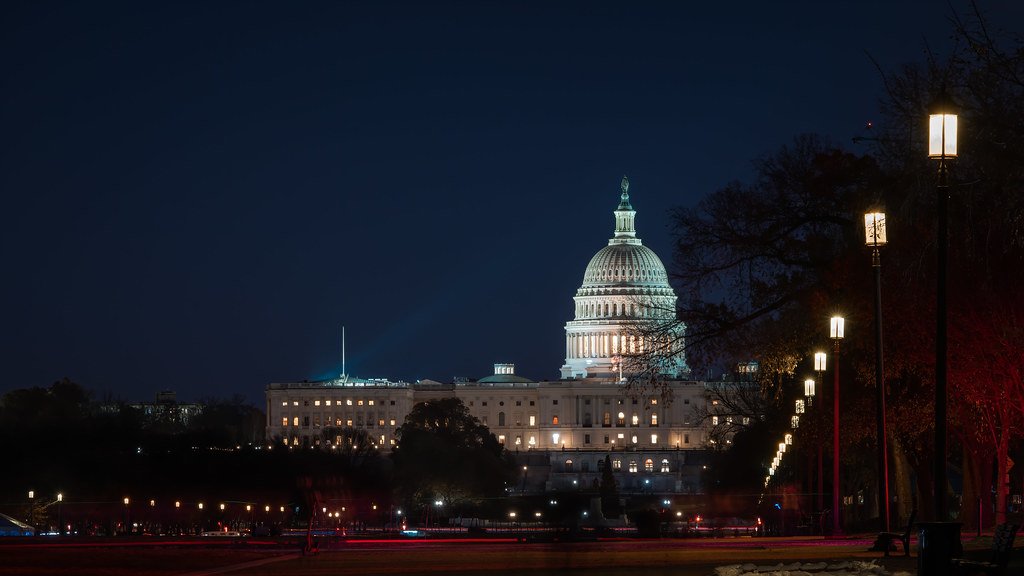
Featured photo: “United States Capitol at Night” by John Brighenti, CC BY 2.0, via Openverse/Flickr. Exterior photograph for context; not evidence of the alleged events. No video is embedded because a directly relevant, independently verified clip could not be established from the available reporting.