Imagine sailing at night into a sea that seems to shine from horizon to horizon—not with waves of blue sparks, but with a steady pale glow. Mariners have reported such ‘milky seas’ for centuries. Unlike ordinary bioluminescent surf, these events can spread over huge areas and persist for weeks.
A legend satellites can see
NASA Earth Observatory has described how sensitive nighttime satellite instruments detect faint offshore light after scientists rule out moonlight, clouds, vessels and other sources. One event observed near Java in 2019 expanded to an estimated 100,000 square kilometers. A 2025 peer-reviewed study archived by NOAA assembled historical accounts and satellite detections into a modern dataset.
What’s producing the glow?
Researchers suspect dense populations of luminous bacteria associated with marine ecosystems, but the chain of conditions that creates and sustains a milky sea remains poorly understood. Most events occur far from easy sampling sites. Very few have been examined directly from a ship while they were happening, limiting the chemical and biological measurements available.
Why the uncertainty matters
A satellite can show that a persistent nighttime glow exists, but cannot by itself tell us every organism, nutrient or ecological interaction behind it. Better coordination between satellite observations and ships could turn a remarkable maritime account into a testable environmental process. The phenomenon is real enough to investigate without invoking alien activity or supernatural oceans.
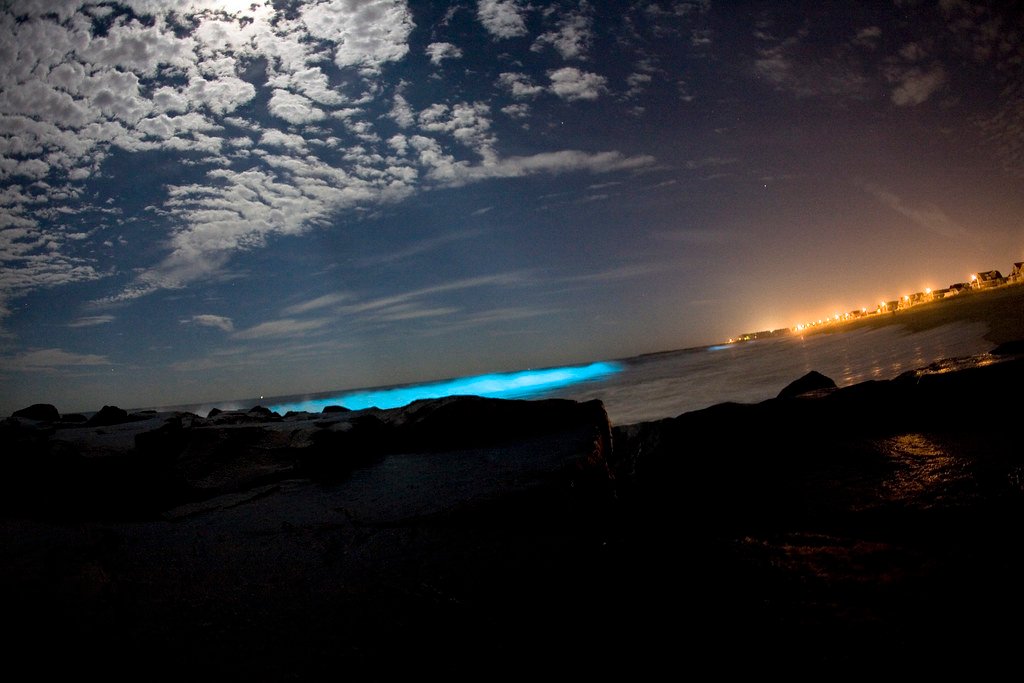
Featured documentary image shows real glowing surf produced by bioluminescence. The surf phenomenon is different from the vast steady offshore milky seas examined in this article.