APEP BAR | ALTERNATIVE SCIENCE | November 11, 2026
Your tattoo may look like a permanent decoration on your skin. To your immune system, it is also a collection of foreign particles that can move, accumulate and provoke an unusually long encounter with the body’s defenses. The surprising part is not that the immune system notices the ink. It is what scientists are still trying to determine about the consequences.
A November 11 ScienceAlert report revisits that question. The most consequential evidence is not a celebrity’s reaction or a frightening list of ink ingredients: it comes from studies tracking pigment into lymph nodes, experiments measuring inflammation and vaccine responses, and conflicting human cancer studies. Together, they support an important conclusion—and an equally important limit. Tattoo ink interacts with immunity; that does not prove tattoos broadly suppress immunity or cause cancer in people.
The immune system is part of what makes a tattoo permanent
A tattoo needle deposits pigment beneath the outermost skin layer, in the dermis. That injury brings immune cells to the area. Macrophages—cells that engulf foreign material—take up pigment particles, but often cannot completely dismantle them. When pigment-bearing macrophages die, other macrophages can pick up the released particles. The design persists through an ongoing cellular handoff.
This was demonstrated in a 2018 study in the Journal of Experimental Medicine. Researchers working with mouse models showed that tattoo ink could remain in place even when pigment-loaded macrophages were depleted. A tattoo is not simply ink locked inside one immortal cell; immune-cell turnover is part of the picture.
The University of Pittsburgh’s Department of Immunology explained the mechanism in August 2026, emphasizing that established local immune reactions should not be confused with proof of large-scale illness.
Ink does not always stay where the needle puts it
In a 2017 human tissue study, researchers used advanced X-ray and chemical analysis to detect the transport of organic pigments, metals and titanium dioxide from tattooed skin into nearby lymph nodes. The evidence came from human skin and lymphatic tissue, not from speculation about how pigment might behave.
Lymph nodes act as filtering and coordination centers for the immune system. Finding pigment there is therefore biologically meaningful. But discovery of a substance in a lymph node is not, by itself, a diagnosis of toxicity, immune failure or cancer. Dose, ink formulation, duration of exposure and actual clinical outcomes matter.
The 2025 experiment that changed the conversation
In research published online November 25, 2025 in Proceedings of the National Academy of Sciences, an international team led by scientists in Switzerland followed black, red and green tattoo pigments through the lymphatic system using mice and supplementary human-cell experiments. Pigment accumulated in draining lymph nodes, where macrophages engulfed it and some cells underwent programmed cell death. Inflammatory signals were still measurable in the nodes two months after tattooing.
Then came a striking observation: vaccine responses in their experimental models were not uniform. When the relevant injection site was tattooed, antibody responses to a tested mRNA COVID-19 vaccine decreased, while responses to a tested inactivated influenza vaccine increased. The different directions matter. The study did not show that tattoos simply switch off the immune system.
There is also an indispensable limitation: these vaccine-response findings came from animal experiments, not from clinical trials demonstrating reduced vaccine protection in tattooed humans. They do not justify skipping vaccines, changing a vaccination schedule or assuming people with tattoos are immunocompromised. The researchers’ university described the findings as grounds for further investigation.
What is actually inside tattoo ink?
Tattoo inks contain pigments and carriers and may contain preservatives, impurities and substances associated with color manufacturing. Studies have identified metals and other chemical compounds in some formulations. Composition varies by product, and laboratory detection does not automatically demonstrate that a person’s exposure reaches a harmful level.
What is more firmly established is that some people develop local reactions: itching, rashes, swelling, nodules called granulomas and, occasionally, significant allergic or inflammatory complications. Red pigments are especially prominent in reports of chronic reactions. The U.S. Food and Drug Administration also warns about infections, keloids and occasional complications involving imaging or tattoo removal.
The rules are more complicated than the phrase “tattoos are unregulated.” In the United States, FDA oversight applies to tattoo inks as cosmetics, while tattooing practices are generally overseen by state and local authorities. FDA says no color additives are approved for injection into the skin. Importantly, contamination can occur in the ink itself, not only on a poorly cleaned needle. In May 2025, the agency specifically warned about named lots of tattoo ink contaminated with microorganisms.
Do tattoos cause cancer? The studies do not agree
Some findings deserve attention without becoming definitive headlines. A 2025 Swedish case-control study reported an adjusted relative estimate of 1.29 for melanoma among tattooed participants—often described as a 29% relative increase. But a separate Utah study found no strong overall melanoma association and observed lower estimated risk in some heavily tattooed groups, while explicitly warning that unmeasured sun-exposure factors could explain the result. Neither study, on its own, establishes cause and effect.
Researchers have investigated lymphoma as well. A 2024 Swedish study estimated an overall relative risk of 1.21, but its 95% confidence interval (0.99–1.48) included no effect, and the researchers did not find a clear dose-response pattern based on tattooed area.
Most useful for perspective is a 2026 systematic review and meta-analysis, published online in June and appearing in the November issue of Clinical and Translational Oncology. Across seven observational studies comprising 140,841 participants, its primary analyses found no statistically significant overall association with skin cancer (pooled odds ratio 0.92, 95% confidence interval 0.83–1.04) or blood cancers (1.02, 0.78–1.32). A sensitivity analysis excluding one influential study did produce a positive blood-cancer association. The authors rated the evidence low to moderate certainty and called for better prospective research.
The fairest reading is neither “tattoos cause cancer” nor “science has proved there is no risk.” The human evidence remains inconsistent, and important questions about particular pigments, dose and long-term exposure are unresolved.
What people considering a tattoo can do now
- Choose a studio that follows applicable licensing, infection-control and single-use equipment requirements; ask what ink brand and lot it uses.
- Ask about sterilization, sealed ink supplies, clean water and aftercare. Even an apparently professional studio cannot eliminate every risk from contaminated products.
- Discuss prior severe allergic reactions, immunosuppression, autoimmune disease or poor wound healing with an appropriate healthcare professional before the appointment.
- Seek medical attention for worsening pain, spreading redness, fever, pus or a persistent, severe skin reaction. These symptoms should not be written off as normal healing.
For more direct consumer guidance, see the FDA’s tattoo-safety advisory.
The unanswered question under the skin
Tattooing has profound cultural, personal and sometimes medical significance. A scientific account should neither dismiss that meaning nor ignore the biological exposure involved. Ink can move beyond the design. Immune cells respond. Laboratory animals show measurable changes in inflammation and, under specific experimental conditions, responses to vaccines. What remains missing is definitive evidence about how often those mechanisms produce long-term health consequences in people.
The essential question is no longer whether our immune system encounters tattoo ink. It does. Which kinds of ink, in which people, at which doses, produce changes that actually matter to health?
Question. Investigate. Reconsider.
Watch: How tattoos persist
TED-Ed — “What makes tattoos permanent?” by Claudia Aguirre (2014). This is a contextual animated explainer about tattooing and macrophages, not footage from the 2025 immune-system experiments or evidence for their vaccine findings.
Sources and further reading
ScienceAlert, Jess Cockerill (November 11, 2026) · Capucetti and colleagues, PNAS (2025) · Pigment transport in human tissues (2017) · Macrophages and tattoo permanence (2018) · Cancer meta-analysis (2026) · FDA tattoo safety and regulation.
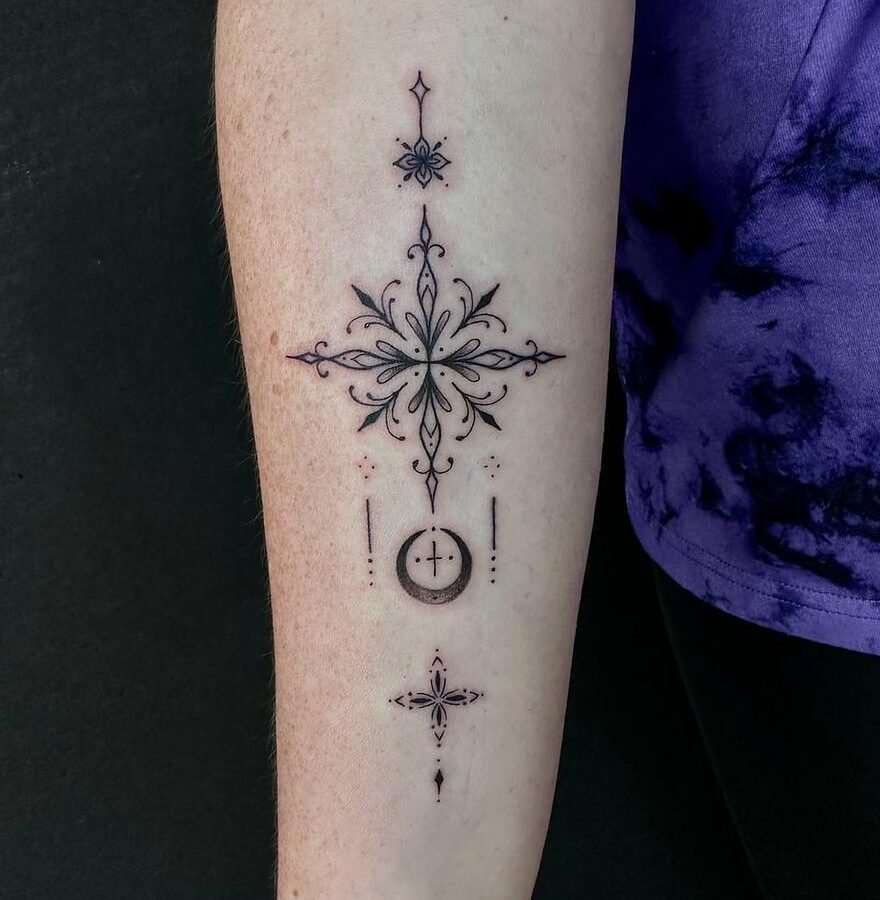
Featured photo: “Floral Motifs Tattoo Forearm Black and White Tattoo,” glvagkvs35, Flickr, via Openverse; CC BY-SA 2.0. Documentary photograph illustrating an ordinary tattoo; it does not depict clinical research or microscopic ink migration.