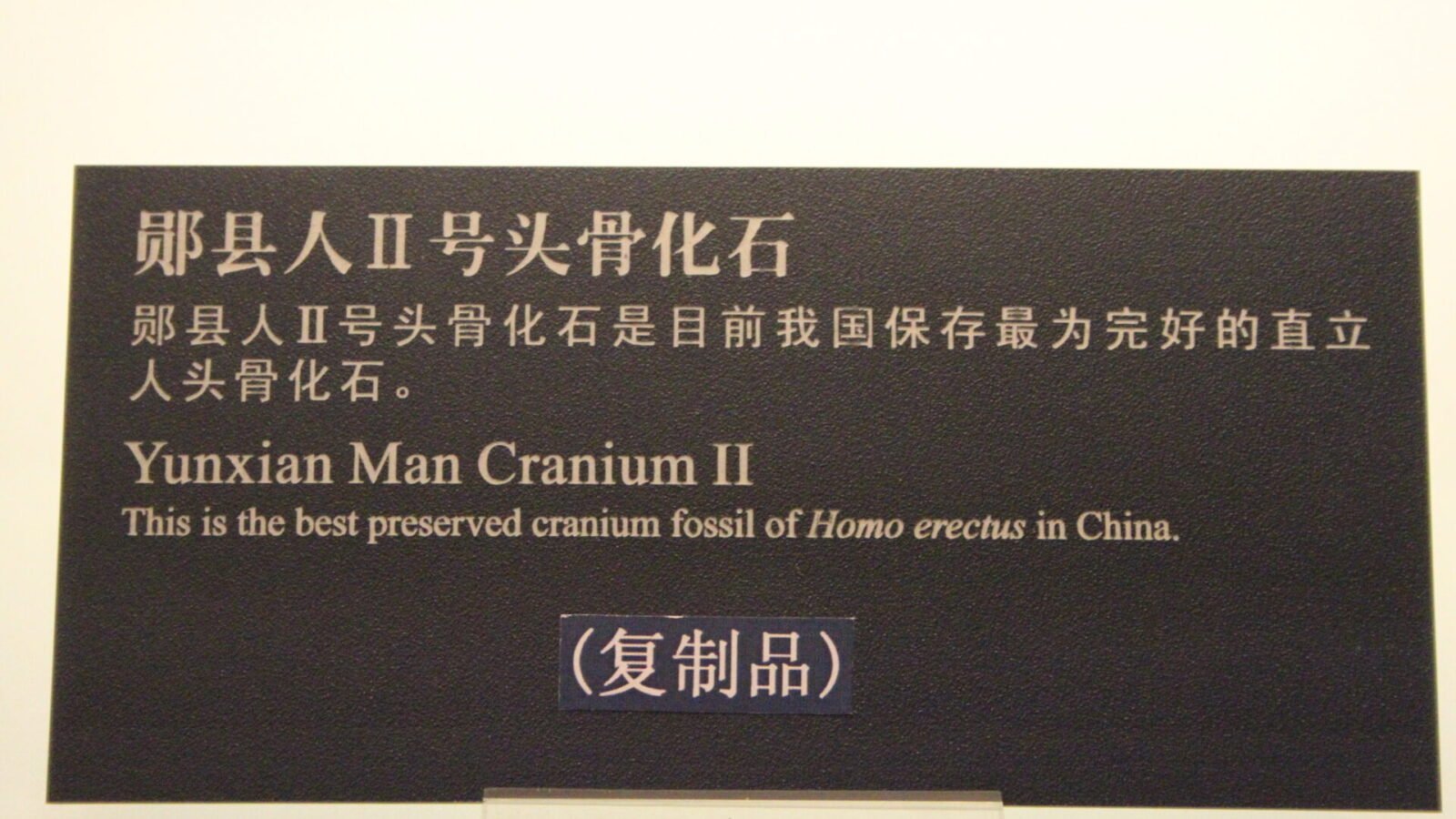
A skull from China was supposed to push the story of human evolution further back in time. Then another scientific team made the skull itself almost 800,000 years older. The result is not one settled rewrite of our ancestry but a fascinating disagreement over two basic questions: how old are the Yunxian fossils, and what kind of humans did they belong to?
The case begins with Yunxian 2, a badly distorted fossil cranium discovered in 1990 near the Han River in Hubei Province. In September 2025, an international team digitally restored it and argued that it belonged to an early branch related to Homo longi (“Dragon Man”) and the enigmatic Denisovans, rather than to Homo erectus. That interpretation appeared to move important evolutionary splits back beyond one million years. But in February 2026, a separate study dated the deposits containing the Yunxian skulls to about 1.77 million years ago—a far older age than the 2025 reconstruction had assumed.
Both papers are real, peer-reviewed research. And both cannot simply be folded into the same tidy headline without confronting what the newer dates may do to the older family tree.
First, the reconstruction that stunned researchers
The original fossil had been crushed and distorted during its long burial. Older studies often treated Yunxian 2 as Homo erectus, the broadly distributed early human group known from Africa and Asia. But its damaged geometry made the classification difficult to test.
In a September 25, 2025 paper in Science, Xiaobo Feng, Xijun Ni, Chris Stringer and colleagues used CT scans, surface imaging and virtual reconstruction to reposition distorted fossil material. They compared the restored skull with more than 100 other fossil specimens. The analysis identified a mosaic of old and more recently evolved features: a long, low cranium and projecting face alongside aspects of the cheekbones, back of the skull and braincase that researchers considered more consistent with the longi lineage.
The researchers proposed that Yunxian 2 was an early member of the Asian Homo longi clade, which they associated with Denisovans. Their evolutionary analysis suggested deep roots for both that lineage and the one leading toward Homo sapiens. The Natural History Museum’s account of the study described a possible divergence extending more than one million years into the past.
That is a hypothesis about the timing of ancestral lineages. It is not evidence that anatomically modern Homo sapiens, as we know the species from much younger fossils, existed in China a million years ago. Nor does a digital reconstruction constitute recovered DNA.
Then the calendar changed: 1.77 million years
On February 18, 2026, another team led by Hua Tu published a new dating study in Science Advances. Instead of starting with the skull’s anatomical shape, they tested quartz gravels from the site’s fossil-bearing deposits using the radioactive-isotope pair aluminum-26 and beryllium-10.
These isotopes accumulate while quartz is exposed near Earth’s surface and then decay or diminish at different rates after burial. Their changing ratio can help estimate when the sediment was buried, provided researchers account for its history and exposure. The team used an isochron approach that compared multiple quartz samples rather than relying on one isolated measurement.
For the fossil-bearing layer, identified as C3, the researchers obtained an age of 1.77 ± 0.08 million years with internal uncertainty; including the total uncertainty reported in the paper, the estimate is 1.77 ± 0.11 million years. A second layer yielded a broadly consistent result of approximately 1.76 million years, with larger uncertainty. The team identified and excluded a sample interpreted as reworked older material from the primary age calculation.
These are dates for the archaeological sediment context, not a direct chemical measurement of skull bone. Their significance rests on the reported association of the fossils and the dated layer. The study’s authors concluded that the Yunxian crania may represent some of the oldest securely excavated early human fossils in eastern Asia. They referred to them as Homo erectus, while explicitly noting that the newly proposed age ought to be tested in the earlier phylogenetic model.
There is an unusual overlap: Xiaobo Feng is an author on both the 2025 reconstruction paper and the 2026 dating paper. That fact does not resolve their different interpretations; it shows that the new chronological evidence is relevant to the same fossil research program.
Why an older date could weaken the Denisovan connection
The 2025 evolutionary analysis used an age of about one million years for Yunxian 2. If the skull instead dates to roughly 1.77 million years ago, the chronological anchor for its proposed position near the longi/Denisovan branch changes dramatically. Simply saying that the fossil is even older—and therefore the initial interpretation is even more revolutionary—would skip the essential scientific reanalysis.
In February 2026 reporting by Ars Technica, paleoanthropologist John Hawks, who was not involved in the study, argued that the revised age is too early for a convincing direct connection to Denisovans when compared with the genomic timeline. Separately, archaeologist Andy Herries told ABC Science that classifying the reconstructed skull within Homo longi was unwarranted given uncertainties in the reconstruction.
Neither critique proves which label will ultimately survive. A skull can retain unexpected anatomical features, and dating, morphology and genetics answer different questions. But a younger-species interpretation built partly on an older age estimate must be revisited when that age changes. The 2026 paper itself makes precisely that point.
Does this overturn the Out-of-Africa story?
No. The new dates, if upheld, strengthen the evidence that early humans were present deep in eastern Asia surprisingly early. That matters for mapping the movements of Homo erectus or related populations beyond Africa. But the presence of early humans in China is not proof that our own species originated there, and neither paper demonstrates that modern humans descended directly from Yunxian 2.
The dating team compared Yunxian with other ancient Eurasian evidence, including Dmanisi in Georgia, and asked how quickly early humans may have spread across the continent. Its findings also sharpen a different mystery: who made stone tools at Chinese sites that may be even older than these skulls? Human evolution has never been a neat procession of one species replacing another at a single address.
Genetic evidence complicates any straightforward fossil tree because later human groups sometimes interbred. But the fact of interbreeding among some ancient populations does not, by itself, identify Yunxian 2 as a Denisovan. The fossil has not yielded the ancient DNA that would directly test that connection.
A third skull, and the questions still buried
Yunxian has yielded a third cranium, reported from the same general site and apparently better preserved than the first two. A fuller anatomical analysis could provide a more independent check on features that were digitally inferred or restored in the earlier material. New samples, refinements to the site’s sediment history and tests of the 2025 evolutionary model using the 2026 dates could also change the picture.
The real surprise is not that a computer conjured a modern face out of ancient rubble. It is that two sophisticated scientific approaches—one reconstructing anatomy, the other measuring geological time—have produced a much harder problem than either headline alone acknowledges. The fossil is real. The reconstruction is real. The age revision is real research. The identity and implications remain contested.
Which evidence should carry the most weight when the shape of a skull and the age of its burial point toward different branches of the human family tree?
Primary research and further reading
- Feng et al., “The phylogenetic position of the Yunxian cranium elucidates the origin of Homo longi and the Denisovans”, Science, September 25, 2025.
- Tu et al., “The oldest in situ Homo erectus crania in eastern Asia: The Yunxian site dates to ~1.77 Ma”, Science Advances, February 18, 2026.
- Natural History Museum: 2025 reconstruction findings and research team’s explanation.
- ABC Science: independent criticism and methodological caveats.
- Ars Technica: 2026 reassessment of the revised age and lineage dispute.
- Apep Bar: What Really Defines a Human Being?
Featured photograph: The actual Yunxian Man Cranium II fossil, photographed at Hubei Provincial Museum by Gary Todd (2010). Source: Wikimedia Commons; CC0 1.0. This is an original fossil photograph, not the digital reconstruction.