In 1961, American scientists set off a nuclear device deep inside a New Mexico salt formation. They hoped to learn whether an underground explosion could become a source of useful energy. Instead, radioactive steam escaped, and investigators later found themselves standing inside a cavern with startlingly colored rock walls.
The experiment, Project Gnome, was not the only moment when the American nuclear program discovered that an explosion could travel beyond the boundaries of its calculations. From New Mexico to Bikini Atoll to the edge of space, four tests tell an unsettling story: the blast itself was often only the beginning.
Recent stories from the Department of Energy on Gnome, Starfish Prime, Trinity, and Castle Bravo revisit those surprises. The more revealing evidence sits in the original government records: geological surveys, declassified meeting minutes, NASA research, and the histories of people who lived downwind.
1945: Trinity worked as a bomb. Its fallout was a different story.
On July 16, 1945, the Manhattan Project detonated the world’s first nuclear explosive device at the Trinity site in New Mexico. The plutonium implosion device functioned; by the weapons program’s immediate measure, it was a success. But thousands of people lived in the surrounding region, and the project did not warn them in advance that an atomic explosion was about to take place.
According to the National Park Service’s history of Trinity downwinders, officials issued a cover story describing an ammunition and pyrotechnics accident. Radioactive material fell across a wide area, with significant deposition northeast of the site. Residents used locally produced food, livestock and, in many households, rainwater collected in cisterns—potential pathways by which radioactive contamination could enter daily life.
The distinction matters. Saying that local residents were exposed to fallout is supported by the historical record. Assigning a specific individual’s cancer or death to the test requires evidence that is more difficult to establish. People who call themselves downwinders have described illness, loss and a long struggle for recognition; the National Park Service documents that history without implying that every later illness can be traced to a single cause.
Decades later, Washington changed its compensation rules. The Justice Department’s current Radiation Exposure Compensation Act guidance explains that the law was reauthorized and expanded in July 2025 to include qualifying people who lived in New Mexico during specified periods. It provides a claims process for eligible illnesses and residency histories; it is not a blanket finding about every claimant.
What went wrong? Secrecy and inadequate public warning left communities outside the chain of decisions about their exposure. A test that succeeded technically created an unresolved public-health and accountability legacy.
1954: Castle Bravo was much bigger than planned—and the fallout reached people
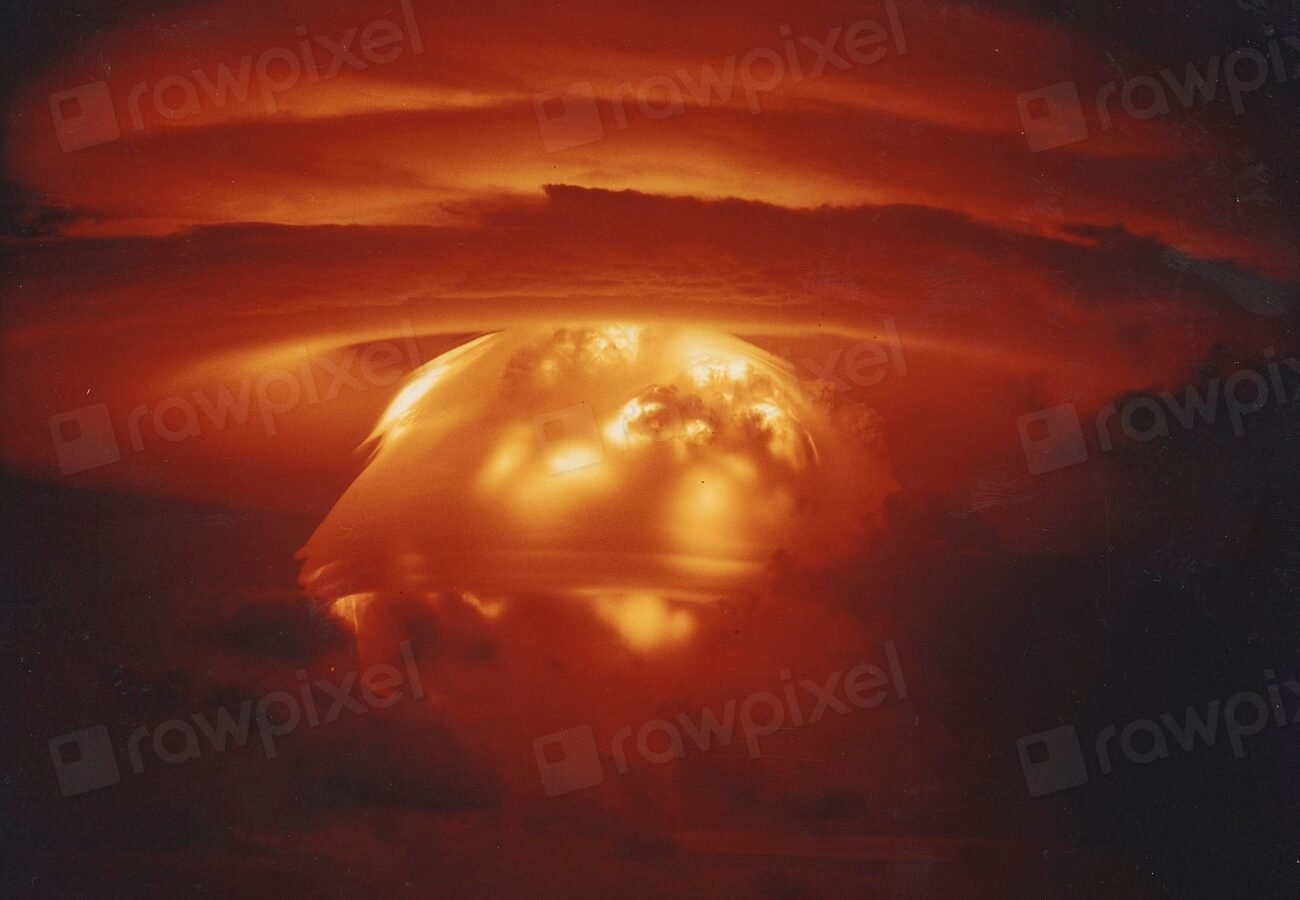
On March 1, 1954, the United States detonated Castle Bravo at Bikini Atoll in the Marshall Islands. The thermonuclear device released roughly 15 megatons of explosive energy, more than double its anticipated yield and the largest nuclear explosion ever conducted by the United States. The test’s radioactive debris reached inhabited atolls and the Japanese fishing vessel Daigo Fukuryū Maru, or Lucky Dragon No. 5.
Why did the yield diverge so sharply? A declassified July 1954 Atomic Energy Commission advisory committee record explains that designers had substantially underestimated the contribution of lithium-7 to the thermonuclear reaction. It records a predicted range of four to eight megatons for Bravo—not one universal figure that every planner used.
That uncertainty became a human emergency. Declassified weather briefings, collected by the National Security Archive, show that officials considered winds toward inhabited Rongelap and Rongerik but judged that hazardous fallout would not reach those locations. The prediction failed. Marshallese residents were exposed, some suffering acute radiation injury and long-term health consequences; Japanese fishermen also encountered radioactive fallout at sea.
Castle Bravo was not simply a chemistry surprise. It exposed a disastrous dependence on assumptions about explosion yield, weather, fallout travel time and who could be kept safe. And it occurred in a region where islanders had already been displaced for nuclear testing.
What went wrong? The test design underestimated the blast; the safety plan underestimated the consequences of being wrong. For residents of the Marshall Islands, that gap was not theoretical.
1961: Project Gnome blew a cavern into salt—and radioactive steam escaped
For Project Gnome, planners went underground. On December 10, 1961, the Atomic Energy Commission detonated a roughly 3.1-kiloton device about 1,184 feet beneath the surface near Carlsbad, New Mexico. It was the first nuclear experiment of the Plowshare program, which examined proposed civilian uses of nuclear explosives, including energy recovery.
Salt was chosen deliberately. Researchers wanted to study how an underground detonation behaved in a bedded salt formation and whether heat trapped in melted salt could be recovered. They also hoped to obtain data about radioactive isotopes, neutrons and seismic signals.

As the Lawrence Radiation Laboratory’s 1965 Project Gnome final report documents, the blast breached material near an experimental tube and caused a ventilation rupture disk to fail. Steam and radioactive gases reached the pre-shot tunnel and shaft, venting to the surface. The rock also fractured and shifted. In the reopened cavity, researchers found yellow and blue colors attributable to radiation damage in the salt, along with other striking colored layers.
The cavern was real. So was the release. But the claim that scientists discovered an unlimited underground energy reservoir would be fantasy: creating a hot, radioactive cavity was not the same as demonstrating a practical and economical power plant.
Nor is Gnome now being developed into the Waste Isolation Pilot Plant. The Energy Department describes Gnome-Coach as a separate legacy site with completed surface remediation, remaining subsurface contamination and continued management and monitoring. WIPP is a distinct repository in southeastern New Mexico; it began accepting waste in 1999.
What went wrong? An experiment conceived partly as a peaceful application of nuclear energy exposed the challenge of containment—and left a site requiring oversight long after the scientific measurements ended.
1962: Starfish Prime created an artificial radiation belt around Earth
The next experiment went upward instead of downward. On July 9, 1962 (UTC), Starfish Prime detonated a 1.4-megaton device roughly 400 kilometers (250 miles) above the Pacific near Johnston Island. Bright displays illuminated parts of the sky far from the detonation. The more consequential discovery was invisible.
High-energy particles from the explosion became trapped in Earth’s magnetic environment, creating an artificial radiation belt. A NASA Goddard historical technical paper reports that the enhanced radiation environment contributed to the loss of seven satellites within months, primarily through damage to solar cells. Telstar, launched after the test, was among the satellites affected.
That is a stronger, more precise finding than the claim that the electromagnetic pulse instantly destroyed half the world’s satellites. EMP effects and the longer-lived radiation-belt damage were related consequences of the same detonation, but not the same mechanism. NASA also notes that particles from the test changed Earth’s radiation environment for far longer than optimistic early forecasts suggested.
NASA’s review of human-caused space-weather effects shows why Starfish remains scientifically relevant. The experiment demonstrated that nuclear activity could alter the very environment on which spacecraft and future human missions depended.
What went wrong? The test converted a military experiment into a space-environment hazard, with damage occurring long after the original flash.
The common failure: the boundary of the experiment was never the boundary of its effects
The four tests were different in purpose and physics, and their human consequences were not equivalent. Trinity’s fallout reached civilians who had not been warned. Castle Bravo spread contamination through the Pacific after planners misjudged both yield and danger. Gnome vented radioactive material through its underground access system. Starfish Prime created a radiation environment that compromised satellites.
All four reveal the same blind spot: the expected result of an experiment is not the full range of consequences that must be anticipated. Weapons designers measured explosive yield. Communities, ecosystems, engineers and future generations had to contend with effects that did not stop at the instrument boundary.
The policy response was substantial but incomplete. The 1963 Partial Test Ban Treaty prohibited nuclear explosions in the atmosphere, underwater and in outer space. It did not impose a blanket ban on underground testing, and it did not erase radioactive material already deposited in the environment.
When we call one of these explosions a “successful test,” whose definition of success are we using?
Archival film: watch the Gnome experiment
The original 29-minute Atomic Energy Commission film Project Gnome, linked from the U.S. Department of Energy’s official film collection, includes genuine preparations, surface effects and post-detonation cavity footage, together with period commentary by Edward Teller. It is historical footage of the actual experiment; its optimistic Plowshare narration reflects the era’s official perspective, not an independent modern safety assessment.
Also worth watching: the National Security Archive’s declassified Castle Bravo footage and documents, which provide a contrasting record of the Pacific test and its consequences.
Primary records and further reading
- National Park Service — Trinity Test Downwinders; U.S. Department of Justice — current RECA eligibility guidance.
- National Security Archive — Castle Bravo declassified records; National Park Service — nuclear test consequences and treaty history.
- Lawrence Radiation Laboratory — Project Gnome, 1965 final report; DOE — Gnome-Coach site status.
- NASA Goddard — The STARFISH Exo-atmospheric, High-altitude Nuclear Weapons Test; NASA — Space Weather Events Linked to Human Activity.
Related Apep Bar reporting: Two Scientists, One ‘Demon Core’: The Real Horror at Los Alamos explores a different type of nuclear-program hazard—the fatal criticality accidents of 1945 and 1946.