October 14, 2026 — Covering a University of Tokyo research announcement dated October 13; the spacecraft measurements were collected earlier.
Space can look empty while behaving like a spectacularly unruly laboratory. Researchers analyzing Parker Solar Probe measurements report an unexpected pattern inside the solar wind’s magnetic turbulence: the preferred direction of magnetic-field rotation changes with scale.
The University of Tokyo’s October 13 announcement describes work by an international team using magnetic-field and particle data from NASA’s spacecraft. The study appears in The Astrophysical Journal Letters under the title Nonlocal Evolution of Magnetic Helicity across the Magnetohydrodynamic–Kinetic Interface.
One turbulent flow, two preferred directions
Viewed outward from the Sun, larger-scale fluctuations preferentially rotate counterclockwise; smaller-scale fluctuations preferentially rotate clockwise. The change occurs around the boundary between fluid-like behavior and particle-dominated dynamics. The reported reversal also evolves with distance from the Sun.
This is a change in the statistical behavior of fluctuations across scales. It is not an announcement that the Sun’s global magnetic poles suddenly flipped, that the solar wind reversed its outward flow, or that a geomagnetic emergency is imminent.
Order hiding inside disorder
The university identifies plasma turbulence as relevant to solar eruptions and geomagnetic-storm modeling. That makes the finding potentially useful, but the announcement supplies no new operational forecast or guarantee of improved warning times.
The intriguing part is the relationship between randomness and structure. Calling a system turbulent does not mean that every property lacks a pattern. Measuring the right quantity at the right scale can reveal regularity that a broader view obscures.
This is a fresh institutional announcement about analysis of earlier observations, not a claim that Parker witnessed the phenomenon for the first time yesterday. The underlying journal paper remains the place to examine the methods and boundaries of the result.
How much apparent cosmic chaos is simply order we have not yet learned to measure?
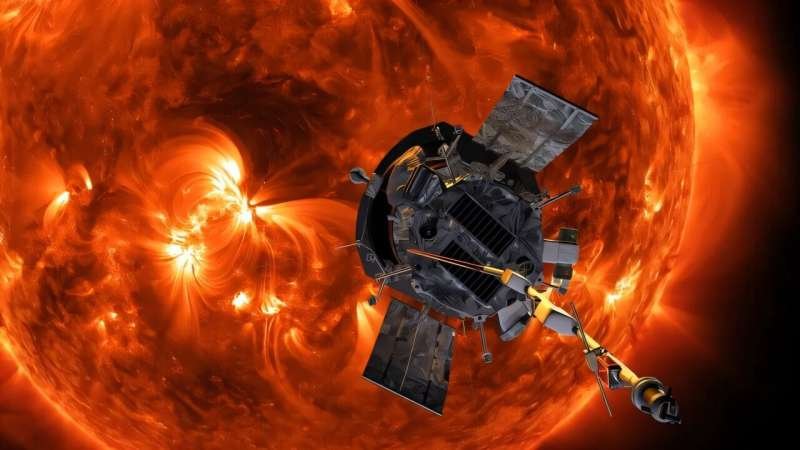
Featured image: artist’s illustration of Parker Solar Probe, not a photograph of the magnetic reversal. Credit: NASA/Johns Hopkins APL/Steve Gribben, accompanying the University of Tokyo release.