The universe appears to have scribbled a musical symbol behind our galaxy. Astronomers call it the “Treble Clef,” and the explanation now emerging is suitably excessive: a black hole supplied the material, and colliding galaxy clusters may have brought it roaring back into radio view. Apparently, cosmic encores require a very large venue.
NASA highlighted the research on October 14, 2026. The underlying study first appeared as a preprint on July 7 and was revised October 5; its arXiv record lists acceptance in Astronomy & Astrophysics. This is a fresh public release about an existing investigation, rather than an object suddenly appearing this week.
A strange shape behind the foreground
The source, VLSS J0318.9+5755, sits behind the Milky Way’s crowded plane, where intervening material complicates observation. Chandra and eROSITA X-ray data reveal hot gas associated with merging galaxy clusters. The new public image combines those observations with radio and infrared measurements. Its musical appearance is a visual resemblance, not evidence of a message.
A phoenix with a paper trail
Andrea Botteon and colleagues classify the object as a “radio phoenix.” Their study combines LOFAR survey observations, new uGMRT measurements and X-ray analysis to characterize both the radio structure and its host cluster. The team finds a strongly filamentary source whose radio emission drops especially sharply toward higher frequencies.
The proposed sequence begins with particles expelled during earlier black hole activity. Their radio glow faded; the cluster collision subsequently compressed or reenergized the material. Collision-driven shocks may have contributed. Think of an old cosmic ember finding a fresh blast of air—an analogy for the proposed physics, not literal combustion.
Where the evidence ends
The paper explicitly treats merger-driven gas motions shaping the tangled filaments as speculation. It also describes a possible central radio halo as tentative. Those qualifications matter: detecting a structure, classifying its emission and reconstructing its history are different scientific jobs. The authors identify very-low-frequency follow-up observations as a promising next step.
That is the pleasure of a mystery with instruments attached. A memorable nickname gets us through the door; measurements decide which explanations survive. The resemblance grabs attention, but the investigation concerns how enormous cosmic structures recycle energy.
If the sky can hide this much history behind a familiar-looking shape, how many other supposed oddities are waiting for someone to observe them in a different wavelength?
Question. Investigate. Reconsider.
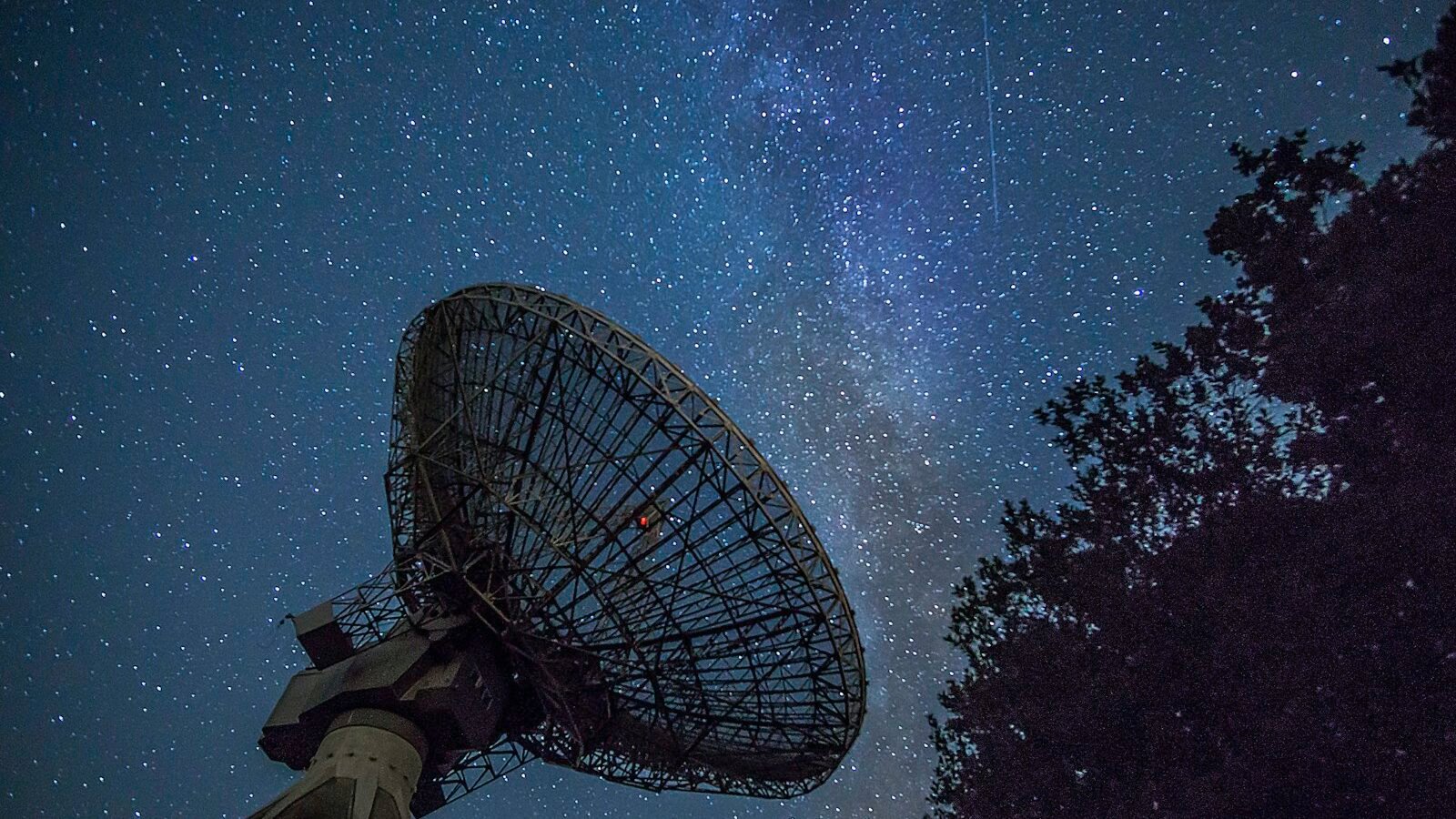
Featured image: Stockert radio telescope, Germany, photographed by Stephan Widua, via Unsplash. Used under the Unsplash License. Illustrative photograph; this telescope is not presented as an instrument used in the study. For the actual astronomical composite and its full credits, see the Chandra release below.
Sources
- NASA: Chandra’s Treble Clef investigation — October 14, 2026.
- Botteon et al.: The Treble Clef radio phoenix and its old nonthermal filaments — submitted July 7; revised October 5, 2026; accepted for publication in A&A.
- Chandra Photo Album: original composite, observation details and credits — October 14, 2026.