Declassified | Foreign-policy investigation. The most revealing scandal of the CIA’s 1954 Guatemala operation may not be what the files say. It is how long an official U.S. diplomatic history managed to tell the story without including the government’s covert role in overthrowing an elected president.
The State Department acknowledged the omission in 2003 when it released a retrospective volume of Foreign Relations of the United States devoted to Guatemala. Its earlier 1983 account had been incomplete: it did not document the U.S.-approved CIA role in ousting President Jacobo Árbenz Guzmán. The later collection drew heavily on declassified CIA cables and memoranda. This is not an allegation invented by a rival state; it is an admission printed by the U.S. government.
The code name, the meetings, the money
The record distinguishes PBFORTUNE, an earlier plan considered in 1951, from PBSUCCESS, the operation ultimately put into practice, and PBHISTORY, the subsequent effort to collect and analyze Árbenz government records. Those distinctions appear in the State Department’s 2003 release statement and the source introduction to the documentary series.
One particularly revealing September 18, 1953 CIA meeting memorandum describes top-level approval of an action plan, a recommendation to raise the budget estimate to $3 million for contingencies, and immediate authorization of $50,000 for early needs. The document also discusses activity involving Nicaragua, Honduras, El Salvador, economic and psychological warfare, personnel moves, and diplomatic action. The figure is a planning estimate, not a verified final cost of the entire coup.
This is what document-led journalism is for: not the lazy declaration that ‘the CIA was involved,’ but the exact moment a covert policy becomes operational planning with budgets, regional coordination, and assignments.
Why Guatemala became a target
Árbenz’s agrarian reform sought to redistribute unused large landholdings in a country with severe rural inequality. His 1952 Decree 900 affected powerful landowners, including the United Fruit Company. The State Department’s historical introduction documents the land conflict and the Cold War reasoning used to advance the overthrow plan.
U.S. officials feared Communist influence in Guatemala, a concern expressed repeatedly in records from the period. Commercial interests and anti-Communist geopolitics overlapped, but reducing the entire episode to a single corporate phone call would understate the machinery involved. The archival evidence shows a government action justified by Cold War security arguments while the intended target’s reforms threatened American business interests.
These are not mutually exclusive motives. They are reasons to interrogate what Washington chose to count as national security and whose economic or political priorities entered that definition.
Psychological warfare was not a decorative detail
The operation relied on pressure that was political, diplomatic, economic, and psychological, alongside covert paramilitary support for forces associated with Carlos Castillo Armas. The National Archives’ historical overview of the CIA in Guatemala identifies misinformation, propaganda, psychological warfare, and sabotage among methods used.
A declassified retrospective account reproduced in the Foreign Relations documentary collection describes pressure on Guatemala’s military and political leadership and efforts to exploit perceptions of momentum. Some CIA documentation from the operation’s aftermath expresses the agency’s own view of what succeeded; readers should recognize that an internal after-action narrative is evidence of what an institution reported, not a neutral camera recording every consequence.
Árbenz resigned on June 27, 1954. The events surrounding that resignation and Castillo Armas’s later rise involved Guatemalan military and political actors as well as the covert U.S. campaign. The plot was not the work of an American agency acting in a country with no internal conflict, but neither can ‘Guatemalans did it’ honestly erase the documentary U.S. role.
The chilling difference between proposed action and accomplished act
Another tranche of CIA files, publicized by the National Security Archive, documents assassination planning and lists considered in the context of the operation. This material is serious. It also requires exact language: a plan or contemplated option is not, by itself, proof that a named killing was carried out under that proposal. The archive shows planning and intent; claims about any particular death need separate evidence.
The larger human aftermath of Guatemala’s political upheaval cannot be adequately narrated as a clever covert victory. Long-term authoritarianism, repression, and a later civil war became part of the country’s history. But attributing every later atrocity solely and directly to one 1954 memorandum would erase decades of actors and decisions. The correct historical question is how an intervention altered political possibilities and helped shape the conditions that followed.
Why the official record took decades to catch up
The State Department said its revised documentary volume followed a 1991 law requiring a more accurate and complete account of major U.S. foreign policy and fuller access to agency records. That means the secrecy extended beyond the operation into the way the official history was assembled. Even the replacement collection contains redactions and gaps.
It is tempting to read old classified material as an all-purpose key to every present political mystery. A better use is more demanding: compare plans with cables, retrospective claims with independent scholarship, and official motives with the people who bore the costs.
Primary sources: State Department’s 2003 publication note; CIA budget and planning memorandum, September 1953; FRUS historical introduction and agrarian reform background; National Security Archive document collection on assassination planning; U.S. National Archives historical overview.
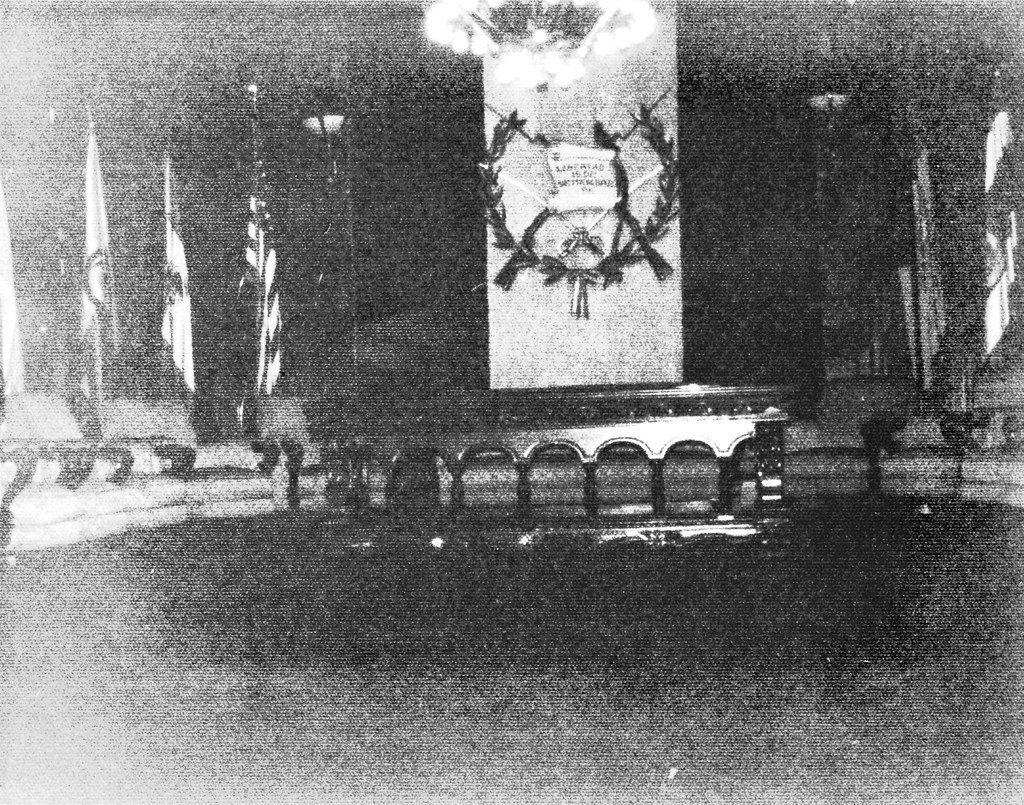
Featured image: historical 1975 photograph of the National Palace, Guatemala City, by Infrogmation, CC BY 2.0. This contextual building photograph does not depict the 1954 overthrow.
Question. Investigate. Reconsider. If the first official history omitted the covert action, what other accepted narratives still depend on the files that were never opened?