Nine people died on November 1, 2026, when a Learjet 60 fell from cruising altitude and crashed near Greenacres in Palm Beach County, Florida. The disaster has generated dramatic footage and urgent questions. What can the evidence actually establish?
November 9 official update: The National Transportation Safety Board announced recovery of the cockpit voice recorder, completion of excavation at the impact site, and laboratory examination of aircraft components. The recorder recovery does not establish the cause. Official NTSB investigation update.
The people aboard
According to a November 4 report citing the Palm Beach County Sheriff’s Office, the crew were captain Jeffrey Gregory and co-pilot Nathalia Filgueiras. The seven passengers were Adam Robinson, Helen Sharp, their children Emma and Charles Robinson, Rachel Reed, Rowan Charmi Fehr Toews, and Ana Maria Ramirez Cetina. Earlier family statements used the names Rachael Reed, Charmi Fehr, and Anita Maria Cetina; the sheriff’s reported list supplies fuller legal names. The children were four and two years old. These are lives, not clues to a theory.
Family accounts described the Robinsons as devoted parents; Cetina was the children’s nanny, and Reed and Fehr were family friends. Filgueiras, 20, had earned her pilot’s license as a teenager and aspired to an airline career. Gregory’s former employer, East Coast Jets, confirmed he had worked there in 2016 and 2017. Available reporting does not justify speculation about the passengers’ private lives or an undisclosed mission.
Aircraft, operator and route
The aircraft was a 2004 Learjet 60, registration N722BD, reportedly operated by Aurora Aviation doing business as Upper Jets. It departed Austin-Bergstrom International Airport bound for North Eleuthera, Bahamas. Published aircraft registration reporting identifies a Delaware corporate registrant, which alone says nothing about the purpose of this flight or beneficial ownership.
The last minutes
Investigators reported that around 12:47 p.m. Eastern the crew described light clear icing, moderate turbulence and deviations of about 700 feet while flying at approximately 35,000 feet. The crew then requested a climb to 37,000 feet after encountering precipitation. Less than 30 seconds after clearance, the aircraft transmitted an emergency descent and a mayday call. It crashed around 12:51 p.m.
The physics of the descent
At 22,000 feet per minute, vertical descent is about 367 feet per second, or 250 miles per hour downward. A reported peak above 32,000 feet per minute would exceed 360 miles per hour vertically. These figures describe instantaneous or reported descent rates, not the aircraft’s complete velocity, and cannot by themselves establish the cause. Rapid descent, overspeed, turbulence, icing, loss of control and structural damage may interact in several sequences. Investigators must establish their order from evidence.
The left elevator and possible breakup
On November 3, NTSB member Tom Chapman reported that much of the left elevator—the movable tail surface used to control pitch—had been found in three pieces approximately 1.3 to 3.8 miles from the main crash site. The location raises serious questions about when and why the parts separated. It does not yet prove that an initial structural failure caused the descent; a breakup can be an initiating event or a consequence of another emergency.
What investigators still need
Key lines of inquiry include weather at flight level, ice accretion and anti-ice performance, aerodynamic loads, control-surface attachments, maintenance records, flight trajectory, air traffic communications and the availability of cockpit recording data. The NTSB confirmed on November 9, 2026 that investigators recovered the cockpit voice recorder from the initial impact site and sent it for examination at its Vehicle Recorders Laboratory in Washington, D.C. No official probable cause has been established.
Questions worth asking—without inventing answers
Did the aircraft enter conditions more severe than the crew anticipated? Did a loss of control produce overspeed and structural overload? Did a mechanical or structural problem occur first? Which components can be reconstructed from the recovered debris? These are legitimate investigative questions. Neither the proximity of the crash to prominent properties nor the aircraft’s corporate registration constitutes evidence of sabotage.
Sources and continuing coverage
- NTSB accident investigation ERA27MA026, updated November 9, 2026 (primary source)
- Reuters, November 1: crash and emergency response
- WPTV, November 2: NTSB briefing and flight timeline
- ABC News, November 3: victims and elevator recovery
- Boca Daily News, November 4: sheriff’s reported identification of all nine victims
- Aerospace Global News, November 2: aircraft registration and tracking
This is a developing investigation. Apep Bar will update the record as primary investigative findings become available.
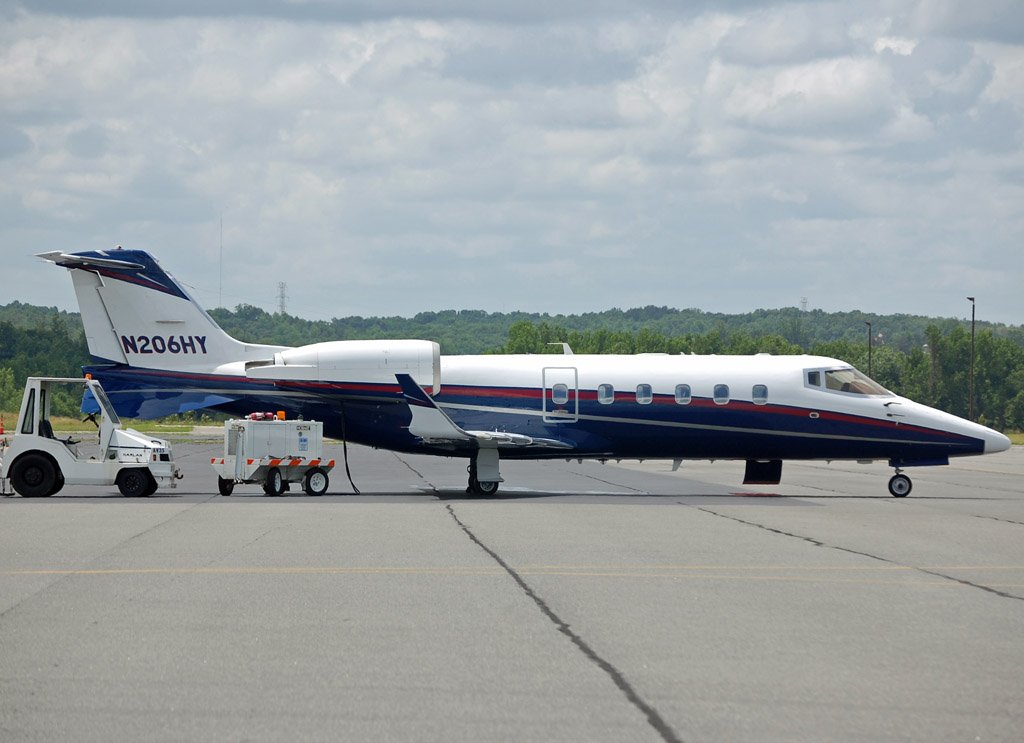
Featured image credit: Bombardier Learjet 60 (registration N206HY), photographed by James Willamor, CC BY-SA 2.0. It is the same model of aircraft but not the plane involved in the November 1, 2026 crash.