APEP BAR COSMIC WIRE | October 14, 2026 — Somewhere in the young universe, a flash of radio energy erupted for just a tiny fraction of a second. More than ten billion years later, the signal reached the neighborhood of Earth—and astronomers now know which distant galaxy it came from.
Researchers reported the record-breaking fast radio burst on October 8, with a further October 13 update from the University of Sydney. Its designation is FRB 20240304B. That label refers to March 4, 2024, when the radio signal was originally detected—not to a new flash observed this week.
One millisecond. An astonishing journey.
Fast radio bursts, or FRBs, are extremely short, powerful flashes detected by radio telescopes. Some repeat. Many appear only once, leaving astronomers without enough information to identify their exact engines. This burst was picked up using South Africa’s MeerKAT radio telescope through the MeerTRAP project.
Scientists needed the James Webb Space Telescope to find and study the extremely faint host galaxy. Their analysis places the signal’s origin at a time when the universe was only about three billion years old. That makes it the most distant FRB identified so far, more than doubling the previous distance record, according to the research teams.
Its home is not what astronomers expected
The host is surprisingly small, comparatively poor in heavier elements, and actively producing new stars. That last clue matters: rapidly forming stars can leave behind magnetars, dense neutron stars with exceptionally powerful magnetic fields. Magnetars are a leading explanation for at least some fast radio bursts.
But leading explanation does not mean conclusively demonstrated. The exact mechanism behind this distant burst remains uncertain, and the signal is not evidence of an intentional alien message.
Why a brief flash can illuminate invisible matter
The trip itself is part of the discovery. As radio waves pass through diffuse material between galaxies, that material changes how different radio frequencies travel. By studying the signal, researchers can learn about matter that is otherwise difficult to see directly.
That means a burst lasting milliseconds may help astronomers chart huge expanses of cosmic space. In a universe where much of the matter is difficult to observe, a fleeting flash becomes a remarkable measuring tool.
What is established: the radio burst was detected, traced to a host galaxy with Webb, and assigned a record-breaking cosmological distance. What remains a hypothesis: its precise astrophysical engine.
What else is traveling toward us from the universe’s earliest chapters, waiting for the right instrument to hear it?
Sources: NASA Webb Mission Team, October 8, 2026; University of Sydney, October 13, 2026; Max Planck Institute for Radio Astronomy, October 8, 2026.
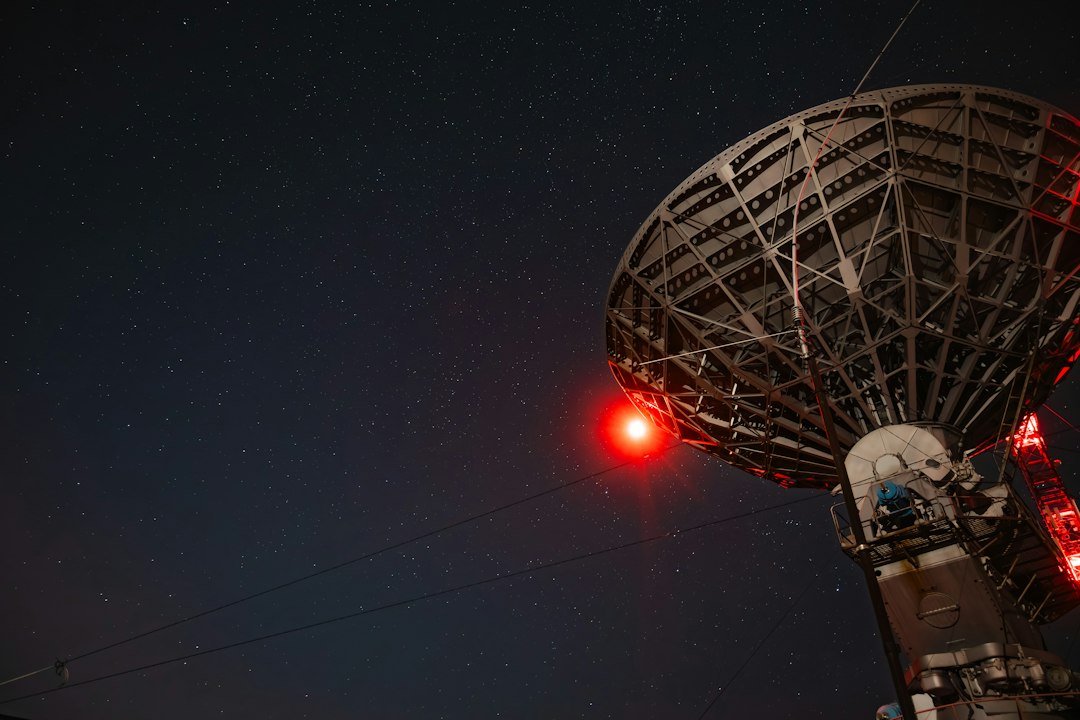
Featured image is illustrative radio-telescope photography by Roman Ilyuhin / Unsplash; it does not show MeerKAT or the actual FRB.