This Fusion Company Just Ordered 10,000 Kilometers of Magnetic Tape. What Are They Building?
An extraordinary superconducting-material order could help bring humanity closer to harnessing the power of the stars. But the biggest experiment is still ahead.
Imagine ordering enough tape to stretch across continents—not to record a single song, but to help build a machine capable of recreating the nuclear reactions that power the Sun.
That’s essentially what Commonwealth Fusion Systems (CFS) is doing.
On September 30, 2026, the Massachusetts-based fusion company announced a massive supply agreement with Japanese manufacturer Fujikura Ltd. for more than 10,000 kilometers of high-temperature superconducting (HTS) tape.
According to the companies, it is the largest single order of its kind.
And this is no ordinary magnetic tape.
A Magnetic Bottle for a Miniature Sun
Nuclear fusion joins lightweight atomic nuclei, releasing enormous amounts of energy. It is the same fundamental process that powers stars.
The problem? Recreating the necessary conditions on Earth requires temperatures exceeding 100 million degrees Celsius.
No ordinary container can hold material that hot.
Instead, fusion scientists use magnetic fields to confine electrically charged gas, known as plasma, inside a doughnut-shaped machine called a tokamak.
That’s where the superconducting tape comes in.
The material can carry enormous electric currents with essentially zero electrical resistance when cooled below its critical temperature. Those currents generate extraordinarily powerful magnetic fields.
Despite the name, high-temperature superconductors still need substantial cooling. They’re not room-temperature miracle materials.
But their ability to operate in intense magnetic fields could enable fusion machines that are smaller than conventional designs.
From SPARC to ARC: The Billion-Dollar Bet
CFS is developing two closely connected projects.
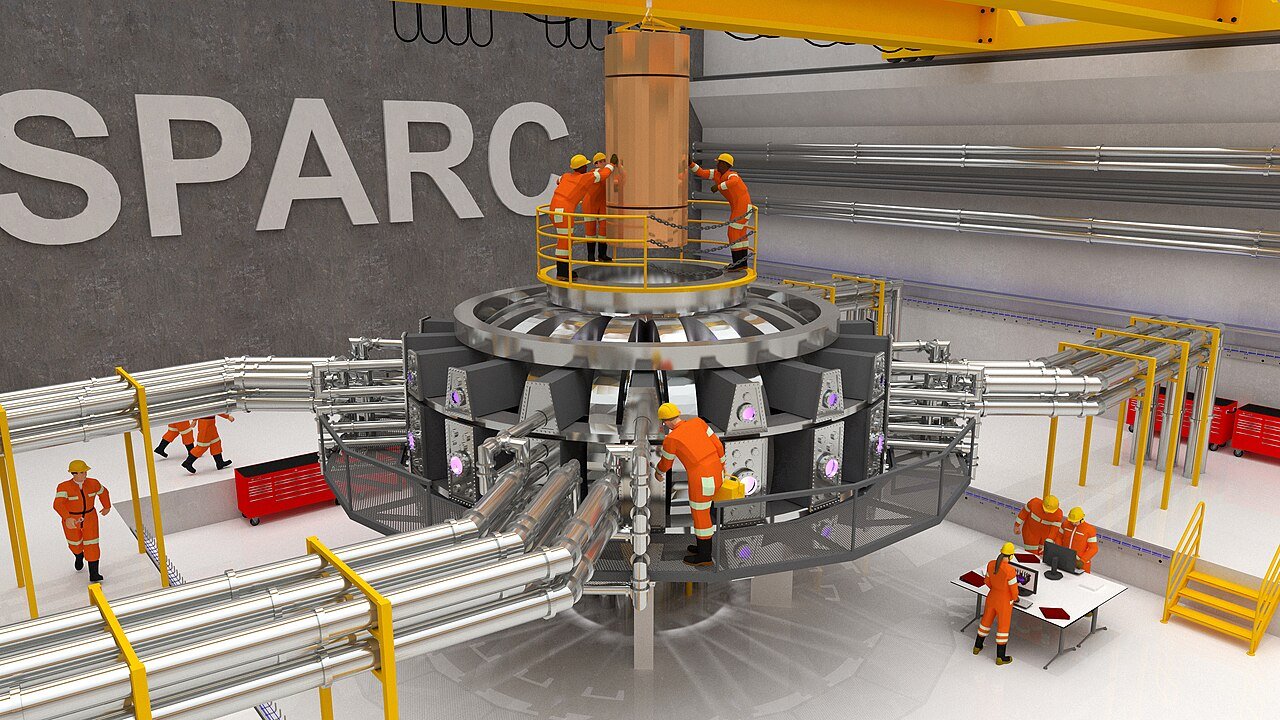
SPARC, under construction in Devens, Massachusetts, is an experimental fusion machine intended to demonstrate that its plasma can produce more fusion energy than the energy delivered to heat it.
ARC is the company’s proposed commercial fusion power plant, intended to turn fusion heat into electricity for the grid.
The first ARC installation is planned for the Fall Line Fusion Power Station in Chesterfield County, Virginia.
CFS is targeting approximately 400 megawatts of electrical output from ARC in the early 2030s.
But those remain company projections, not demonstrated commercial performance.
Why Order So Much Tape Before the Experiment Is Finished?
This is where the story becomes particularly interesting.
CFS is committing to long-lead manufacturing supplies before SPARC has demonstrated its central fusion-energy milestone.
Its chief executive, Bob Mumgaard, says the Fujikura partnership allows the company to prepare for ARC construction as SPARC progresses toward achieving a fusion energy gain greater than one, expressed as Q>1.
Meanwhile, Fujikura is investing in additional production capacity to supply the enormous quantity of specialized material.
The companies have not publicly disclosed the contract’s financial value or a detailed delivery schedule.
The larger significance is industrial: commercial fusion would require more than successful physics experiments. It would need factories, suppliers, trained workers, reliable materials, and equipment manufactured at unprecedented scales.
The Crucial Question Nobody Should Ignore
There is an important difference between generating net fusion energy in a plasma and delivering net electricity from an entire power plant.
The first measures fusion output against the energy delivered to heat the plasma.
The second must account for the electricity used by the entire facility, including cooling, magnets, heating systems, and other equipment.
SPARC achieving Q>1 would be a significant scientific accomplishment. It would not, by itself, establish that ARC can produce commercially viable electricity.
That challenge remains.
Has the Fusion Revolution Finally Entered the Factory?
For decades, commercial fusion has often seemed like a technological promise forever waiting just over the horizon.
This purchase agreement suggests something different: companies are beginning to make the industrial commitments needed to build the machines, even while important scientific and engineering questions remain unanswered.
Ten thousand kilometers of superconducting tape won’t guarantee a working fusion power plant.
But it is a tangible sign of how seriously some investors and manufacturers are pursuing the possibility.
The question for Apep Bar readers: Are we watching the foundation of an entirely new energy industry—or another enormously expensive chapter in humanity’s longest-running technological promise?
Watch the video
https://www.youtube.com/shorts/uMO1gTcwBKM
Sources and further reading
https://cfs.energy/news-and-media/commonwealth-fusion-systems-places-largest-single-/
https://www.fujikura.co.jp/en/news/pressrelease/20260930cfsarc1km.html
https://www.cfs.energy/technology/arc/
Question. Investigate. Reconsider.
Apep Bar