In 1966, an MIT computer program asked people to talk about their problems. Some responded as though a real person were listening. Its creator, Joseph Weizenbaum, was less impressed than alarmed.
The program was ELIZA, widely recognized as the first chatbot. It could not feel concern, diagnose illness or understand a confession. Yet the responses it generated appeared personal enough to make people invest them with meaning. Weizenbaum’s subsequent criticism was not simply that computers could make mistakes. It was that people might grant machinery authority it had never earned.
That warning has returned to the spotlight in Michael Hiltzik’s November 19, 2026, Los Angeles Times column and the new MIT Press volume Inventing ELIZA: How the First Chatbot Shaped the Future of AI. Six decades on, the story is stranger—and more complicated—than the familiar parable about a computer pretending to be a therapist.
What ELIZA actually did
Weizenbaum developed ELIZA at MIT in the mid-1960s and described it in the January 1966 issue of Communications of the ACM. The original research paper explained a system that recognized certain words, broke a person’s typed input into parts and reassembled those parts into a plausible reply.
In its most famous configuration, a script called DOCTOR imitated the non-directive style associated with Rogerian psychotherapy. If someone typed about family trouble, the computer might ask a question about that family rather than offer a diagnosis. The answer could feel perceptive because the computer recycled the speaker’s own words.
There was no hidden therapist behind the curtain. Nor was there a language model trained on enormous amounts of text. ELIZA was rule-driven software running in the environment of MIT’s Project MAC, with conversations ordinarily entered on teletype terminals rather than through the sleek chat windows familiar today. The ELIZA Archaeology Project’s technical overview explains its keyword matching, script rules and period hardware.
One important correction to the popular legend: DOCTOR was a script, not the whole ELIZA system. Researchers have documented other scripts and versions, including uses far removed from therapy. Reducing the project to a fake psychologist obscures the design experiment Weizenbaum actually created.
The uncomfortable discovery was about people, not processors
What disturbed Weizenbaum was how rapidly users attributed understanding to the program. His best-known anecdote describes a secretary who knew it was software but reportedly asked him to leave the room while she continued talking with it.
That story has become part of AI folklore. It also deserves a footnote: researchers writing in the 2026 journal article “Conversations about conversational code” found discrepancies among historical transcripts and questioned what can be established about the anonymous people in Weizenbaum’s examples. They do not conclusively identify the secretary or determine whether every published conversation was a single unedited exchange.
The honest historical finding is narrower but powerful: Weizenbaum himself repeatedly described users treating a limited simulation as though it were a knowing companion. The exact details of the famous anecdote are not all independently settled.
Today, the tendency to perceive intention, empathy or comprehension in conversational output is often called the ELIZA effect. A machine need not genuinely understand someone for its words to produce a very human reaction.
Why the inventor turned critic
Weizenbaum was no outsider who feared computers because he did not understand them. He was an accomplished computer scientist who had worked on commercial computing systems before joining MIT. According to MIT’s account of his life, he became increasingly skeptical of attempts to give machines responsibility for choices requiring human judgment.
His 1976 book, Computer Power and Human Reason: From Judgment to Calculation, separated what computers can do from what they ought to be permitted to do. He challenged the assumption that technical capability, by itself, makes the transfer of authority morally acceptable.
This was a criticism of power and judgment, not proof that every automated system is harmful. A computer can be useful for calculation, retrieval or analysis without being qualified to take responsibility for a patient’s welfare, determine a person’s worth or resolve a conflict of values. The distinction is whether humans remain meaningfully accountable for the outcome.
Weizenbaum also criticized the institutional and political settings in which computers were deployed, including military applications and the prospect of increasingly extensive surveillance. His concerns brought him into conflict with other AI pioneers. As the Smithsonian’s historical examination notes, researchers including John McCarthy rejected aspects of his position. The divide was not between people who understood technology and people who did not; it was between competing judgments about its permissible uses.
A lost program returns, and the old story changes
The 60th anniversary arrives with unusually tangible evidence. Researchers located source code in Weizenbaum’s papers at MIT in 2021. Their work, culminating in the MIT Press book released in July 2026, traced ELIZA’s development through archival records, multiple scripts and versions. The project website offers close readings of the code and a faithful interactive recreation.
For decades, many people encountered later imitations of ELIZA rather than the original system. The recovered code clarifies that Weizenbaum’s work was a broader conversation-building environment written using the period’s MAD and SLIP tools, not simply a tiny modern script passed down unchanged.
Researchers also restored ELIZA to operation on an emulation of the IBM 7094 and its historical Compatible Time-Sharing System. Their technical account of the restoration distinguishes the recovered original material from the small portions they had to reconstruct to make the system run.
Watch: Researchers bring ELIZA back to life
Watch the ELIZA restoration demonstration on YouTube. This is a modern demonstration of a reconstructed historical computing environment, not footage recorded at MIT in 1966. The video is linked by the researchers who performed the restoration.
Is today’s AI just ELIZA with better marketing?
No. Modern large language models differ fundamentally from ELIZA in their training methods, breadth of abilities and the kinds of tasks they can perform. An assistant that can analyze documents or generate working software is not technically equivalent to a rule-based conversation script from 1966. Treating the two as identical would replace history with a slogan.
Yet Weizenbaum’s central social question survives the technical leap: When a system produces convincing conversation, how does the person using it know which kinds of trust are justified?
That question grows more consequential when chatbots are presented as companions, advisers or substitutes for human contact. Emotional immersion can be a legitimate product design choice, but it also creates obligations around accuracy, privacy, informed consent and the handling of vulnerable users. Separate from the ELIZA story, Apep Bar has examined how AI-companion branding can be exploited in romance-related scams. Neither case proves that every conversational system manipulates its users; both show why perceived intimacy deserves scrutiny.
The policy challenge is not to pretend the clock can be turned back to 1966. It is to distinguish helpful tools from systems being asked to perform roles in which convincing words may be mistaken for professional competence, moral judgment or care.
The warning hidden inside the first conversation
Hiltzik’s new column and the recovered code return Weizenbaum to a conversation he began long before the modern AI boom: Who decides when a computer should be believed? And who is answerable when that belief goes wrong?
The most unsettling discovery of ELIZA was never that a computer could sound sympathetic. It was that humans could supply the sympathy themselves—and then credit the machine for it. Sixty years later, our systems are incomparably more capable. Whether our standards for trusting them have advanced as quickly remains an open question.
Sources and further reading
- Joseph Weizenbaum’s original ELIZA paper, Communications of the ACM (January 1966).
- ELIZA Archaeology Project: recovered source, timeline, scripts and reconstruction.
- Inventing ELIZA, MIT Press (July 2026).
- Research on recovered ELIZA conversations, AI & Society (2026).
- MIT’s biographical account of Weizenbaum (2008).
- Michael Hiltzik’s Los Angeles Times column (November 19, 2026).
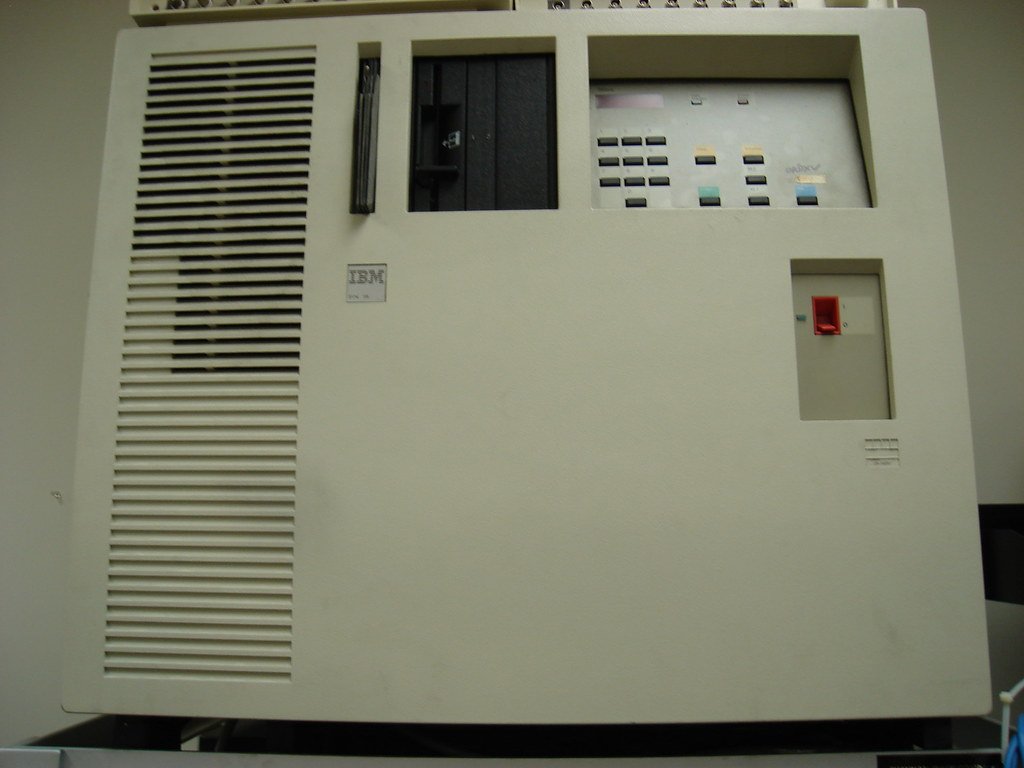
Featured photograph: “Old IBM mainframes” by Kevin Walter, CC BY-SA 2.0. A real photograph of historic IBM computers used as period context; the machines pictured are not identified as the particular IBM 7094 used for ELIZA at MIT.