APEP BAR NEWSROOM | October 17, 2026 | Evidence status: Peer-reviewed modeling; hypothesis not confirmed.
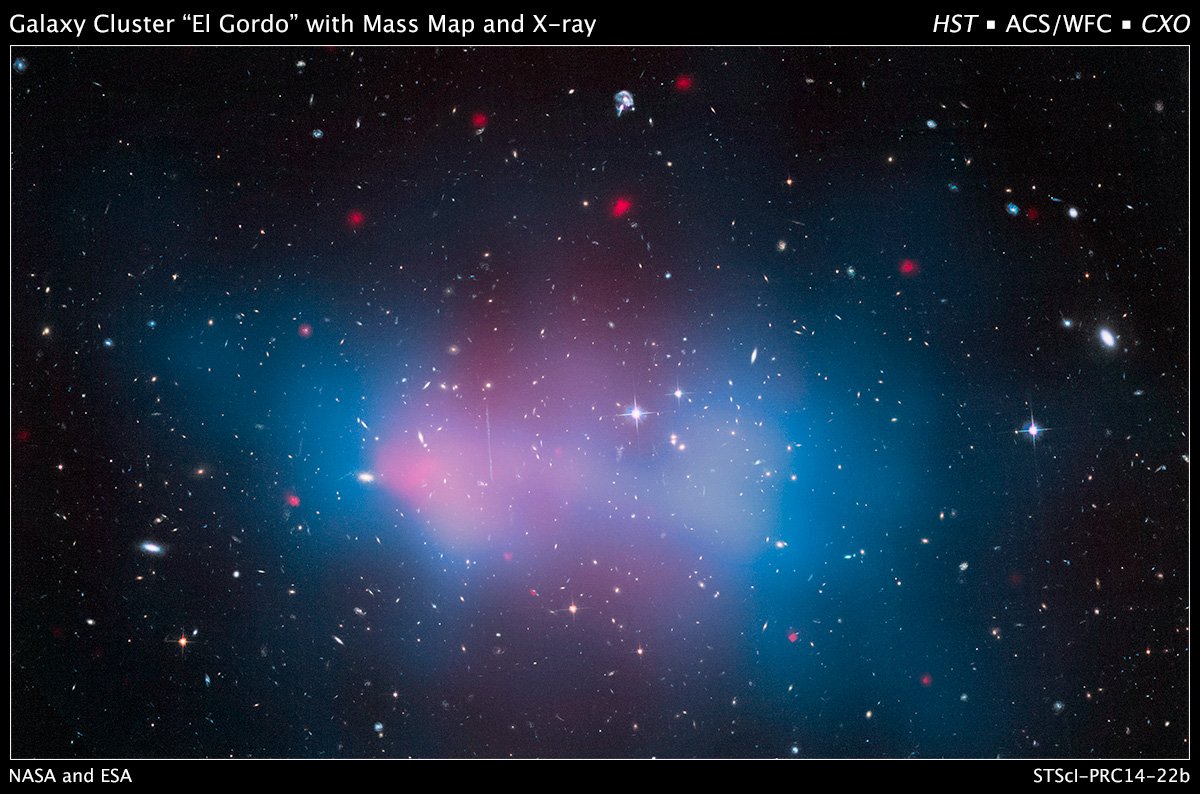
About seven billion light-years away, an enormous colliding galaxy cluster nicknamed El Gordo has posed an uncomfortable question for cosmologists: how did so much mass assemble so early in the universe?
A new study discussed on October 16 offers an unconventional answer. Perhaps dark matter—the invisible material inferred from gravity—does more than simply gather and drift. Perhaps it can interact with itself in multiple ways.
A two-state dark-matter possibility
The research models dark matter particles with a lower-energy state and an excited state. In some collisions, particles could absorb kinetic energy by transitioning between states. In principle, such behavior could let dark matter clump while avoiding some of the heating problems faced by simpler self-interacting dark-matter models.
The researchers explored the idea using numerical simulations of El Gordo’s merger. According to the analysis summarized by astrophysicist Brian Koberlein, the two-state model fits certain observational features better than comparison scenarios with noninteracting dark matter or only elastic interactions.
What the study does not prove
No telescope has seen an actual dark-matter particle change states. Dark matter has not been directly identified in the laboratory, and the cluster’s estimated mass and collision speed still have important uncertainties. At the lower end of the possible mass range, the proposed model may not fit.
That distinction matters: a successful simulation is a testable candidate explanation, not a discovery of a new force or particle.
Why the mystery is still alive
The standard cosmological model is powerful precisely because it explains so much. Unusual objects such as El Gordo are valuable because they put those explanations under stress. Additional observations and competing models may show whether this apparent solution survives.
The Apep question: What if the universe’s invisible matter has internal states that have never appeared in our textbooks?
Sources
- Universe Today — October 16 research analysis
- NASA — El Gordo composite image and scientific context
Featured image: NASA / ESA / Chandra composite of El Gordo with scientific overlays. The overlays illustrate inferred matter and hot gas, not a direct photograph of dark-matter particles.