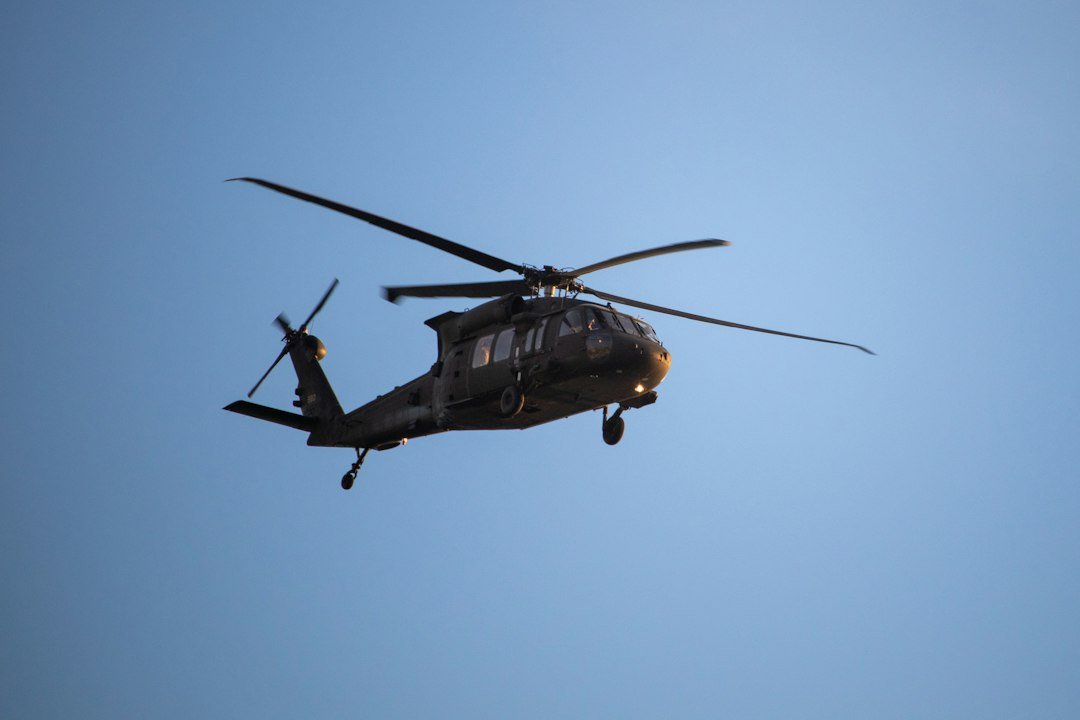
For decades, the Black Hawk helicopter has been an icon of human military aviation: pilots, crew, noise, danger and split-second decisions.
Now remove the pilot.
In 2026, Sikorsky—a Lockheed Martin company—announced that it had completed integration of its MATRIX autonomy system on the U.S. Army’s experimental UH-60MX Black Hawk. The Army-owned aircraft is intended to support research into optionally piloted and increasingly autonomous flight.
This is not a concept animation. Autonomous Black Hawks have already flown.
The helicopter can fly the mission
MATRIX combines sensors, flight-control software and onboard autonomy so an aircraft can perform missions with reduced direct pilot input. Lockheed Martin says the system has accumulated more than 1,000 autonomous flight hours across its development program and has been demonstrated on multiple aircraft types.
In April 2026, the company released footage of two Black Hawks conducting an autonomous side-by-side flight. The demonstration was designed to show that the technology is moving beyond a single experimental aircraft toward coordinated real-world operations.
The company promotes applications ranging from wildfire response to contested logistics—missions where sending a human flight crew can be dangerous, difficult or unnecessary.
Watch the autonomous Black Hawks fly
Video: Lockheed Martin, “Two Autonomous Black Hawks, One Mission,” April 29, 2026.
“Optionally piloted” is the phrase to watch
Autonomous aviation is often described in reassuring language: fewer risks to crews, better logistics, emergency response, safer operations.
All of those uses are real possibilities.
But the same core capability has obvious military implications. A helicopter that can navigate, respond to changing conditions and execute a mission without a pilot directly manipulating the controls can also operate where commanders may be unwilling to risk a crew.
That changes the economics of danger.
The aircraft itself remains valuable, but the human-risk calculation is dramatically different when there are no pilots aboard.
Is it an autonomous weapon?
Not based on the evidence discussed here.
The MATRIX-equipped Black Hawk demonstrations concern aircraft autonomy: flying, navigation and mission execution. That is different from giving a machine independent authority to select and engage human targets.
Conflating the two would be misleading.
Still, autonomous mobility is one layer of the larger military autonomy stack. Once aircraft can fly themselves reliably, future debates shift toward what payloads they carry, who authorizes their missions, how much decision-making is delegated and what happens when communications fail.
The network changes everything
Lockheed Martin describes autonomous aircraft as part of a broader networked environment. In practical terms, that means a future force may involve human-operated aircraft, autonomous aircraft, drones, ground systems and remote operators sharing data and coordinating missions.
The most important technological change may not be a single unmanned helicopter. It may be the ability for many machines to cooperate while a smaller number of humans supervise the larger mission.
That is where the “pilotless helicopter” story becomes something bigger: the gradual transformation of warfare from people controlling individual machines to people directing networks of semi-autonomous systems.
Sources
- Lockheed Martin: MATRIX integration on the U.S. Army UH-60MX
- Lockheed Martin: Autonomy in the Air
- Video: Two Autonomous Black Hawks, One Mission
Apep Bar verdict: Documented technology, not speculation. The helicopter-autonomy capability is real. What remains open is how aggressively militaries will connect autonomous flight to increasingly autonomous mission systems.
When the aircraft no longer needs a pilot, which human decision will engineers automate next?