A missing woman is a relative whose place in her family and community cannot be replaced. Missing and Murdered Indigenous Women, or MMIW, names both a crisis and the movement demanding that Native women receive protection, serious investigations and justice. Its history belongs to families who searched, organized and insisted that their loved ones mattered long before the issue gained national attention. This article focuses on the United States, with a separate explanation of Canada’s related movement. Historical background and current developments are distinguished below; information was checked on November 2, 2026.
What the names mean
MMIW centers women; MMIWG explicitly includes girls. MMIP means Missing and Murdered Indigenous Persons and includes people of all genders. Some organizations use MMIWR, for women and relatives, or terms explicitly including Two-Spirit and LGBTQ+ people. These names overlap without making the experiences of women, men, children and gender-diverse relatives interchangeable. Two-Spirit is a culturally situated term, not a label to assign automatically to every Indigenous LGBTQ+ person. The National Indigenous Women’s Resource Center connects remembrance with demands for safety and accountability.
Historical background: violence and the erosion of protection
The colonial context is more than a distant introduction. Dispossession, forced removal and coercive assimilation disrupted relationships among land, family and community, while federal law restricted Native nations’ ability to govern and protect their citizens. The Interior Department’s boarding-school investigation, completed in two volumes in 2022 and 2024, documents a system that separated children from families in pursuit of assimilation. These findings help explain institutional distrust and intergenerational harm; they do not establish the cause of any particular disappearance or excuse an individual perpetrator.
Native nations have distinct histories, laws and kinship systems. There is no single traditional role shared by all Native women, and violence should never be represented as an inevitable feature of Indigenous life. Nor should Native communities be reduced to victimhood. The movement draws on surviving systems of care, political leadership, cultural knowledge and sovereignty. Describing a woman by her nation, when that identification is verified and appropriate, is more accurate than treating Indigenous identity as a generic racial category.
What the evidence establishes—and what it cannot count
A 2016 National Institute of Justice analysis of the 2010 National Intimate Partner and Sexual Violence Survey estimated that 84.3 percent of American Indian and Alaska Native women had experienced lifetime violence within the study’s definitions. Those included sexual violence, physical intimate-partner violence, stalking and psychological aggression by an intimate partner. This is a survey estimate about lifetime victimization, not an annual homicide rate, a missing-person count or a measurement of conditions in 2026. It cannot be used to claim that four in five Native women have disappeared or been murdered.
The Urban Indian Health Institute’s 2018 study identified 506 unique cases across 71 selected U.S. cities: 128 missing-person cases, 280 murder cases and 98 cases with unknown status. Cases extended from 1943 through 2018, with roughly two-thirds from 2010–2018. This was a selected-city, multiyear investigation with incomplete agency participation, not a national annual total or a ranking of population-adjusted risk. Its importance lies partly in showing how much information official systems failed to make available.
Widely repeated comparisons between 5,712 missing-women-and-girls reports in the National Crime Information Center in 2016 and 116 cases logged in NamUs must also be handled carefully. Reports are not necessarily unique people, and these systems have different purposes, participation and inclusion practices. Subtracting the figures does not reveal a count of women permanently lost by government. The broader problem remains serious: racial misclassification, inconsistent identifiers, incomplete records and disconnected databases can obscure Native people and make cases harder to connect. An absent entry is not evidence that a family’s concern was unfounded.
On reservations, in villages and in cities
Reservation geography can mean long travel distances, limited staffing and complex coordination among agencies. Alaska Native villages face their own geographic and legal circumstances, which should not be collapsed into a Lower 48 reservation model. In cities, Native women can encounter municipal systems that fail to record their identity accurately or recognize their connections to a Native nation. Moving between a city and a reservation does not erase those connections. Urban Indian organizations are therefore essential participants, rather than an afterthought in a supposedly reservation-only crisis.
Disappearances and deaths do not have one explanation. Cases can involve domestic or sexual violence, stalking, exploitation and other circumstances; a disappearance is not automatically proof of homicide or trafficking. Responsible reporting distinguishes confirmed findings from family concerns, investigative theories and unresolved questions. Housing instability, transport barriers or substance use must never become reasons to treat a woman as less deserving of an urgent response. Families should not have to present an idealized biography to establish that a loved one deserves to be found.
Jurisdiction: sovereignty and practical responsibility
Jurisdiction can depend on the location, offense, legal status of the people involved and applicable federal statutes. Tribal, federal, state and local authorities may have different or overlapping roles. The Supreme Court’s 1978 Oliphant decision restricted tribal criminal jurisdiction over non-Indians absent congressional authorization. That limitation has profound implications for safety, but it does not mean every crime against a Native woman belongs exclusively to federal authorities. A city case outside Indian country may principally involve municipal and state systems. Confusion should trigger coordination, not become a reason for an agency to abandon a family.
The 2013 and 2022 Violence Against Women Act reauthorizations recognized important tribal authority over certain non-Indian defendants. The 2022 law expanded covered offenses to include sexual violence, stalking, sex trafficking, child violence and specified offenses affecting tribal justice, alongside earlier domestic-violence provisions. It also established an Alaska pilot. These are substantial sovereignty measures, but they do not restore unrestricted tribal jurisdiction over all crimes everywhere. Participation entails procedural protections and institutional capacity; legislation alone cannot supply every court, attorney, investigator or service provider a community needs.
Families built the movement
Family-led searches, memorial walks, posters and public testimony made an issue visible that institutions too often treated as isolated cases. Such labor can mean financial costs, repeated exposure to painful details and the burden of pressing several agencies for answers. A survivor-centered response gives families meaningful updates, respects their choices about publicity and provides practical support. It also recognizes that relatives may disagree about how a case should be represented. Public interest is not permission to circulate private information or turn grief into entertainment.
Indigenous-led organizations connect that work to structural change. NIWRC promotes community action and policy accountability; UIHI has challenged urban data failures; the National Congress of American Indians preserves resources around the Not Invisible Act Commission’s recommendations. These efforts make clear that the movement is about prevention and self-determination as well as investigation. Supporting Native leadership means listening to local priorities and respecting tribal control over information, rather than assuming an outside database or campaign can speak for every family.
Why red dresses—and why May 5
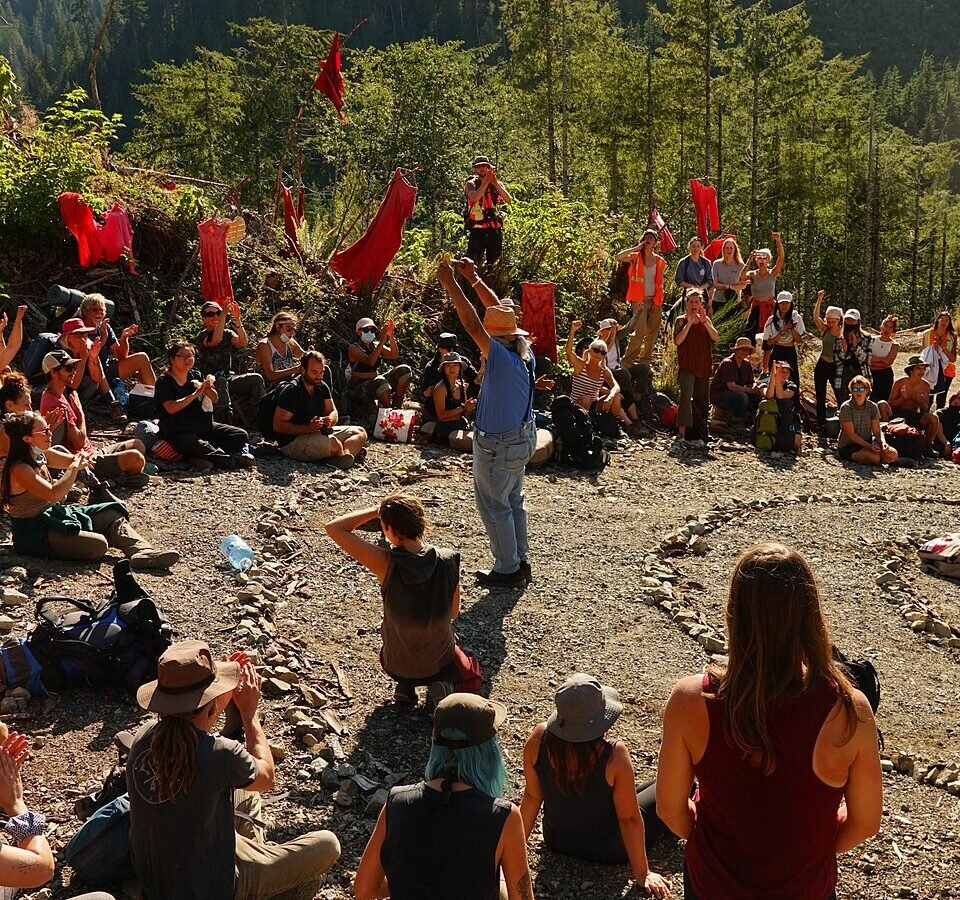
The empty red dress makes absence visible without requiring a photograph of a victim. Red River Métis artist Jaime Black-Morsette identifies the founding of The REDress Project in 2009. Its influence has crossed the U.S.–Canada border, but interpretations and ceremonial meanings should not be described as identical across all nations. The Puyallup Tribe’s account of its own red-dress display illustrates how communities adapt the symbol through local advocacy.
In the United States, May 5 is a National Day of Awareness associated with the birthday of Hanna Harris, a Northern Cheyenne woman murdered in 2013. NIWRC’s 2017 account describes organizing by families and hundreds of supporting organizations, followed by Senate recognition that year. Wearing red and holding walks can honor relatives and build pressure, but advocates emphasize that recognition must lead to resources and accountability. The observance is an annual organizing point, not the beginning or end of the work.
Federal responses and their limits
Savanna’s Act, signed in October 2020, sought better protocols, information access and coordination in missing and murdered Indigenous-person cases. The Not Invisible Act, also enacted in 2020, established a commission incorporating tribal leaders, survivors, relatives and other specialists. Its recommendations were submitted November 1, 2023, followed by a federal response in March 2024. These measures acknowledge systemic failures. A published recommendation or protocol, however, is not evidence that every agency has implemented it or that outcomes have improved for every family.
The BIA’s Missing and Murdered Unit focuses on cases involving American Indians and Alaska Natives. Such specialized work can help connect investigations and revisit unresolved cases, but its existence does not replace frontline response, tribal policing or urban services. Durable improvement requires staffing, evidence handling, reliable data exchange and accountability when responsibilities are missed. Arrest totals and funding announcements should be assessed alongside case outcomes and families’ ability to obtain information.
Current developments verified for this article
On August 18, 2026, the FBI announced Voices Not Forgotten, including an interactive map and expanded rewards for qualifying publicly advertised Indian-country investigations. The announcement describes rewards using the agency’s wording, a minimum reward of up to $25,000. Readers should consult the individual case poster for its actual terms; this is not a guaranteed payment for every tip or a program covering every missing Native person.
An October 20, 2026 federal announcement reported results from Operation Not Forgotten’s April–September surge: 118 arrests, 41 people federally charged and 25 child victims identified or located. These are agency-reported operational results across a broader Indian-country violent-crime effort. They are not counts of MMIW cases solved, women found alive or convictions. Charges remain allegations until adjudicated. The distinction matters because a successful investigative surge can coexist with unresolved disappearances and long-term capacity problems.
Canada’s related history is distinct
Canada’s National Inquiry released Reclaiming Power and Place in 2019, with 231 Calls for Justice addressing violence against Indigenous women, girls and 2SLGBTQQIA people. Its findings connect persistent rights violations to the crisis and characterize the violence as genocide. That is the inquiry’s conclusion within Canada’s history and institutions. First Nations, Inuit and Métis experiences must be distinguished, and Canadian findings or totals should not be substituted for U.S. statistics. Cross-border solidarity does not make the two countries’ laws, inquiries or datasets interchangeable.
What accountability should mean
Families need more than visibility: a clear agency contact, prompt investigative action, accurate identification, respectful communication and support that continues after cameras leave. Prevention also requires accessible services and the ability of Native nations to exercise meaningful authority. Readers can follow verified family and tribal requests, support Indigenous-led organizations and avoid sharing speculation or graphic material. A memorial should preserve a woman’s humanity, not freeze her identity at the worst thing that happened to her. The central demand of MMIW remains practical and profound: Native women and their families deserve safety, answers and justice.
Featured photograph: Red-dress memorial at the Fairy Creek Blockade, Canada, August 29, 2021. Photograph by JoshuaWright / JoshuaWrightFilm, via Wikimedia Commons, licensed CC BY-SA 4.0; resized. This is a Canadian advocacy gathering, not a photograph of victims or of a U.S. case.